
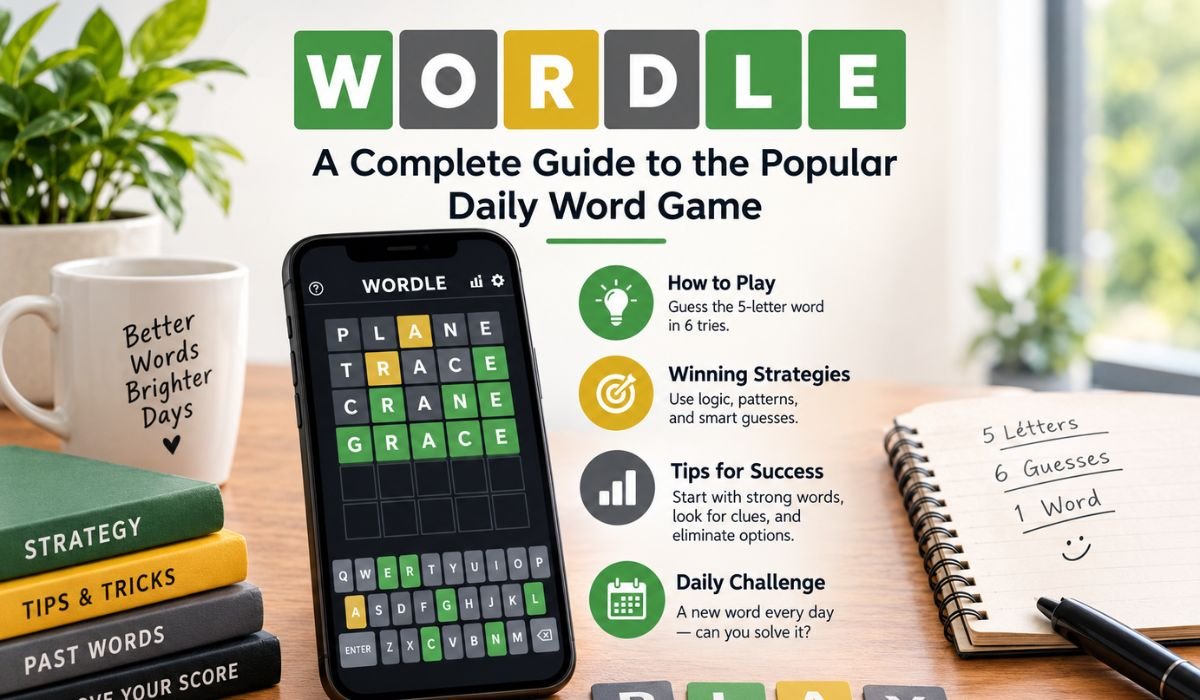
Wordle is one of those rare games that looks incredibly simple but can become surprisingly challenging after just one guess. The idea is straightforward: find a hidden five-letter word in six attempts. Each guess gives you useful clues through colored tiles, helping you understand which letters belong in the answer and where they should go. That simple formula turned a small personal project into a worldwide puzzle phenomenon.
Created by software engineer Josh Wardle, Wordle was designed around familiar words, a clean interface, and one puzzle each day. Its shareable results helped it spread rapidly online because players could compare their results without revealing the answer. Today, Wordle is part of The New York Times Games and remains a recognizable part of the daily puzzle routine for millions of people.
This complete Wordle guide explains how the game works, its history, useful strategies, Hard Mode, WordleBot, its cultural impact, and the many games inspired by its format.
Quick Bio Information
| Information | Details |
|---|---|
| Game Name | Wordle |
| Creator | Josh Wardle |
| Original Developer | Josh Wardle |
| Genre | Word Game |
| Main Format | Daily Five-Letter Puzzle |
| Attempts | Six Guesses |
| Original Public Release | October 2021 |
| Current Publisher | The New York Times Games |
| Acquisition | January 2022 |
| Acquisition Price | Reported Low Seven Figures |
| Main Answer Length | Five Letters |
| Daily Puzzle | One Main Puzzle Per Day |
| Main Feedback | Green, Yellow, and Gray Tiles |
| Hard Mode | Available |
| Analysis Tool | WordleBot |
| Dedicated Editor | Tracy Bennett |
| Inspiration | Mastermind and Other Word Games |
| Major Feature | Shareable Results |
| Accessibility | Dark and High-Contrast Modes |
| Major Expansion | Numerous Wordle-Inspired Games |
What Is Wordle?
Wordle is a daily word game in which players try to identify a five-letter answer within six guesses. After every guess, the game provides clues using three colors. A green letter is correct and in the correct position. A yellow letter belongs to the answer but is in another position. A gray letter does not appear in the answer.
The game is deliberately limited to one main daily puzzle, creating a shared experience among players. Everyone can work on the same daily challenge, discuss their results, and return for another puzzle the following day.
The game’s appeal comes from its balance. The rules can be learned in seconds, but finding the answer may require vocabulary, deduction, probability, and careful decision-making.
How Does Wordle Work?
A Wordle game begins with a five-letter guess. The first guess does more than attempt to solve the puzzle; it also gathers information. Once the letters are evaluated, the player uses those clues to make a better second guess.
For example, if a letter turns green, its position is confirmed. If a letter turns yellow, it must be somewhere else in the answer. Gray letters can normally be removed from consideration. Repeating this process gradually reduces the number of possible answers.
One important detail is that repeated letters can behave differently depending on how many times the letter appears in the answer. If a guess contains the same letter more times than the solution does, not every occurrence will necessarily receive the same positive color. Understanding this rule becomes especially important with words containing repeated letters.
Understanding Wordle’s Color Clues
The three Wordle colors form the heart of the game. Green is the strongest clue because it confirms both a letter and its exact location. Yellow confirms the letter but tells the player that its current position is wrong. Gray normally means the letter is absent from the answer.
These clues should be treated as information rather than simply signs of success or failure. A guess containing several yellow letters can be extremely valuable because it identifies letters that must be rearranged. Likewise, a guess containing several gray letters can eliminate many possibilities.
This is why a good Wordle player does not simply search for a word that looks right. The goal is to use every guess to learn something useful.
How Many Guesses Do You Get?
Players receive six guesses for the daily Wordle puzzle. The limited number of attempts is a major part of the game’s design because every decision matters.
A player who guesses randomly can quickly run out of opportunities. A player who studies the clues, however, can use each attempt to reduce uncertainty. This makes Wordle part vocabulary test, part logic puzzle, and part probability exercise.
Winning in two or three guesses can feel satisfying, but solving the puzzle in four or five attempts is also completely normal. The important challenge is to reach the answer before the six available attempts are exhausted.
Wordle Hard Mode
Wordle Hard Mode adds another layer of difficulty. Once players discover a green or yellow letter, later guesses must follow the revealed information. A green letter must remain in its confirmed position, while a yellow letter must continue to be used somewhere else.
This rule prevents players from making completely unrelated guesses simply to test new letters. As a result, Hard Mode can feel much more restrictive than the standard game.
It also changes the strategy. In regular Wordle, a player can sometimes sacrifice a guess to test several new letters. Hard Mode requires greater attention to the information already discovered.
The History of Wordle
Wordle began as a personal project created by Josh Wardle. An early version was developed years before the game became famous and originally had a much larger collection of possible words. Wardle eventually refined the concept after realizing that obscure vocabulary could make the experience feel unnecessarily random.
During the COVID-19 pandemic, Wardle and his partner became interested in daily puzzle games, including games from The New York Times. This renewed his interest in his own word-game project. He redesigned Wordle around a minimalist interface and a one-puzzle-per-day structure.
The name Wordle itself was also a playful reference to Wardle’s surname. The game initially remained a private experience shared with a small group of people before being released publicly in 2021.
How Wordle Became a Viral Sensation
Wordle’s rise was remarkably fast. One of its biggest advantages was the decision to make the game a daily experience rather than an unlimited collection of puzzles.
The shareable results feature was equally important. Players could post a pattern of colored squares showing how many attempts they needed without giving away the answer. This created a natural way for friends and strangers to compare their performance.
The game also benefited from being extremely easy to explain. Someone could encounter a Wordle result online, become curious, open the game, and understand the rules almost immediately.
The combination of scarcity, simplicity, competition, and social sharing helped Wordle become a major online phenomenon.
Why Is Wordle So Popular?
Wordle’s popularity is closely connected to its restraint. Many online games are designed to encourage long sessions, but Wordle traditionally asks for only a few minutes of attention each day.
That makes it easy to fit into a morning routine, lunch break, or evening schedule. The daily reset also gives players something to look forward to without overwhelming them with hundreds of puzzles.
Another important factor is the social experience. Players can compare results without spoiling the answer, creating friendly competition without requiring a traditional multiplayer system.
The game also provides a satisfying feeling of discovery. Every green and yellow tile makes the possible answer smaller, so the final solution feels earned.
Who Owns Wordle Today?
The New York Times Company acquired Wordle from Josh Wardle in January 2022 for a reported low-seven-figure amount. The acquisition moved Wordle from its independent website into the broader New York Times Games ecosystem.
The New York Times initially said the game would remain free and that its core gameplay would not change. The transition eventually brought Wordle into the company’s wider digital puzzle environment, including account-based progress and statistics.
The acquisition was significant because Wordle had become one of the internet’s most recognizable puzzle games in only a few months.
What Changed After the Acquisition?
The New York Times made several changes as Wordle became part of its Games platform. The game was rebuilt for integration with the company’s systems, and players gained additional ways to track progress.
The answer list also received editorial changes. Some words were removed because they were considered offensive, insensitive, or unsuitable. Certain spelling variants were also removed as the New York Times version moved toward its preferred word list.
These changes meant that older copies or versions of Wordle could sometimes become different from the current New York Times version.
The core experience, however, remained recognizable: guess a five-letter word, use the clues, and solve the daily puzzle within six attempts.
Who Chooses the Daily Wordle Answer?
Tracy Bennett became Wordle’s dedicated editor in November 2022. Her role involves reviewing the curated collection of possible answers and considering whether individual words are appropriate for the daily game.
Word selection is not only about dictionary validity. A word may have another meaning that is offensive, confusing, or unsuitable. Bennett has also explained that some answers can occasionally connect with particular dates or events.
This editorial process helps explain why Wordle’s answer list is different from a general dictionary containing every possible five-letter word.
What Is WordleBot?
WordleBot is a New York Times tool designed to analyze a player’s Wordle performance. It can provide feedback about how a person played, including assessments related to skill and luck.
For players who want to improve, this kind of analysis can be more useful than simply knowing whether they solved the puzzle. It encourages players to think about whether their guesses revealed enough information and whether another choice might have been more efficient.
WordleBot therefore adds an analytical layer to what initially appears to be a very simple guessing game.
Choosing a Good Wordle Starting Word
A strong starting word can reveal several useful letters early. Common starting choices mentioned in discussions of Wordle include ADIEU, AUDIO, STARE, RAISE, ARISE, SLATE, CRANE, and TRACE.
There is no single starting word that guarantees an easy solution every day. A useful opening word generally contains common letters and, depending on the strategy, several vowels or frequently occurring consonants.
The most important principle is not memorizing one supposedly perfect starting word. It is understanding what the first guess is supposed to accomplish. A good opening should provide information that makes the next decision easier.
Wordle Tips and Advanced Strategy
Good Wordle strategy is largely about information. If a first guess produces several gray letters, those letters can immediately be removed from future consideration. If it produces yellow letters, the next guess should test different positions for them.
Players should also be careful about becoming attached to one possible answer too early. Several five-letter words can share the same known letters, and choosing one without enough evidence can waste a valuable attempt.
Repeated letters deserve special attention. A word may contain two copies of the same letter, but players should not assume that every repeated letter in a guess belongs to the solution.
Advanced players can also think about common English patterns, letter frequency, and possible endings. The best strategy changes according to the information already revealed.
Common Wordle Mistakes
One common mistake is continuing to use letters that have already been confirmed as absent. Another is leaving a yellow letter in the same position even though the game has already shown that position is incorrect.
Players can also waste guesses by testing only one new letter at a time. When several possibilities remain, a carefully chosen word that tests multiple unknown letters can sometimes provide more useful information than an immediate attempt at the answer.
Another frequent mistake is forgetting that repeated letters are possible. When the clues do not seem to fit any obvious answer, checking whether a letter might appear twice can open up new possibilities.
Wordle’s Accessibility and Features
Wordle’s clean interface is one reason the game is easy to approach. It also includes features designed to make the experience more accessible.
Dark Mode changes the visual presentation for players who prefer a darker interface. A high-contrast option provides an alternative color scheme that can make the clues easier to distinguish for some players with color-vision difficulties.
Statistics and streak tracking also add a sense of continuity. Players can return each day and see how their recent performance compares with earlier games.
Wordle’s Influence on Other Games
The success of Wordle inspired a huge range of games built around similar ideas. Some remained focused on words, while others transferred the guessing-and-feedback concept to entirely different subjects.
Quordle, for example, asks players to solve four puzzles at once. Semantle focuses on semantic relationships rather than letter positions. Worldle applies the idea to geography, while Heardle uses music identification.
Other variations include Poeltl, which centers on basketball players, and Globle, which uses geographic distance as a clue.
These games show how flexible the basic Wordle concept became.
Wordle Around the World
Wordle’s format was quickly adapted into other languages and linguistic systems. This was not always a simple translation exercise because different languages have different alphabets, word lengths, letter frequencies, and grammatical structures.
Wordle-inspired projects have appeared across numerous languages and communities. One well-known example is Termo, a Brazilian adaptation that became popular in both Brazil and Portugal.
The international growth of Wordle demonstrates that the basic idea of receiving feedback after every guess can work well beyond English.
Wordle: The Party Game
The Wordle concept eventually moved from the screen to the tabletop. Hasbro, working with The New York Times, released Wordle: The Party Game in 2022.
The physical version changes the experience because players can compete directly with one another. One participant chooses a secret word while other players attempt to solve it using Wordle-style rules.
This adaptation shows how a minimalist digital game could be transformed into a social, face-to-face activity.
Wordle’s Cultural Impact
Wordle became more than a casual puzzle. At the height of its popularity, people discussed daily answers on social media, searched for unfamiliar words, compared streaks, and shared colored-square results.
Its influence also extended to the wider New York Times Games business. The game’s enormous audience introduced many players to other puzzles in the company’s collection.
Perhaps the most lasting part of Wordle’s cultural impact is its format. The idea of a short, daily challenge with easily shareable results has influenced many games and online puzzle experiences.
Wordle Clones and Intellectual Property
Wordle’s popularity also created a wave of clones and adaptations. Some developers created genuinely different games inspired by the format, while others produced versions that closely resembled the original.
After acquiring Wordle, The New York Times took steps to protect the game’s intellectual property, including trademark-related action and copyright enforcement against some online repositories containing clone code.
This became an important part of Wordle’s story because it showed how even a seemingly simple word puzzle could become a valuable digital property.
Wordle vs. Other Word Games
Wordle shares ideas with older games such as Mastermind, Jotto, Lingo, and Bulls and Cows, but its daily structure gives it a distinct identity.
Unlike a traditional crossword, Wordle does not provide clues in the form of definitions or questions. Unlike an unlimited word game, it restricts players to one main puzzle per day. And unlike a traditional multiplayer game, players can compete socially without being in the same game session.
That combination of simplicity and shared timing is a major part of what makes Wordle recognizable.
Final Thoughts
Wordle succeeded because it did not try to make a simple idea complicated. Its five-letter format, six guesses, clear feedback, and one-puzzle-per-day structure are easy to understand, yet the game leaves plenty of room for strategy.
Its history is equally interesting. What began as Josh Wardle’s personal word-game project became a viral internet phenomenon, was acquired by The New York Times, and inspired a large family of games across languages and subjects.
For beginners, the best approach is to focus on learning from every guess rather than simply chasing an immediate answer. For experienced players, Wordle can become a fascinating exercise in probability, vocabulary, pattern recognition, and decision-making.
That balance is ultimately what keeps Wordle interesting. It takes only a few minutes to play, but each puzzle can offer a completely different challenge. In a digital world filled with endless content, the simple promise of one small puzzle each day remains surprisingly powerful.
FAQs About Wordle
What Is Wordle?
Wordle is a daily five-letter word puzzle created by Josh Wardle. Players have six attempts to identify the hidden answer, receiving colored clues after each guess.
How Many Guesses Do You Get in Wordle?
You get six guesses to solve the daily Wordle. Each attempt should ideally provide useful information about the letters and their positions.
What Does Green Mean in Wordle?
Green means the letter is correct and appears in the correct position. It is the strongest positional clue in the game.
What Does Yellow Mean in Wordle?
Yellow means the letter appears somewhere in the answer but is in the wrong position. The letter needs to be tested in another position.
Can Wordle Have Repeated Letters?
Yes. A Wordle answer can contain repeated letters. The game evaluates repeated letters according to how many instances actually occur in the solution.
What Is Wordle Hard Mode?
Hard Mode requires players to use revealed green and yellow letters in subsequent guesses. This makes the game more restrictive and requires more careful planning.
Who Created Wordle?
Wordle was created by software engineer Josh Wardle. He originally developed it as a personal project before releasing it publicly in 2021.
Who Owns Wordle Now?
The New York Times Company acquired Wordle from Josh Wardle in January 2022. It is now part of The New York Times Games collection.
Learn more and explore exciting content on: Kathleen Cain: A Complete Guide to Her Family, Marriage, and Life




Leave a Reply