
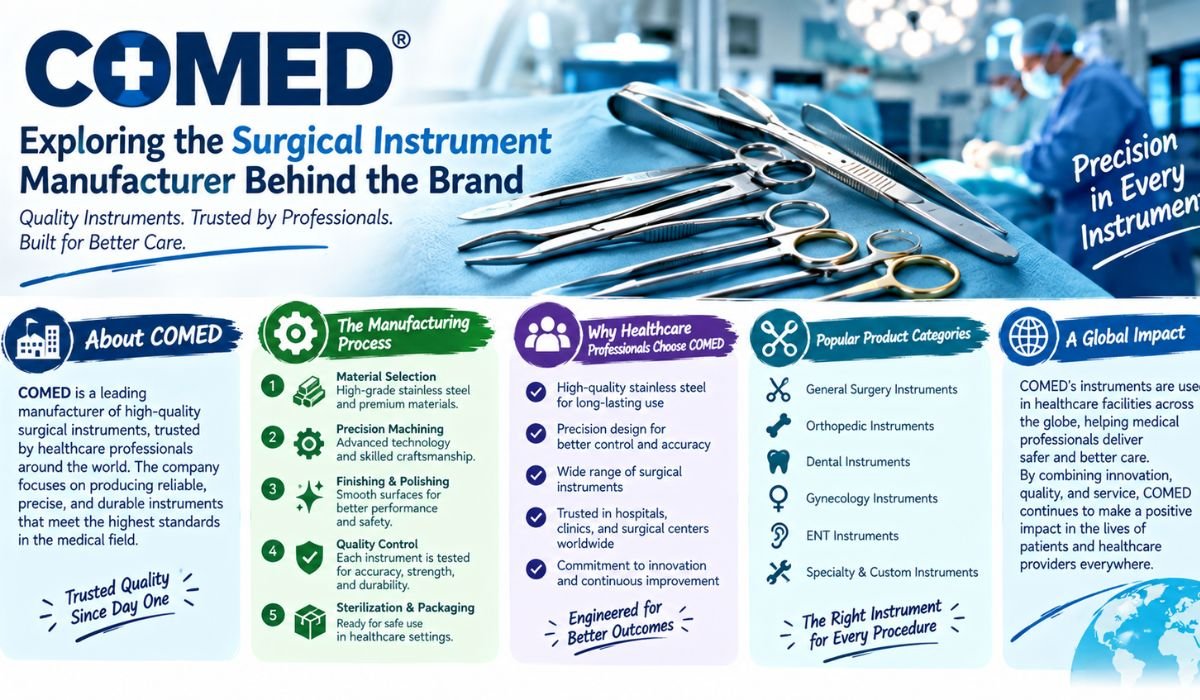
Surgical Instruments Play An Important Role In Modern Healthcare. From Small Procedures To Complex Operations, Medical Professionals Depend On Tools That Offer Precision, Reliable Handling, And Consistent Performance. Behind These Instruments Are Manufacturers That Combine Technical Knowledge, Skilled Craftsmanship, Material Selection, And Quality Management. COMED Is One Such Company Operating In The Surgical Instrument And Medical Device Industry.
Based In Sialkot, Pakistan, COMED Has Developed A Business Focused On Handheld Surgical Instruments, Medical Device Manufacturing, And International Distribution. The Company States That Its Product Portfolio Includes Approximately 15,000 Items Covering Different Surgical Disciplines. It Also Offers Products Under Its Own Brand And Provides Original Equipment Manufacturer (OEM) Services For Customers With Specific Product Requirements.
Understanding COMED Involves More Than Looking At Its Catalogue. Its Manufacturing Approach, Materials, Quality Certifications, Customization Services, And Customer Support All Help Explain Its Position In The Medical Device Market. This Guide Explores The Company And The Factors Healthcare Businesses Should Consider When Evaluating Surgical Instrument Manufacturers.
Quick Bio Information
COMED Is A Surgical Instrument Manufacturer And Medical Device Supplier Based In Sialkot, Pakistan. The Following Company Facts Summarize Its Published Business Profile.
| Information | Details |
|---|---|
| Company Name | COMED |
| Business Location | Sialkot, Pakistan |
| Reported Establishment Year | 1984 |
| Industry | Surgical Instruments And Medical Devices |
| Main Product Focus | Handheld Surgical Instruments |
| Reported Product Portfolio | Approximately 15,000 Items |
| Brand | COMED |
| Manufacturing Services | Own-Brand And OEM Products |
| Customization | Customer-Specified Products, Subject To Confirmation |
| Reported International Reach | More Than 50 Countries |
| Manufacturing Approach | Skilled Craftsmanship And Technology |
| Materials Mentioned | AISI 410, AISI 420, AISI 440, And AISI 304 |
| Published Quality Standard | ISO 9001:2015 |
| Medical Device Quality Standard | ISO 13485:2016 |
| Conformity Documentation | CE-Related Documentation Listed By The Company |
| Warranty Information | Three Years For Reusable Instruments, Subject To Terms |
| Sample Availability | Samples Can Be Requested, With Shipping Costs Applicable |
| Sterile Supply Status | Instruments Are Stated To Be Supplied Non-Sterilized |
| Customer Support | Catalogue, Product, And Distributor Inquiries |
These Details Reflect COMED’s Published Company Information And Should Be Rechecked Before Publication Or Commercial Use.
What Is COMED?
COMED Is A Surgical Instrument Manufacturer And Medical Device Supplier That Serves The Healthcare Industry. Its Business Includes The Development, Manufacturing, Marketing, And Distribution Of Handheld Surgical Instruments. The Company Supplies Products Under The COMED Brand And States That It Can Manufacture Customer-Specified Products Through OEM Arrangements.
Its Business Model Addresses Different Types Of Customers. Medical Device Distributors May Be Interested In Adding Surgical Instruments To Their Catalogues, While Importers And Wholesalers May Seek Manufacturing Partners For Their target Markets. Healthcare Procurement Teams May Also Research manufacturers to understand product specifications, quality documentation, availability, and purchasing conditions.
An Important Part Of Understanding COMED Is Recognizing That A Large Product Catalogue Does Not Mean Every Instrument Is Suitable For Every Procedure. Each Product Has Its Own Purpose, Design, Material Requirements, And Instructions For Use. Buyers Should Review The Specifications Of Individual Instruments Before Making Purchasing Decisions.
COMED Company History And Background
COMED Identifies 1984 As Its Establishment Year In Its Company Information. This Places Its Origins Within Sialkot’s Longstanding Surgical Instrument Manufacturing Industry. The Company Also Describes Itself As Having More Than Three Decades Of Experience Serving Healthcare Customers.
Sialkot Has Become An Important Center For Surgical Instrument Production, With Manufacturers Serving Domestic And International Markets. The Industry Combines Metalworking Skills, Specialized Manufacturing Knowledge, Finishing Techniques, And Export Experience. This Industrial Background Helps Explain Why Companies In The Region Participate In The Global Medical Instrument Supply Chain.
COMED Highlights Experienced Craftsmen And Modern Manufacturing Technology As Parts Of Its Approach. These Capabilities Matter Because Surgical Instruments Often Require Accurate Dimensions, Carefully Finished Surfaces, And Properly Working Components. However, A Company’s History Alone Does Not Establish The Quality Of Every Product. Buyers Should Also Review Current Product Documentation, Manufacturing Specifications, And Applicable Certifications.
COMED Surgical Instruments And Product Range
One Of COMED’s Main Features Is Its Reported Catalogue Of Approximately 15,000 Items. The Company Describes Its Portfolio As Covering Instruments From Different Surgical Disciplines. A Broad Catalogue Can Be Useful For Distributors And Healthcare Businesses That Need To Source Multiple Types Of Instruments From One Manufacturer.
Surgical Instruments Perform Different Functions. Scissors Cut Tissue Or Other Materials, Forceps Help Grasp And Hold Objects, And Clamps Can Control Or Secure Structures During Particular Procedures. Retractors Help Maintain Access To An Operative Area, While Needle Holders Assist With Suturing. These Categories Represent Common Types Of Surgical Instruments Rather Than A Guarantee That Every Specific Design Is Available From COMED.
The Correct Instrument Depends On The Procedure, The Clinician’s Requirements, And The Applicable Clinical Guidelines. Buyers Should Check Dimensions, Jaw Design, Handle Type, Material, Finish, And Other Relevant Specifications. Reviewing The Exact Product Catalogue Is More Reliable Than Assuming That A Manufacturer’s Overall Product Count Covers Every Instrument A Facility May Need.
Surgical Specialties Served By COMED
Surgical Instrument Manufacturers Often Organize Their Products According To Medical Specialties. COMED Describes Its Portfolio As Covering Multiple Surgical Disciplines, Making Specialty-Specific Catalogue Information Important For Customers Researching Its Offerings.
General Surgery Uses A Wide Range Of Instruments For Cutting, Grasping, Clamping, Retracting, And Suturing. Neurosurgery Requires Instruments Designed For Procedures Involving The Brain, Spine, And Nervous System. Cardiovascular Surgery Has Different Requirements For Procedures Involving The Heart And Blood Vessels, Where Instrument Design Must Match The Intended Surgical Task.
Ear, Nose, And Throat Surgery Uses Tools Designed For Particular Anatomical Areas, While Orthopedic Surgery Involves Instruments Used In Procedures Concerning Bones, Joints, And Other Musculoskeletal Structures. These Examples Help Explain The Variety Of Instruments Found Across Surgical Disciplines. For An Accurate Assessment Of COMED’s Coverage, Readers Should Confirm Each Specialty And Product Type In The Company’s Current Catalogue.
How COMED Surgical Instruments Are Manufactured
Manufacturing Surgical Instruments Requires More Than Shaping Metal Into A Useful Form. Depending On The Product, Production May Involve Design Development, Material Selection, Cutting, Machining, Forming, Surface Finishing, Assembly, And Inspection. Each Stage Can Affect The Instrument’s Dimensions, Handling, Durability, And Intended Function.
COMED Highlights Skilled Craftsmen And Advanced Technology In Its Manufacturing Approach. These Two Elements Can Complement Each Other. Technology Can Help Produce Consistent Dimensions, While Experienced Workers May Contribute To Detailed Finishing, Assembly, And Identification Of Problems That Require Attention.
Quality Checks Are Also Important. An Instrument With Moving Parts May Need To Be Evaluated For Smooth Operation And Proper Alignment. Cutting Instruments Require Appropriate Edge Characteristics, While Grasping Instruments must meet their design requirements. These Are General Manufacturing Considerations; The Exact Processes Used For A Particular COMED Instrument Should Be Confirmed Through Its Product And Quality Documentation.
Materials Used In COMED Medical Instruments
Material Selection Influences How A Surgical Instrument Performs And How It Responds To Repeated Cleaning, Disinfection, And Sterilization. COMED’s Published Information Identifies Several Stainless Steel Grades, Including AISI 410 And AISI 420. Its Materials Information Also Mentions AISI 440, While Its FAQ References AISI 304.
These Grades Have Different Properties. Depending On Their Composition And Processing, Stainless Steels Can Vary In Hardness, Strength, Corrosion Resistance, And Suitability For Particular Designs. For Example, A Cutting Instrument May Require Different Material Characteristics From An Instrument Designed Primarily For Grasping Or Handling.
It Is Important Not To Assume That All COMED Instruments Use The Same Steel Grade. Buyers Should Confirm The Material Specification For The Exact Product They Intend To Purchase. Proper Cleaning, Drying, Storage, And Instrument-Specific Reprocessing Also Matter Because Even Suitable Materials Can Be Damaged By Incorrect Care Or Exposure To Incompatible Chemicals.
COMED Quality Management And Certifications
Quality Management Is An Important Part Of Medical Device Manufacturing Because Instruments Must Be Produced According To Defined Specifications And Applicable Requirements. COMED Publishes Information About ISO 9001:2015, ISO 13485:2016, And CE-Related Documentation On Its Quality Pages.
ISO 9001:2015 Is A Quality Management System Standard Used Across Different Industries. ISO 13485:2016 Is Specifically Designed For Quality Management Systems In The Medical Device Sector. Such Standards Address Documented Processes, Management Responsibilities, Risk-Related Considerations, And Consistent Control Of Activities Within Their Applicable Scope.
CE Marking Is Connected To Applicable European Union Product Conformity Requirements. Its Meaning Depends On The Product, Relevant Legislation, And Supporting Documentation. Buyers Should Check Current Certificates, Their Scope, Validity, And The Specific Products They Cover. Certification Should Not Be Presented As Proof That Every Instrument Is Suitable For Every Procedure Or That It Guarantees A Particular Clinical Outcome.
OEM And Custom Surgical Instrument Manufacturing
Alongside Its Own Brand, COMED States That It Offers OEM Manufacturing For Customer-Specified Products. OEM Services Can Help Medical Device Businesses Source Instruments That Meet Their Commercial And Technical Requirements Without Building Their Own Manufacturing Facilities.
Depending On The Project, Customers May Provide Technical Drawings, Photographs, Samples, Product Names, Or Catalogue References. These Materials Help Clarify The Intended Design And Specifications. Before Production Begins, Both Parties Need To Understand Requirements For Materials, Dimensions, Finishing, Branding, Inspection, Packaging, And Applicable Regulatory Documentation.
Private Labeling May Also Be Relevant To Businesses That Want Products Associated With Their Own Brand. However, The Availability Of A Particular Customization Option, Minimum Order Quantity, Production Schedule, And Commercial Terms Must Be Confirmed Directly With COMED. A Clear Written Specification Helps Reduce Misunderstandings And Makes It Easier To Evaluate Whether The Finished Product Meets The Buyer’s Requirements.
COMED’s International Distribution Network
COMED Reports Working Through A Network Of Trade Partners In More Than 50 Countries. This International Reach Is An Important Part Of Its Business Profile Because Medical Instrument Manufacturers Often Depend On Importers, Distributors, And Local Commercial Partners To Reach Buyers In Different Markets.
Distribution Partners Can Help Customers Obtain Product Information, Understand Local Purchasing Arrangements, And Coordinate Orders. International Supply Also Involves Practical Considerations Such As Shipping, Customs Documentation, Delivery Schedules, And The Regulatory Requirements Of The Destination Market.
COMED’s Published Information References International Healthcare And Medical Industry Exhibitions, Including MEDICA In Düsseldorf, IDS In Cologne, And FIME In The United States. Such Events Provide Opportunities For Businesses To Present Products And Develop Professional Relationships. Participation In An Exhibition, However, Should Not Be Treated As Proof Of Market Leadership Or A Specific Level Of Sales.
Warranty, Samples, And Customer Support
Purchasing Surgical Instruments Often Requires More Than Comparing Prices. Customers May Need Product Catalogues, Material Specifications, Samples, Warranty Information, And Assistance Identifying The Correct Instrument. COMED’s Published FAQ Addresses Several Of These Practical Topics.
The Company States That Reusable Surgical Instruments Have A Three-Year Warranty, Subject To Its Applicable Terms. Prospective Buyers Should Review The Warranty Conditions To Understand What Is Covered, Which Exclusions Apply, And How A Claim Must Be Submitted. A Warranty Does Not Replace Proper Handling, Maintenance, Or Reprocessing.
COMED Also States That Customers Can Request Samples, With Shipping Costs Borne By The Customer, And Can Contact The Company For Catalogue And Distributor Information. Sample Evaluation May Help Buyers assess design, handling, finishing, and suitability before placing a larger order. Availability and sample conditions should be confirmed directly with the company before making purchasing commitments.
Cleaning, Sterilization, And Instrument Care
Instrument Care Is Essential For Patient Safety And Product Longevity. COMED States That Its Instruments Are Supplied Non-Sterilized. This Means Healthcare Facilities Must Follow The Appropriate Manufacturer Instructions And Their Validated Reprocessing Procedures Before Using The Instruments On Patients.
Reusable Surgical Instruments Generally Require Proper Cleaning And Decontamination, Inspection, And Sterilization According To Their Intended Use And Applicable Instructions. Cleaning Removes Contamination, While Sterilization Uses A Validated Process To Address Microbial Contamination. The Correct Method And Cycle Depend On The Specific Instrument, Its Materials, Its Design, And The Manufacturer’s Instructions.
After Processing, Instruments Should Be Inspected For Corrosion, Damage, Alignment Problems, And Other Signs Of Wear. They Must Be Stored And Handled According To Appropriate Healthcare Procedures. No Single Cleaning Or Sterilization method should be assumed suitable for every instrument. Users should always follow the instructions supplied for the specific product and their facility’s infection-prevention requirements.
Choosing A Surgical Instrument Manufacturer
Healthcare Businesses Need A Consistent Way To Evaluate Surgical Instrument Manufacturers. A Large Catalogue Or Long Business History May Be Helpful, But Neither Should Replace A Review Of Product-Specific Evidence. Buyers Should Begin By Defining The Instrument Types, Intended Uses, Quantities, And Regulatory Requirements Relevant To Their Operations.
Material Specifications, Quality Documentation, Inspection Processes, Traceability, And Product Instructions Are Important Areas To Review. Buyers Should Also Confirm Warranty Terms, Replacement Procedures, Sample Availability, Packaging Requirements, And Delivery Timelines. For International Purchases, Regulatory Compliance In The Destination Market Requires Particular Attention.
Price Is Another Factor, But The Lowest Quotation May Not Represent The Best Overall Value. Consistent Specifications, Reliable Communication, Appropriate Documentation, And Predictable Supply Can Matter Just As Much. Businesses Considering COMED Should Compare Its Confirmed Capabilities With Their Own Requirements Rather Than Relying Solely On General Company Descriptions.
Why Healthcare Businesses May Consider COMED
COMED Presents Several Features That May Interest Medical Device Buyers. These Include Its Reported Experience In Surgical Instrument Manufacturing, A Catalogue Of Approximately 15,000 Items, Its Own Brand, OEM Services, Published Quality Information, And Distribution Relationships Across More Than 50 Countries.
For Distributors, A Broad Product Range May simplify sourcing across different instrument categories. For Medical Device Brands, OEM Capabilities May Provide A Route To Discuss Customized Or Private-Label Products. For Procurement Teams, Published Material Specifications, Certification Documents, Product Instructions, And Warranty Terms Can Help Inform Supplier Evaluation.
The Suitability Of COMED Ultimately Depends On The Buyer’s Needs And The Evidence Available For The Specific Products Under Consideration. Checking Current Documentation, Asking Detailed Questions, And Reviewing Samples Where Appropriate Can Help Buyers Make Better-Informed Decisions.
How To Contact COMED
Prospective Customers Can Use COMED’s Official Company Information To Explore Its Product Range And Ask About Business Requirements. Buyers Interested In Standard Instruments Should Identify The Relevant Product Names Or Catalogue Numbers Before Requesting A Quotation. This Makes It Easier To Discuss Specifications, Quantities, Packaging, And Availability.
Businesses Seeking OEM Services Should Prepare Clear Technical Information, Including Drawings Or Samples Where Available. They Should Also Explain Their Branding Needs, Destination Market, Required Documentation, And Expected Order Volume. COMED Can Then Confirm Whether The Proposed Requirements Can Be Supported And Provide Information About Applicable Commercial Terms.
Customers Should Verify Current Contact Details, Product Documentation, Certificates, And Distributor Information Through The Company’s Official Channels. For Regulated Medical Devices, It Is Particularly Important To Confirm That The Product Meets The Requirements Of The Market Where It Will Be Sold Or Used.
Conclusion
COMED Is A Surgical Instrument Manufaccomedturer And Medical Device Supplier With A Reported History Dating To 1984, A Broad Product Portfolio, Own-Brand Offerings, And OEM Manufacturing Services. Its Published Company Information Also Highlights Quality Management Standards, International Trade Relationships, And Customer Support For Buyers Exploring Surgical Instruments.
For Healthcare Businesses, The Most Important Step Is To Connect These General Company Details With The Requirements Of The Exact Products They Need. Reviewing Material Specifications, Current Certifications, Product Instructions, Warranty Terms, And Regulatory Documentation Can Help Establish Whether A Particular Instrument Meets The Intended Requirements.
Ultimately, A Strong Supplier Relationship Depends On Clear Specifications, Transparent Communication, Appropriate Quality Controls, And Reliable Documentation. Understanding These Factors Provides A More Practical Picture Of COMED And Its Role In The Surgical Instrument Industry.
FAQs About COMED
What Is COMED Known For?
COMED Is Known For Its Business In Handheld Surgical Instruments And Medical Devices. It Offers Products Under Its Own Brand And Reports A Broad Catalogue Covering Different Surgical Disciplines. The Company Also States That It Provides OEM Manufacturing For Customers With Specific Product Requirements.
Where Is COMED Based?
COMED Is Based In Sialkot, Pakistan. The City Has A Longstanding Surgical Instrument Manufacturing Industry That Supplies Products To Domestic And International Markets. Buyers Should Confirm The Company’s Current Business And Contact Details Through Its Official Information.
How Many Products Does COMED Offer?
COMED Reports A Portfolio Of Approximately 15,000 Items. Its Range Is Described As Covering Different Surgical Specialties And Instrument Categories. The Exact Availability And Specifications Of Individual Products Should Be Checked In The Current Catalogue.
Does COMED Offer OEM Services?
Yes. COMED States That It Provides OEM Manufacturing For Customer-Specified Products. Depending On The Project, Buyers May Need To Supply Drawings, Samples, Photographs, Or Other Technical Information. Branding, Specifications, Production Schedules, Minimum Orders, And Commercial Conditions Should Be Confirmed Directly.
Which Quality Certifications Does COMED List?
COMED’s Published Quality Information Includes ISO 9001:2015, ISO 13485:2016, And CE-Related Documentation. Buyers Should Verify The Current Validity And Scope Of Each Certificate And Confirm That It Applies To The Relevant Product And Market.
Are COMED Surgical Instruments Supplied Sterile?
COMED States That Its Instruments Are Supplied Non-Sterilized. Healthcare Facilities Must Follow The Applicable Manufacturer Instructions And Validated Reprocessing Procedures Before Patient Use. The Appropriate Cleaning And Sterilization Process Depends On The Specific Instrument.
Does COMED Provide A Product Warranty?
The Company’s Published FAQ States That Reusable Surgical Instruments Have A Three-Year Warranty, Subject To Applicable Terms And Conditions. Customers Should Confirm Coverage, Exclusions, And Claim Procedures Before Purchasing.
How Can Businesses Buy From COMED?
Businesses Can Contact COMED To Request Product Catalogues, Confirm Specifications, Discuss Samples, And Obtain Quotation Or Distributor Information. Companies Seeking Customized Or OEM Products Should Prepare Clear technical requirements and confirm regulatory, quality, delivery, and commercial conditions before placing an order.
Learn more and explore exciting content on: Chronicle Telegram: Everything to Know About Lorain County’s News Source











Leave a Reply