
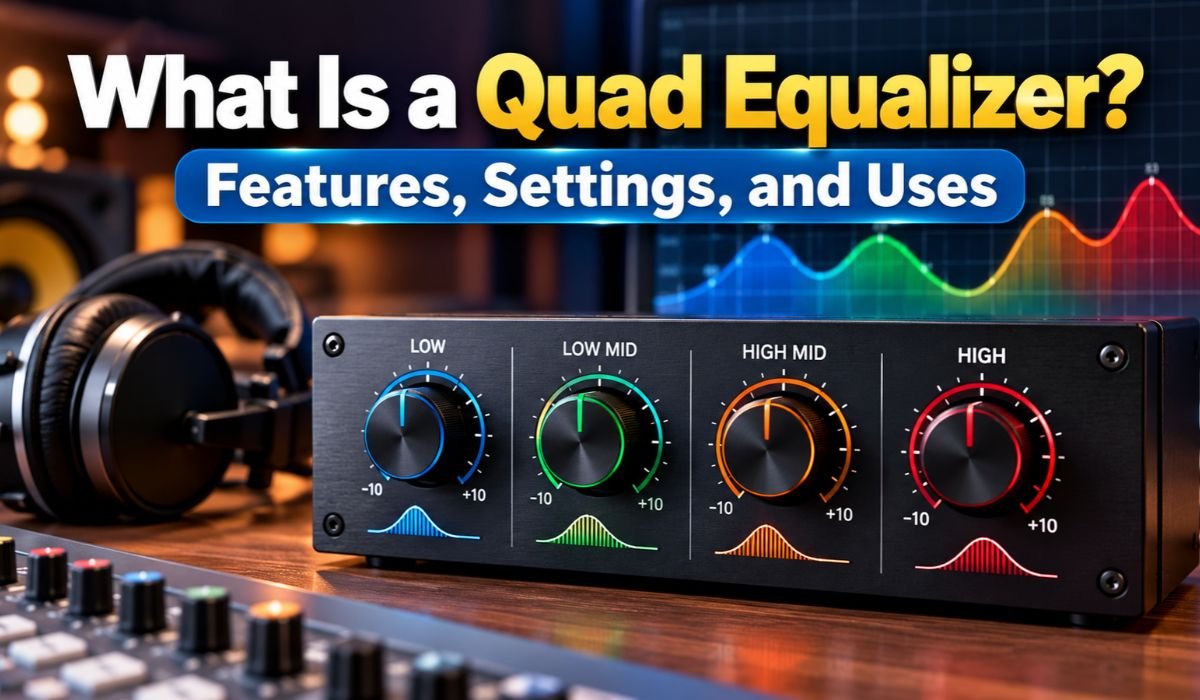
Great sound isn’t always about expensive speakers, powerful amplifiers, or professional recording equipment. Sometimes, a few careful adjustments can make a noticeable difference. Whether you’re listening to music, recording vocals, or playing an instrument, controlling different sound frequencies can help create a clearer and more balanced listening experience.
A Quad Equalizer, commonly called a 4-Band Equalizer, is an audio tool that allows users to adjust four frequency bands independently. These controls help manage bass, midrange, and treble, making it easier to shape the overall character of sound.
Quad Equalizers are used in music studios, car audio systems, guitar amplifiers, mixing consoles, and digital audio software. Understanding how they work can help beginners and experienced users make better sound adjustments without complicated equipment.
What Is a Quad Equalizer?
A Quad Equalizer is a sound-processing tool designed to control four separate frequency bands within an audio signal. Each band affects a particular part of the sound spectrum, allowing users to increase or decrease selected frequencies.
A common arrangement includes Bass, Low-Mid, High-Mid, and Treble. However, manufacturers may choose different frequency ranges or control layouts.
Unlike a basic two-band equalizer, which usually adjusts only bass and treble, a Quad Equalizer provides additional control over middle frequencies. This is particularly useful because vocals, guitars, keyboards, and many other instruments contain important midrange information.
The term Quad Equalizer describes the number of adjustable bands rather than a single standardized product design. Some models use fixed frequencies, while others allow users to select the exact frequencies they want to change.
Quick Bio Information About Quad Equalizer
| Information | Details |
|---|---|
| Common Name | Quad Equalizer |
| Alternative Name | 4-Band Equalizer |
| Audio Category | Sound Processing |
| Main Function | Frequency Adjustment |
| Number Of Bands | Four |
| Common Band Arrangement | Bass, Low-Mid, High-Mid, Treble |
| Frequency Measurement | Hertz (Hz) |
| Gain Measurement | Decibels (dB) |
| Common EQ Types | Graphic, Parametric, Semi-Parametric |
| Basic Control | Gain Adjustment |
| Advanced Controls | Frequency And Q Factor |
| Common Filter Types | Bell And Shelving |
| Hardware Applications | Amplifiers And Mixing Consoles |
| Software Applications | Digital Audio Workstations |
| Music Production Use | Tonal Shaping And Mixing |
| Car Audio Use | Sound Balance Adjustment |
| Guitar Application | Instrument Tone Control |
| Main Advantage | Flexible Four-Band Sound Control |
| Main Limitation | Limited Independent Frequency Bands |
| Recommended Starting Point | Flat Settings At 0 dB |
How Does a Quad Equalizer Work?
A Quad Equalizer works by changing the level of selected frequencies in an audio signal. Sound contains many frequencies playing together, from deep bass notes to bright cymbals and high-pitched vocals.
Each EQ band uses a filter to affect a particular frequency region. Increasing the gain strengthens that region, while decreasing it reduces its level.
These adjustments are measured in decibels. A positive gain value represents a boost, while a negative value represents a cut. A setting of 0 dB normally means that the band applies no boost or cut.
For example, if a recording sounds muddy, reducing certain low-mid frequencies may improve clarity. If vocals lack presence, a small upper-mid adjustment might help them stand out.
Advanced equalizers also provide a Q Factor control, which determines how widely an adjustment affects nearby frequencies. This allows more targeted sound correction.
Understanding the Four Frequency Bands
The four frequency bands are the foundation of a Quad Equalizer. Understanding their characteristics makes sound adjustments easier and more effective.
Bass Frequencies commonly occupy the lower part of the audible spectrum, approximately 20 Hz to 250 Hz. They contribute depth, weight, and power to kick drums, bass guitars, and electronic music.
Low-Mid Frequencies, roughly 250 Hz to 2 kHz in a broad illustrative division, influence warmth, vocal body, and instrument fullness. Excessive energy in parts of this region can make audio sound thick or boxy.
High-Mid Frequencies, approximately 2 kHz to 6 kHz, contribute presence, speech intelligibility, and instrumental definition. Too much emphasis can produce harsh or tiring sound.
Treble Frequencies, broadly 6 kHz to 20 kHz, influence brightness, cymbal detail, and the airy character of recordings.
These boundaries are approximate listening regions, not fixed band specifications. Actual Quad Equalizers may use overlapping filters with different center frequencies and bandwidths.
Different Types of Quad Equalizers
Quad Equalizers are available in several designs, each offering different levels of control.
A Graphic Quad Equalizer uses four fixed-frequency bands, usually adjusted through sliders or knobs. Its simple layout makes it convenient for quick tonal changes, although users generally cannot move the center frequencies.
A Parametric Quad Equalizer provides more detailed control. Users can typically adjust frequency, gain, and Q Factor for each band. This flexibility makes it useful for studio mixing and correcting specific tonal problems.
A Semi-Parametric Equalizer offers adjustable frequency and gain but usually has fixed bandwidth. These controls are common in audio mixing equipment because they balance flexibility with straightforward operation.
The best choice depends on whether the user needs simple sound shaping or more precise frequency correction.
Key Features And Controls
A Quad Equalizer may include several controls beyond its four basic gain adjustments.
Frequency controls determine which region of the audio spectrum is affected. Gain controls set how much that region is increased or reduced.
The Q Factor determines bandwidth. A lower Q generally produces a broader adjustment, while a higher Q targets a narrower frequency region.
Some equalizers include Bell Filters, which affect frequencies around a selected center point. Others use Shelving Filters, which raise or lower a broad range above or below a chosen frequency.
A bypass function temporarily disables EQ processing, allowing users to compare the adjusted signal with the original.
Some advanced models also provide output-level controls, useful for managing signal levels after significant EQ changes.
Analog Vs. Digital Quad Equalizers
Analog and digital Quad Equalizers perform similar sound-shaping functions, but they process signals differently.
Analog Equalizers use electronic circuits to modify audio. They are commonly found in mixing consoles, instrument amplifiers, and dedicated hardware processors. Their physical controls can make adjustments quick and convenient.
Digital Equalizers process audio mathematically through software or digital signal processors. They are widely used in recording applications, digital mixers, and modern audio systems.
Digital models may provide visual frequency displays, stored presets, automation, and precise numerical controls.
Neither approach automatically guarantees better sound quality. Filter design, implementation, noise performance, and appropriate settings matter more than whether an equalizer is analog or digital.
Best Quad Equalizer Settings For Clear Sound
There is no universal Quad Equalizer setting that works perfectly for every recording or speaker system.
A reliable starting point is to set all four bands to 0 dB and listen carefully before making changes.
If bass sounds excessive, try reducing the low band by approximately 1–3 dB. Muddy audio may benefit from a small low-mid cut, while unclear vocals sometimes respond to a gentle presence adjustment.
For dull recordings, a modest treble boost may add brightness. However, excessive high-frequency boosts can make cymbals and vocals sound sharp.
Changes of approximately 1–3 dB are useful starting experiments, not guaranteed solutions. The results depend on each band’s frequency and bandwidth.
When comparing settings, maintain similar overall loudness. Louder audio can appear more impressive even when its tonal balance is not actually better.
How To Set Up A Quad Equalizer
Setting up a Quad Equalizer is usually straightforward, whether it is built into an amplifier or available through audio software.
Begin by connecting the equipment correctly or opening the equalizer settings in your application. Set the bands to their neutral positions and choose a familiar recording.
Listen at a comfortable volume and identify the main issue. The sound might have excessive bass, unclear vocals, or unpleasant brightness.
Adjust one band at a time, making small changes and listening carefully after each adjustment.
If your equipment includes bypass, compare the processed sound with the original signal. This helps determine whether the adjustment provides a genuine improvement.
Avoid boosting several bands heavily because the combined increase in signal level may cause clipping or distortion. Reducing output gain can help preserve headroom.
Quad Equalizer Uses In Music Production
Music producers use Quad Equalizers to shape the tonal character of vocals, instruments, and complete mixes.
For vocal recordings, reducing excessive low-mid energy may help remove unwanted thickness. Gentle upper-mid adjustments can sometimes improve intelligibility and presence.
Electric guitars may benefit from midrange shaping to fit alongside vocals, while bass instruments often require careful low-frequency control.
Equalization also helps address Frequency Masking, which occurs when overlapping sounds make individual instruments difficult to distinguish.
For example, a bass guitar and kick drum may compete in the lower frequencies. Carefully adjusting their tonal balance can improve separation without simply increasing volume.
However, EQ works best alongside good recording techniques, thoughtful arrangement, and appropriate level balancing.
Quad Equalizer For Car Audio And Home Listening
Car interiors create unusual listening conditions because speakers are positioned at different distances from passengers. Windows, seats, and cabin surfaces also influence the sound.
A Quad Equalizer can help adjust excessive bass, improve vocal presence, and control bright treble.
For example, reducing an overly powerful bass band may make spoken words and vocals easier to hear. A gentle high-frequency adjustment can improve perceived detail when the system sounds dull.
Home audio systems benefit from similar adjustments. Speakers, headphones, furniture, and room acoustics all influence perceived sound quality.
However, equalization cannot completely correct poor speaker placement or severe acoustic problems.
For safety, make car audio adjustments while the vehicle is parked rather than while driving.
Quad Equalizer For Guitar And Bass Amplifiers
Many guitar and bass amplifiers provide four-band tone controls, allowing musicians to shape their instrument’s sound.
Bass controls influence low-end weight, while low-mid adjustments affect warmth and fullness. High-mid controls can change note definition and presence, and treble influences brightness.
For electric guitar, reducing excessive low-mid energy may help create a cleaner tone within a busy band arrangement.
Bass players may use midrange adjustments to improve note definition, especially when performing alongside drums and distorted guitars.
The effect of each control depends on amplifier design, pickup characteristics, playing technique, and the connected speaker cabinet.
Importantly, amplifier tone controls do not always behave like independent studio EQ bands. Their responses may interact, so experimenting by ear remains essential.
Quad Equalizer Vs. Other Equalizers
Equalizers are available with different numbers of bands, including three-band, five-band, and ten-band designs.
A three-band equalizer commonly provides bass, midrange, and treble controls. A four-band model adds another independently adjustable region, often separating the middle frequencies.
Five-band and ten-band equalizers provide additional frequency regions, which can be useful for more detailed tonal adjustments.
However, more bands do not automatically mean better results.
A fully parametric four-band equalizer may offer more targeted control than a ten-band graphic equalizer with fixed center frequencies.
The ideal choice depends on the available filter controls, the audio problem being addressed, and the user’s experience.
Common Problems And Better EQ Techniques
Poor EQ adjustments can make audio muddy, harsh, weak, or distorted.
Muddy sound often involves excessive low-frequency or low-mid energy. Reducing the relevant band may improve separation and clarity.
Harsh vocals and sharp instruments may contain too much energy in parts of the upper-mid spectrum. A careful reduction can make listening more comfortable.
Distortion after equalization may result from excessive boosts or insufficient signal headroom. Lowering EQ gain or output level can help when clipping is the cause.
One useful technique is to reduce unwanted frequencies before boosting other regions. This can improve tonal balance while limiting unnecessary increases in signal level.
It is also important to remember that EQ cannot repair every recording problem. Background noise, severe clipping, poor microphone placement, and excessive reverberation may require other solutions.
Advantages, Limitations, And Choosing The Right EQ
The biggest advantage of a Quad Equalizer is its balance between simplicity and useful tonal control.
Four bands provide enough flexibility for many everyday sound adjustments without overwhelming beginners with complicated settings.
These equalizers are suitable for casual listening, instrument amplification, recording, and live sound applications.
Their main limitation is the restricted number of independent adjustment bands. Complex recordings or narrow unwanted resonances may require additional filters.
When choosing a Quad Equalizer, consider whether you need adjustable frequencies, Q controls, software compatibility, or physical hardware controls.
A basic fixed-band model may be sufficient for everyday listening. More advanced parametric controls are often valuable for detailed mixing and corrective work.
Final Thoughts
A Quad Equalizer is a practical tool for controlling bass, midrange, and treble through four adjustable frequency bands. It offers an approachable way to improve tonal balance across music systems, recording equipment, and instrument amplifiers.
The most effective approach is to begin with neutral settings, listen carefully, and make gradual changes based on the actual sound.
Rather than searching for one perfect preset, focus on understanding what each frequency band contributes. With practice, even small adjustments can help create clearer, more balanced, and more enjoyable audio.
FAQs About Quad Equalizer
What Is A Quad Equalizer Used For?
A Quad Equalizer adjusts four frequency bands to change the tonal balance of an audio signal. It is commonly used to manage bass, improve vocal presence, reduce unwanted midrange emphasis, and control treble. Its applications include music production, car audio, instrument amplifiers, and home listening systems.
What Are The Four Bands Of A Quad Equalizer?
A common four-band arrangement includes Bass, Low-Mid, High-Mid, and Treble. Each region affects different aspects of the sound, including depth, warmth, presence, and brightness. However, exact frequencies and band configurations vary depending on the equalizer design.
What Are The Best Quad Equalizer Settings?
The best starting point is usually to set all bands to 0 dB. Listen to familiar audio and make small adjustments to address specific problems. There is no universal setting because speakers, recordings, listening environments, and personal preferences differ.
Can A Quad Equalizer Improve Vocal Clarity?
Yes. Reducing excessive low-mid frequencies may remove muddiness, while carefully adjusting upper-mid frequencies can improve vocal presence. However, the results depend on the recording and the frequencies available on the equalizer.
Is A Quad Equalizer Better Than A Three-Band EQ?
A Quad Equalizer generally provides one additional independently adjustable frequency region, offering greater tonal flexibility. However, the quality and usefulness of an equalizer depend on its filter design and controls, not simply the number of bands.
Can I Use A Quad Equalizer In My Car?
Yes. A four-band equalizer can help balance bass, vocals, and treble inside a vehicle. It is especially useful when a car audio system sounds overly bass-heavy or bright. Adjustments should be made while parked and at safe listening levels.
What Is The Difference Between Graphic And Parametric EQ?
A graphic equalizer normally uses fixed-frequency bands with adjustable gain. A parametric equalizer allows users to select frequency, gain, and bandwidth. Parametric models offer greater flexibility for addressing specific tonal problems, while graphic models are generally simpler to operate.
Can Too Much Equalization Damage Speakers?
Excessive frequency boosts can increase signal levels and contribute to amplifier clipping or excessive speaker movement, particularly at high playback volumes. EQ adjustments alone do not necessarily cause damage, but combining extreme boosts with loud playback can increase the risk. Moderate settings and sensible volume levels are safer.
Learn more and explore exciting content on: How to Choose Luxury Gifts for Every Special Occasion















Leave a Reply