
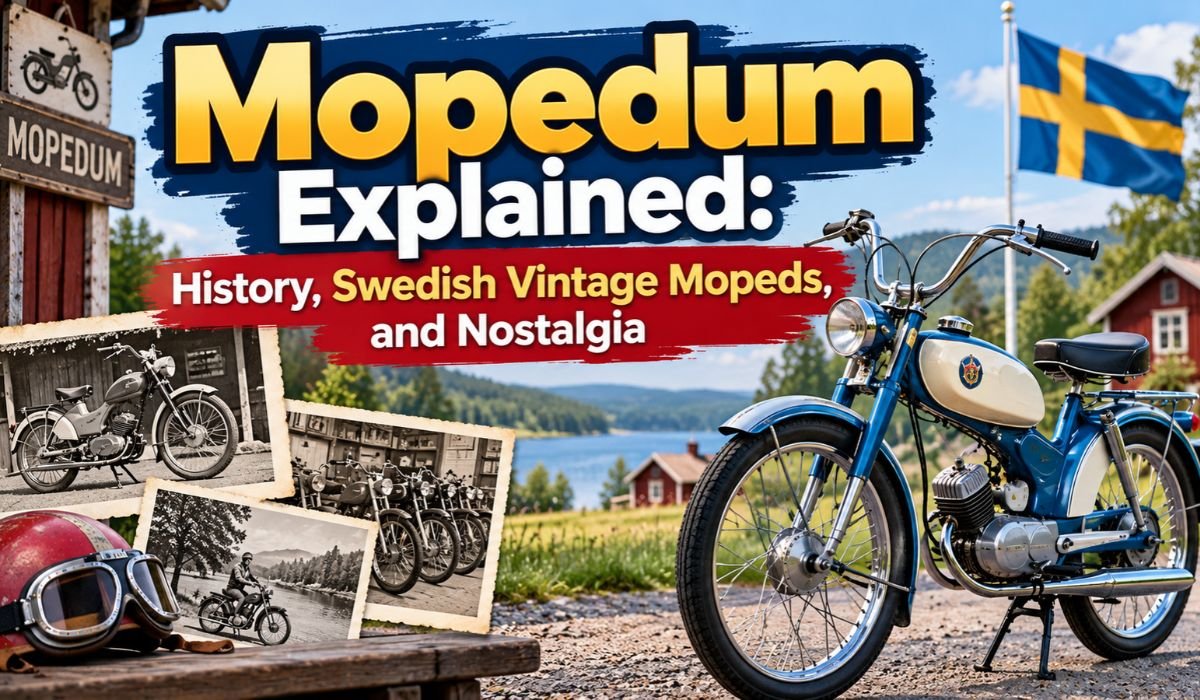
Mopedum represents a fascinating part of Swedish history, where vintage mopeds, everyday memories, and classic transportation come together. For many people, these small two-wheeled vehicles were more than a convenient way to travel. They represented independence, friendship, and the excitement of exploring new places.
The name Mopedum became closely associated with a nostalgia museum in Nynäshamn, Sweden. The museum celebrated Swedish life from 1952 to 1979 through classic mopeds, historical clothing, furniture, and recreated everyday environments. Although the physical museum closed in December 2022, its cultural significance remains.
Today, Mopedum offers an interesting starting point for exploring Swedish vintage mopeds, their history, restoration, and lasting popularity. Understanding this story reveals how simple machines became meaningful symbols of an entire generation.
Quick Bio Information
Name
Mopedum
Full Museum Name
Mopedum – Svenska Nostalgimuseet
Country
Sweden
Former City
Nynäshamn
Former Address
Vikingavägen 39
Museum Status
Permanently Closed
Closure
December 2022
Historical Focus
1952–1979
Main Theme
Swedish Nostalgia
Vehicle Focus
Vintage Mopeds
Historical Transport
Motor-Assisted Bicycles
Key Historical Date
July 1, 1952
Design Regulation Change
1961
Notable Model
Puch Dakota
Swedish Classic
Crescent Compact
Another Classic
Monark Monarped
Related Engine Name
Sachs Saxonette
Classic Two-Wheeler
Zündapp KS50
Cultural Importance
Freedom And Independence
Continuing Legacy
Collecting And Preservation
What Is Mopedum?
Mopedum is best known as the name associated with a former Swedish nostalgia museum dedicated to vintage mopeds and everyday life during the middle decades of the twentieth century. It brought together transportation history, household objects, and cultural memories in a way that appealed to visitors of different ages.
Unlike a conventional motorcycle museum, Mopedum focused on the relationship between vehicles and the people who used them. Its displays helped visitors imagine what Swedish homes, shops, and streets looked like when mopeds were becoming increasingly common.
The name also appears in discussions about classic Swedish mopeds, restoration, and historical collections. However, Mopedum should not be confused with a currently operating museum or a particular manufacturer. Its strongest historical identity remains connected to the former attraction in Nynäshamn.
The History And Origins Of Mopedum
The story of Mopedum is closely connected to Sweden’s changing transportation culture. During the 1950s, small motorized bicycles offered an affordable alternative to cars and larger motorcycles. They were practical, relatively simple machines that helped ordinary people travel greater distances.
As the decades passed, mopeds became increasingly associated with young riders, leisure activities, and personal independence. Their changing role created a rich history worth preserving.
Mopedum explored this development through exhibits covering the period from 1952 to 1979. Rather than presenting vehicles without context, the museum recreated historical environments that showed how people lived during those years.
The museum’s approach recognized that transportation history involves more than engines and mechanical improvements. It also reflects changing lifestyles, consumer habits, and personal experiences. That broader perspective made Mopedum a cultural attraction rather than simply a collection of old vehicles.
Where Was The Mopedum Museum Located?
The former Mopedum Museum was located at Vikingavägen 39 in Nynäshamn, a coastal town in Sweden.
Its location connected the museum with the local community while attracting visitors interested in classic vehicles and Swedish nostalgia. The displays provided opportunities to explore familiar objects from earlier decades and learn how transportation influenced daily routines.
The museum permanently closed in December 2022. Therefore, its former address should be treated as historical information rather than a current visitor destination.
Anyone researching Mopedum in 2026 should be careful with older travel guides or museum listings that may still display outdated opening information.
Why Did The Mopedum Museum Close?
Mopedum’s physical museum closed at the end of December 2022. Information from its final year indicated that the people behind the attraction were moving toward other projects.
The closure marked the end of its public exhibition activities in Nynäshamn. However, the museum’s historical importance did not disappear with the building’s closure.
Museums preserve objects, but they also preserve knowledge. Photographs, exhibition descriptions, original vehicles, and personal memories can continue telling a museum’s story long after its doors close.
There is no reliable basis in the supplied historical account for attributing the closure to financial difficulties or declining attendance. Those explanations should not be presented as facts without additional documentation.
What Could Visitors See Inside Mopedum?
One of Mopedum’s most interesting qualities was its combination of classic mopeds and recreated Swedish environments.
Historical descriptions mention a 1950s kitchen, a small shop, and a Nynäshamn petrol station. Period clothing, furniture, and household items helped visitors imagine the atmosphere of earlier decades.
A vintage moped displayed beside historical surroundings can communicate more than a technical description. It helps explain who might have owned the vehicle, where they traveled, and how it fitted into everyday life.
The museum’s focus on ordinary objects was particularly meaningful. Familiar household items could remind older visitors of childhood, while younger visitors could discover how dramatically daily life has changed.
This combination of transportation and social history was central to Mopedum’s appeal.
The Beginning Of Swedish Moped History
Swedish moped history experienced an important development on July 1, 1952, when new rules established a distinct position for bicycles fitted with auxiliary engines.
These early machines were intended primarily as practical transportation. Their bicycle-like construction made them different from heavier motorcycles, while their small engines reduced the physical effort required for travel.
Historical accounts describe a regulatory framework that offered lighter requirements than those applied to larger motor vehicles. The exact conditions depended on the legal definitions of the period.
For workers, affordable motorized transportation could make commuting easier. For people living outside major urban centers, a moped could expand everyday travel possibilities.
The importance of 1952 lies in the recognition of a vehicle category that would eventually become deeply connected with Swedish society.
How Swedish Mopeds Changed During The 1960s
Swedish mopeds gradually moved away from their original bicycle-like appearance.
A significant regulatory change occurred in 1961, when requirements concerning bicycle-style construction and pedals were removed. This helped manufacturers develop machines with more distinctive motorized designs.
Fuel tanks, frames, seating arrangements, and engine layouts became increasingly important parts of moped styling. Some models maintained a practical appearance, while others adopted a sportier character.
These developments reflected changing consumer expectations. Riders wanted affordable transportation, but they also appreciated attractive designs and enjoyable riding experiences.
The transformation helped establish mopeds as recognizable vehicles in their own right, rather than bicycles that happened to have engines.
Mopedum And Swedish Youth Culture
Mopeds became important symbols of independence for many young people in Sweden.
Owning or having access to a moped meant being able to visit friends, explore nearby communities, and enjoy greater personal mobility. For some riders, it represented an early experience of making independent travel decisions.
This emotional connection helps explain why classic Swedish mopeds continue to attract attention decades later.
An old moped may remind someone of school friends, weekend adventures, or learning basic mechanical skills with a family member. Such memories often make the vehicle meaningful regardless of its market value.
Mopedum captured this connection by presenting mopeds alongside objects from the decades in which they were widely used.
Famous Swedish Vintage Moped Models
Several classic models are strongly associated with Swedish vintage moped enthusiasm.
The Puch Dakota is remembered for its recognizable appearance and connection to Scandinavian moped culture. The Crescent Compact represents an important part of Sweden’s domestic moped heritage, while the Monark Monarped reflects earlier developments in small motorized transportation.
Other familiar names include Sachs Saxonette and Zündapp KS50, which represent different aspects of European small-engine and lightweight two-wheeler history.
Each model has its own design characteristics, mechanical arrangements, and collector appeal.
However, not every vehicle associated with Swedish moped culture can automatically be considered part of Mopedum’s documented collection. Museum-specific claims require historical evidence.
What Makes A Vintage Swedish Moped Special?
Vintage mopeds attract enthusiasts because they combine distinctive design, mechanical history, and personal memories.
Original fuel tanks, headlights, badges, frames, and engine components can reveal important information about a vehicle’s manufacturing period.
Collectors often value originality, although restoration preferences differ. Some owners prefer carefully preserved machines showing natural signs of age. Others enjoy restoring neglected vehicles to attractive and mechanically reliable condition.
Rarity can influence collector demand, but age alone does not guarantee high financial value.
A common moped with documented family history may hold greater personal importance than a rare model with no known background. This relationship between historical value and emotional meaning is an important part of classic vehicle collecting.
Vintage Moped Restoration And Maintenance
Restoring a classic moped can be enjoyable, but it requires patience and careful inspection.
Older machines may suffer from corrosion, deteriorated fuel systems, damaged wiring, worn cables, or aging rubber components. Even a moped that appears complete may need significant mechanical attention before it can be ridden safely.
A proper restoration should begin with an assessment of the frame, steering, brakes, tires, engine, and fuel delivery system.
Original workshop manuals are particularly helpful because they explain how individual models were assembled and maintained.
Replacement parts should be selected carefully. Components that look similar are not always mechanically compatible.
For enthusiasts who value historical authenticity, preserving original parts whenever practical can help maintain the vehicle’s character.
Buying And Collecting Classic Swedish Mopeds
Buying a vintage moped involves more than choosing an attractive model.
Potential buyers should examine mechanical condition, frame identification, ownership documentation, missing components, and signs of previous repairs.
Parts availability is another important consideration. Popular models may benefit from larger enthusiast communities and easier access to replacement components. Less common machines can require more time and expense to restore.
Collector prices vary according to condition, originality, rarity, demand, and documented history.
A vintage moped can be a rewarding collectible, but it should not automatically be viewed as a financial investment. Maintenance, storage, transportation, and restoration costs can be substantial.
Buyers planning to ride their machines should also confirm applicable registration, insurance, licensing, and roadworthiness requirements.
Why Vintage Mopeds Still Matter In 2026
Vintage mopeds continue to appeal to enthusiasts because they offer a direct connection with older engineering and transportation culture.
Compared with many modern vehicles, classic mopeds often have relatively straightforward mechanical systems. This can make them interesting learning projects for people who enjoy understanding how engines and controls work.
Their styling is another attraction. Traditional fuel tanks, simple frames, distinctive lamps, and period finishes create an appearance that modern transportation rarely reproduces exactly.
Beyond mechanical interest, vintage mopeds preserve stories about everyday life.
Mopedum demonstrated that even modest vehicles can reveal important changes in technology, personal mobility, and social culture. Its legacy remains relevant to anyone interested in preserving Swedish transportation heritage.
Final Thoughts
Mopedum represents an important connection between Swedish vintage mopeds, nostalgia, and everyday history. The former museum in Nynäshamn showed how small motorized vehicles influenced transportation, independence, and personal memories during the decades from 1952 to 1979.
Although the physical attraction closed in December 2022, the history it celebrated continues through collectors, restorers, preserved vehicles, and historical documentation.
What makes Mopedum memorable is its recognition that ordinary machines can tell extraordinary stories. A vintage moped is not simply an old engine mounted on two wheels. It can represent a changing society, a personal milestone, or a treasured memory from another generation.
FAQs About Mopedum
What Is Mopedum?
Mopedum is associated with a former Swedish nostalgia museum in Nynäshamn. The museum presented vintage mopeds alongside historical household objects and recreated environments, helping visitors explore Swedish life between 1952 and 1979.
Where Was Mopedum Located?
The former Mopedum Museum was located at Vikingavägen 39 in Nynäshamn, Sweden. The address refers to its historical location and should not be treated as a currently operating museum.
Is Mopedum Still Open In 2026?
No. The physical Mopedum Museum permanently closed in December 2022. Its historical legacy continues through information about Swedish vintage mopeds and the culture surrounding them.
Why Is 1952 Important In Swedish Moped History?
July 1, 1952, marked an important development in Swedish regulations for bicycles with auxiliary engines. The legal framework helped establish mopeds as practical motorized transportation.
Which Vintage Mopeds Are Popular In Sweden?
Well-known names include Puch Dakota, Crescent Compact, Monark Monarped, and Zündapp KS50. Their appeal varies according to design, history, originality, mechanical condition, and collector interest.
Can Vintage Mopeds Still Be Restored?
Yes. Many vintage mopeds can be restored using appropriate parts, workshop documentation, and mechanical expertise. However, restoration feasibility depends on the vehicle’s condition and the availability of compatible components.
Are Old Swedish Mopeds Valuable?
Some vintage Swedish mopeds attract significant collector interest, but value depends on rarity, condition, originality, demand, and historical documentation. Being old does not automatically make a moped expensive.
Why Is Mopedum Historically Important?
Mopedum connected transportation history with everyday Swedish culture. By displaying vintage mopeds alongside historical environments, it helped demonstrate how small vehicles influenced personal freedom, daily routines, and memories across generations.
Learn more and explore exciting content on: Helonium Meaning: Definition, Origin, Uses, and Key Facts















Leave a Reply