
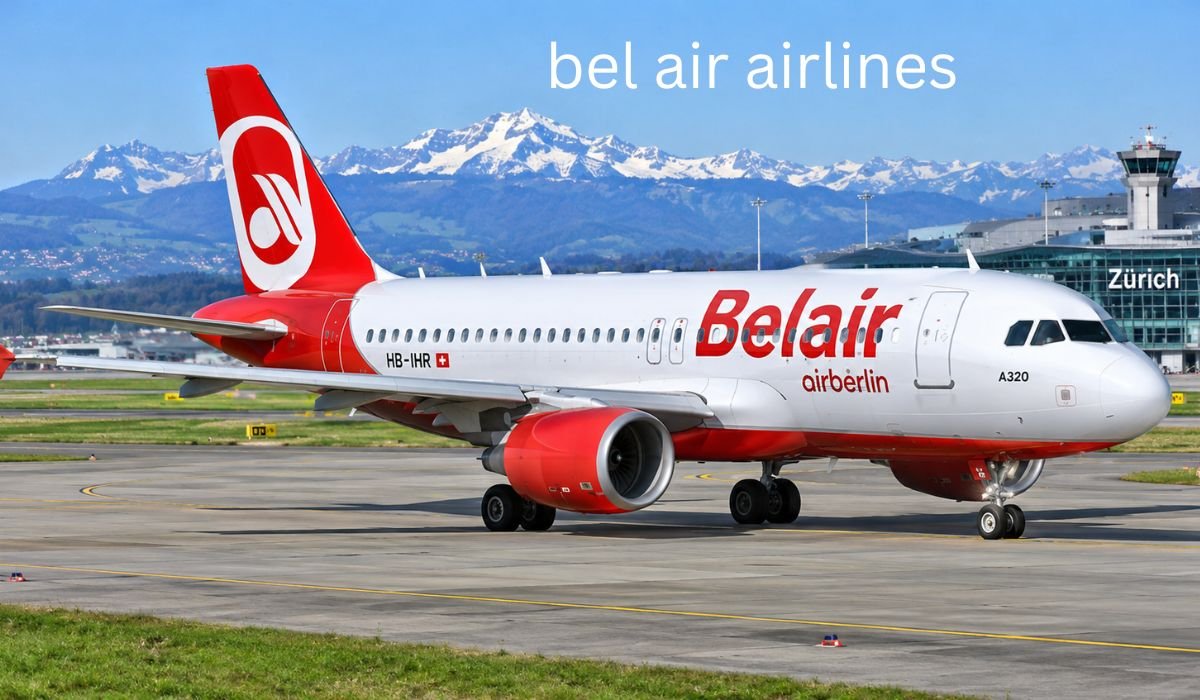
Bel Air Airlines was once a familiar name in Swiss holiday aviation, connecting travelers with sunny Mediterranean resorts and popular international destinations. Officially known as Belair Airlines AG, the company operated from Switzerland and became closely associated with Air Berlin, one of Europe’s major leisure airlines. Although its aircraft disappeared from the skies in 2017, its history remains an interesting chapter in European aviation.
The story of Bel Air Airlines goes beyond a single company. Its roots are connected to Balair, a Swiss airline established in 1925, and the development of Swissair. Over the decades, changing ownership, financial challenges, and growing competition shaped the business. Understanding this history explains how Belair developed, what made its services valuable, and why the airline eventually closed.
Quick Bio Information About Bel Air Airlines
| Information | Details |
|---|---|
| Official Name | Belair Airlines AG |
| Common Search Name | Bel Air Airlines |
| Airline Type | Charter and Leisure Airline |
| Country | Switzerland |
| Historical Origins | Balair, Founded in 1925 |
| Belair Established | October 16, 2001 |
| First Commercial Flight | November 3, 2001 |
| Headquarters | Glattbrugg, Opfikon, Switzerland |
| Main Airport | Zürich Airport |
| Additional Operating Base | EuroAirport Basel Mulhouse Freiburg |
| IATA Code | 4T |
| ICAO Code | BHP |
| Call Sign | BELAIR |
| Original Business Connection | Hotelplan and Migros |
| Later Parent Company | Air Berlin |
| Air Berlin’s Initial Investment | 2007 |
| Full Air Berlin Ownership | 2009 |
| Airline Alliance | Oneworld Affiliate |
| Frequent-Flyer Program | topbonus |
| Operational Closure | October 2017 |
What Was Bel Air Airlines?
Bel Air Airlines was a Swiss charter carrier specializing in leisure travel. Unlike traditional airlines that concentrate heavily on business passengers and regular scheduled routes, Belair primarily served holidaymakers traveling to popular vacation destinations. Its services connected Swiss airports with Mediterranean resorts, the Canary Islands, and other international locations.
The airline operated under its own Swiss aviation identity while maintaining commercial relationships with larger companies. During its later years, Belair became increasingly integrated into Air Berlin’s network. This arrangement allowed it to operate flights under Air Berlin branding while retaining its Swiss operating structure. The company played a useful role in Switzerland’s tourism market, particularly for passengers booking package holidays through travel operators.
The Early History of Balair in Switzerland
The historical background of Bel Air Airlines begins in 1925, when aviation entrepreneur Balz Zimmermann established Basler Aviation AG, commonly called Balair, in Basel. The name reflected Basel’s French name, Bâle. Its earliest routes connected Basel with Freiburg and Mannheim, offering air transportation during a period when commercial aviation was still developing.
By 1929, Balair had expanded to destinations including Zürich, Geneva, Lyon, Karlsruhe, and Frankfurt. However, the Great Depression placed considerable pressure on the young aviation industry. On January 1, 1931, Balair merged with Ad Astra Aero to establish Swissair. Before this merger, Balair had transported more than 18,000 passengers, along with substantial quantities of cargo and mail. This early airline was separate from the Belair company founded decades later.
How Balair Returned to the Aviation Industry
A second Balair company emerged in January 1953 following a public decision in Basel the previous year. Hans Peter Tschudin became its first president. Initially, the business focused on aircraft maintenance, flight training, and ground services rather than operating an extensive passenger network.
Its direction changed in June 1957 when Balair acquired two Vickers Viking aircraft and entered the charter market. Swissair purchased a 40 percent ownership stake in 1959, strengthening cooperation between the companies. Additional aircraft, including the Douglas DC-4 and DC-6, supported further growth. These developments helped Balair establish itself as a recognizable Swiss charter operator during a period when international holiday travel was becoming increasingly accessible.
Balair’s Expansion Into International Flights
During the following decades, Balair expanded its fleet and introduced jet aircraft. The Convair 990 Coronado, McDonnell Douglas DC-9, and Douglas DC-8 helped the airline serve longer routes and growing passenger demand. Its international operations included destinations such as Bangkok, Colombo, and Rio de Janeiro.
In 1979, Balair introduced the McDonnell Douglas DC-10-30, a wide-body aircraft suited to long-distance flights. By 1982, the company operated an all-jet fleet, while the Airbus A310 and McDonnell Douglas MD-82 became important aircraft during the 1980s. Balair also participated in humanitarian aviation activities connected with the Biafran airlift. These operations illustrate how charter aircraft could support both commercial travel and emergency transportation.
The Formation of BalairCTA and Its Challenges
In 1993, Balair merged with Compagnie de Transport Aérien, commonly known as CTA, creating BalairCTA. The restructuring was intended to combine operations and improve the efficiency of Swissair’s charter activities. The company’s registered office was located in Geneva, while accounting functions remained in Basel and operational activities centered on Zürich.
Despite these changes, financial performance remained disappointing. The airline faced restructuring pressures, workforce reductions, and difficulties maintaining profitable operations. By 1995, BalairCTA’s flying activities had ended. Short-haul services were transferred to Crossair, while Swissair assumed responsibility for long-haul operations. This episode demonstrated the financial challenges facing European charter airlines even before the emergence of modern low-cost carriers.
The Relaunch of Balair Before Belair Was Founded
Swissair revived the Balair name in November 1997 as part of another attempt to organize its charter business. The relaunched airline worked closely with Hotelplan, a Swiss travel company, and operated Boeing 757-200 aircraft for leisure flights. Boeing 767-300ER aircraft supported longer international journeys.
However, the financial collapse of Swissair in 2001 disrupted these operations. Balair’s final flight landed in Zürich on October 5, 2001, ending this phase of the company’s history. The situation created uncertainty for employees, aircraft operators, and travel companies that depended on charter capacity. Hotelplan responded by helping establish a replacement airline, ensuring that an important part of Switzerland’s holiday travel market could continue operating.
How Bel Air Airlines Was Established
Belair Airlines AG was officially established on October 16, 2001, following discussions between Hotelplan and its parent company, Migros. The new business inherited two Boeing 757 aircraft associated with the previous Balair operation and employed approximately 120 former Balair workers.
Its first commercial flight departed from Zürich on November 3, 2001. The airline concentrated on holiday services, particularly flights to Mediterranean destinations. A leased Boeing 767-300ER also provided long-haul capacity. The slightly modified Belair name helped preserve recognition among passengers while distinguishing the company from its predecessor. Although Belair continued an established aviation tradition, it was a newly formed airline rather than the original Balair company.
Bel Air Airlines Headquarters and Operating Bases
Bel Air Airlines maintained its headquarters in Glattbrugg, part of the municipality of Opfikon near Zürich. Its main operating bases were Zürich Airport and EuroAirport Basel Mulhouse Freiburg, both important gateways for Swiss travelers.
Zürich Airport offered access to Switzerland’s largest metropolitan aviation market, while Basel served passengers from northwestern Switzerland and neighboring regions of France and Germany. Belair also operated services from Geneva during its history. These locations helped the airline reach holiday customers across different parts of the country. Its Swiss operating identity remained important even after Air Berlin acquired the company and introduced greater operational coordination.
Bel Air Airlines Fleet and Aircraft Types
The Bel Air Airlines fleet changed as the company’s business developed. During its early years, Boeing 757-200 aircraft were particularly important for medium-haul holiday routes. The Boeing 767-300ER provided additional capacity for longer journeys.
Following Air Berlin’s involvement, Airbus aircraft became increasingly significant. Belair operated aircraft from the Airbus A320 family, including A319, A320, and A321 models during different periods. Four Airbus A321-200 aircraft were operating on behalf of Niki during the airline’s final year.
The fleet’s evolution reflected broader changes in European aviation, where operators increasingly favored efficient, standardized aircraft. Earlier Balair aircraft, including the Douglas DC-8 and McDonnell Douglas DC-10, belong to the historical predecessor’s fleet rather than the modern Belair operation.
Where Did Bel Air Airlines Fly?
Bel Air Airlines destinations primarily reflected the travel preferences of Swiss holidaymakers. The airline connected Switzerland with Mediterranean vacation regions, including destinations in Spain, Greece, and other popular European holiday markets. The Canary Islands were also an important part of its leisure network.
During its earlier operations, Belair used long-haul aircraft to support international holiday travel. Its route network later became closely integrated with Air Berlin’s services, with flights marketed under the German carrier’s brand.
Because charter routes frequently changed according to seasonal demand and travel-company agreements, Belair did not maintain one unchanged destination network throughout its existence. Its strongest commercial focus remained transporting leisure passengers from Switzerland to established holiday destinations.
Bel Air Airlines and Its Partnership With Swiss Air Rescue
One of Belair’s less widely discussed activities involved cooperation with REGA, Switzerland’s air rescue organization. As part of this relationship, a Boeing 757 was adapted for possible repatriation and disaster-related rescue missions.
Such arrangements allowed commercial aviation resources to support emergency transportation when circumstances required additional aircraft capacity. This partnership added an important humanitarian dimension to Belair’s history. Although the airline was primarily associated with tourism, its aircraft could also contribute to specialized transportation operations beyond ordinary passenger services.
How Air Berlin Became the Owner of Belair Airlines
Air Berlin acquired a 49 percent stake in Belair in 2007, beginning a major change in the Swiss airline’s ownership. By October 2009, Air Berlin had taken full control. The acquisition strengthened the German company’s presence in Switzerland and expanded its access to leisure travelers.
Belair gradually adopted Air Berlin’s branding, management arrangements, and commercial network. In January 2010, related Swiss aviation operations were consolidated under the Belair organization. The airline continued operating with its Swiss identity while becoming increasingly dependent on Air Berlin’s wider business strategy.
Belair was also associated with the Oneworld alliance as an Air Berlin affiliate between 2012 and 2017. Its passengers were connected with the topbonus frequent-flyer program, reflecting its integration into the larger airline group.
Why Did Bel Air Airlines Close?
Bel Air Airlines closed because of the financial and operational difficulties affecting its parent company, Air Berlin. During 2017, the German airline was undergoing significant restructuring while struggling with serious financial problems.
In January 2017, Belair announced the discontinuation of its Basel routes. From April, four Airbus A321 aircraft began operating on behalf of Niki, another company associated with Air Berlin. These changes reduced Belair’s independent operational role.
Air Berlin entered insolvency proceedings in August 2017, placing additional pressure on its subsidiaries. Belair ceased flying in late October 2017. Although investors explored the possibility of restarting the airline in 2018, the proposed revival did not succeed, and Belair subsequently faced insolvency.
The closure marked the end of a Swiss charter airline whose business had become closely tied to the fortunes of a larger European aviation group.
Is Bel Air Airlines Still Operating Today?
As of 2026, Bel Air Airlines is no longer operating. The company has not resumed commercial passenger flights since its closure in 2017, and the attempted revival in 2018 did not produce a lasting return.
Travelers searching for Belair flights today may encounter historical airline information, old aircraft photographs, or archived route listings. These references describe its former operations rather than an active airline.
Belair’s history remains relevant because it illustrates how European leisure aviation changed through mergers, acquisitions, and financial restructuring. Its story also highlights the importance of Switzerland’s charter airline industry and its connections with major travel companies.
Final Thoughts
Bel Air Airlines represents an interesting period in Swiss aviation history. From its establishment following Swissair’s collapse to its years under Air Berlin, the airline helped connect Swiss travelers with international holiday destinations.
Its story is also closely connected to the much older Balair tradition, which began in 1925 and influenced Swiss charter aviation for decades. Although Belair’s operations ended in 2017, its history demonstrates how aviation businesses adapt to changing markets, ownership structures, and financial pressures.
Today, Belair remains part of Switzerland’s commercial aviation heritage, remembered for its holiday services, distinctive aircraft, and connections with some of Europe’s most recognizable airline companies.
FAQs About Bel Air Airlines
What Was Bel Air Airlines?
Bel Air Airlines, officially Belair Airlines AG, was a Swiss charter airline established in 2001. It primarily operated leisure flights from Swiss airports to holiday destinations and later became a subsidiary of Air Berlin.
Is Bel Air Airlines Still Operating?
No. Belair stopped operating commercial flights in October 2017. Attempts to revive the company in 2018 were unsuccessful, and it remains inactive in 2026.
Who Owned Bel Air Airlines?
Belair was initially established through Hotelplan, which belonged to the Migros group. Air Berlin acquired a minority stake in 2007 and became its full owner in 2009.
Why Did Bel Air Airlines Shut Down?
The airline closed during Air Berlin’s financial collapse and restructuring in 2017. Its dependence on the parent company’s operations made continued flying increasingly difficult.
Where Was Bel Air Airlines Based?
Belair was headquartered in Glattbrugg, near Zürich, Switzerland. Its principal operating bases included Zürich Airport and EuroAirport Basel Mulhouse Freiburg.
What Aircraft Did Bel Air Airlines Use?
Belair operated Boeing 757-200 and Boeing 767-300ER aircraft during its earlier years. Later operations included Airbus A319, A320, and A321 aircraft.
Was Bel Air Airlines Part of Air Berlin?
Yes. Air Berlin purchased an initial ownership stake in 2007 and acquired full control in 2009. Belair subsequently operated closely within the Air Berlin network.
Learn more and explore exciting content on: Danny Jones Penniman Biography: Age, Wife, Family, Net Worth, and Life Today













Leave a Reply