
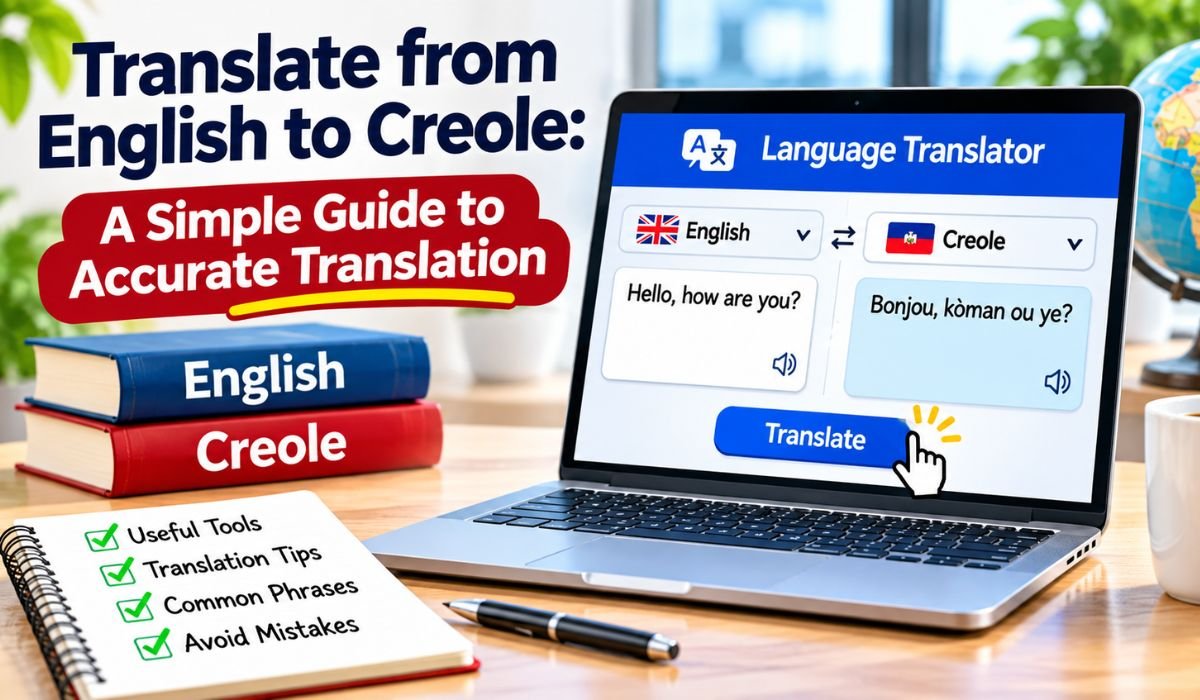
Language helps people connect, share ideas, and understand different cultures. However, communication becomes challenging when two people speak different languages. If you want to translate from English to Creole, knowing the right methods and tools can make everyday conversations much easier.
Haitian Creole, also called Kreyòl Ayisyen, is widely spoken in Haiti and Haitian communities around the world. Whether you’re planning a trip, communicating with friends, studying a new language, or translating an important message, understanding basic translation methods can save time and prevent misunderstandings.
Today, online translation tools make converting English into Haitian Creole more accessible than ever. Still, accurate translation requires more than replacing individual words. Grammar, context, pronunciation, and cultural expressions all influence meaning.
This guide explains how English to Haitian Creole translation works, explores useful tools, introduces common phrases, and shares practical advice for achieving clearer translations in 2026.
What Does It Mean to Translate from English to Creole?
To translate from English to Creole means converting English words, sentences, or messages into a Creole language while preserving their original meaning. In this guide, Creole specifically refers to Haitian Creole.
Translation involves understanding what someone wants to communicate and expressing that message naturally in another language. A direct word-for-word translation doesn’t always work because English and Haitian Creole follow different grammatical patterns.
For example, the English sentence “I am hungry” becomes “Mwen grangou” in Haitian Creole. The meaning stays the same, although the sentence structure differs.
Accurate translation is especially important when discussing personal information, travel arrangements, educational topics, or professional matters.
Understanding the Haitian Creole Language
Haitian Creole developed through language contact during Haiti’s colonial history. Its vocabulary comes largely from French, while its development also reflects important African linguistic influences.
Today, Haitian Creole and French are Haiti’s official languages. Haitian Creole is the primary everyday language of most Haitians and plays a central role in family life, music, education, and cultural identity.
Although Haitian Creole contains many French-derived words, it has its own grammar, spelling conventions, and pronunciation.
It is also important to understand that Creole is not a single worldwide language. Jamaican Creole, Louisiana Creole, and Haitian Creole are distinct languages or language varieties. Choosing the correct one matters when using translation software.
Quick Information About English to Haitian Creole Translation
| Information | Details |
|---|---|
| Translation Direction | English to Haitian Creole |
| Focus Keyword | Translate from English to Creole |
| Target Language | Haitian Creole |
| Native Name | Kreyòl Ayisyen |
| Main Country | Haiti |
| Language Status | Official Language of Haiti |
| Language Family | French-Lexifier Creole |
| Writing System | Latin Alphabet |
| Main Vocabulary Influence | French |
| Other Historical Influences | African Languages and Other Contact Languages |
| Common Word for Hello | Bonjou |
| Common Word for Thank You | Mèsi |
| Common Word for Yes | Wi |
| Common Word for No | Non |
| Basic Sentence Order | Commonly Subject-Verb-Object |
| Translation Methods | Online Tools, Dictionaries, Human Translators |
| Common Uses | Travel, Education, Business, Communication |
| Translation Availability | Free and Paid Services |
| Professional Translation | Recommended for Important Documents |
These details provide a useful introduction to the language and the different ways English speakers can communicate with Haitian Creole speakers.
How to Translate from English to Creole Online
Online translation is one of the easiest ways to convert English text into Haitian Creole. Many translation platforms provide a text field where users enter words or sentences and select their preferred language.
Begin by choosing English as the source language and Haitian Creole as the target language. Type or paste your message into the available field, then review the generated translation.
Some services allow users to copy results, translate documents, or hear spoken pronunciations. These features vary depending on the platform.
For better results, enter complete, clearly written sentences rather than disconnected words. If the translation sounds unusual, simplify the original English and try again.
Remember that automatic translation is helpful for everyday communication but may not accurately capture complicated expressions or specialized terminology.
Best Methods for Accurate English to Creole Translation
Different translation methods work better for different situations. Online translators are convenient for simple messages, common questions, and basic vocabulary.
Bilingual dictionaries are useful when learning individual words or checking alternative meanings. They can also help explain expressions that automatic translation systems misunderstand.
Language-learning resources provide additional value by introducing grammar, pronunciation, and common sentence patterns.
For legal documents, medical instructions, official records, or sensitive business communication, professional human translation is usually the safer choice.
A qualified translator can consider cultural meaning, technical vocabulary, and context that automated systems might overlook.
The most reliable approach is to choose a method based on the importance and complexity of the information being translated.
Common English to Haitian Creole Words and Phrases
Learning everyday phrases can make communication easier, even when you have access to a translation application.
| English | Haitian Creole |
|---|---|
| Hello | Bonjou |
| Good Evening | Bonswa |
| Thank You | Mèsi |
| Please | Tanpri |
| Yes | Wi |
| No | Non |
| How Are You? | Kijan ou ye? |
| What Is Your Name? | Kijan ou rele? |
| My Name Is John | Mwen rele John |
| I Love You | Mwen renmen ou |
| I Don’t Understand | Mwen pa konprann |
| Where Are You Going? | Ki kote ou prale? |
| How Much Does It Cost? | Konbyen sa koute? |
| I Need Help | Mwen bezwen èd |
| Goodbye | Orevwa |
These expressions are useful for greetings, shopping, travel, and friendly conversations.
However, pronunciation and word choice may vary according to context. Practicing with fluent speakers or reliable audio resources can improve your confidence.
Understanding Haitian Creole Grammar and Sentence Structure
Haitian Creole grammar differs from English in several important ways. Understanding these differences helps prevent awkward translations.
Both languages commonly use subject-verb-object sentence order. However, Haitian Creole generally does not change verb endings to indicate tense in the same way English does.
Instead, words placed before verbs can communicate time and aspect. For example, “Mwen manje” can mean “I eat” or “I ate,” depending on context, while “Mwen te manje” explicitly refers to a past situation.
The word “ap” often indicates an ongoing action or a future situation, depending on context.
Haitian Creole also uses the word “pa” for negation. For example, “Mwen pa konnen” means “I don’t know.”
Learning these patterns makes it easier to recognize whether an online translation preserves the intended meaning.
How Accurate Are English to Creole Translation Tools?
Translation accuracy depends on sentence complexity, available language data, and the system being used.
Simple expressions such as greetings and everyday questions are often easier for translation software to handle. Complicated sentences involving humor, cultural references, or specialized terminology may produce less reliable results.
Context is particularly important. An English word may have several meanings, and a translation system must determine which meaning fits the sentence.
Automatic translators can also struggle with informal speech, regional expressions, and spelling variations.
For casual conversations, these limitations may be manageable. However, important information should be checked by someone who understands both languages.
Accuracy should always matter more than translation speed when the message has serious consequences.
Common Mistakes When Translating from English to Creole
One frequent mistake is translating English sentences word for word. This can produce unnatural Haitian Creole because the languages use different grammatical structures.
Another mistake is assuming Haitian Creole and French are interchangeable. Although they share vocabulary, their grammar and pronunciation differ significantly.
English idioms can also create confusion. Expressions such as “break the ice” or “hit the road” may require a meaning-based translation rather than a literal one.
Spelling deserves attention as well. Haitian Creole has established writing conventions, and incorrect spelling can make a message harder to understand.
Finally, relying entirely on machine translation without reviewing the result can lead to misunderstandings.
Practical Tips for Better English to Creole Translation
Clear English is the foundation of a good translation. Short, direct sentences usually make the intended meaning easier for both software and human translators to understand.
Avoid unnecessary slang, complicated idioms, and ambiguous wording. If a sentence contains several ideas, consider separating them into shorter statements.
Whenever possible, provide context. A phrase used in a restaurant may require different wording from a similar phrase used in a business conversation.
Comparing translations from different resources can reveal possible mistakes, although matching results do not automatically guarantee correctness.
Learning basic Haitian Creole grammar and vocabulary also makes it easier to recognize unusual translations.
With regular practice, you can develop a better understanding of how natural Haitian Creole expressions are formed.
Benefits of Learning Basic Haitian Creole
Learning Haitian Creole offers benefits beyond using translation software. Even a small vocabulary can help create more meaningful conversations.
Travelers may find it easier to ask questions, understand directions, and interact respectfully with local communities.
Students can gain insight into Haitian literature, history, and cultural traditions. Language knowledge can also support communication in multilingual educational environments.
For people with Haitian friends, relatives, or colleagues, learning common expressions can strengthen everyday relationships.
Understanding the language also reduces dependence on automatic translation tools.
Most importantly, learning Haitian Creole encourages cultural appreciation and helps people communicate with greater confidence and respect.
English to Creole Translation for Travel and Everyday Life
Travel is a common reason people search for an English to Haitian Creole translator.
Visitors to Haiti may need help understanding transportation information, asking for directions, ordering meals, or communicating with local residents.
For example, “Ki kote twalèt la ye?” means “Where is the bathroom?” Another useful phrase, “Mwen bezwen dlo,” means “I need water.”
Translation tools can also support everyday communication through text messages, emails, and social conversations.
However, travelers should remember that internet access, mobile coverage, and application features can vary.
Learning essential phrases before traveling provides a useful backup when digital translation is unavailable.
Using English to Creole Translation for Business and Education
English to Haitian Creole translation can support communication in schools, workplaces, healthcare settings, and community organizations.
Teachers may use bilingual materials to explain classroom information to Haitian Creole-speaking students and families.
Businesses can translate basic customer messages, service descriptions, and general instructions to communicate with a broader audience.
Community organizations may also benefit from providing accessible information in Haitian Creole.
Nevertheless, professional accuracy is essential when translating contracts, official notices, medical information, or safety instructions.
For these situations, qualified translators and appropriate review processes help ensure that the final message is understandable and reliable.
Translating English to Creole Files and Documents
Some translation services support document translation, allowing users to work with text files, word-processing documents, or PDFs.
The process depends on the service and the document format. Files containing selectable text are generally easier to process than scanned documents.
Scanned pages may require optical character recognition before translation. This additional step can introduce errors, especially when the original document is unclear.
Formatting can also change during translation because the translated text may be longer or shorter than the original.
Before sharing a translated document, review names, dates, numbers, technical terms, and important instructions.
Confidential documents should only be uploaded to services with suitable privacy and security protections.
English to Creole Audio Translation and Pronunciation
Audio translation can help people communicate when typing is inconvenient. Some applications combine speech recognition with machine translation to convert spoken English into Haitian Creole text.
Certain services may also offer text-to-speech features, allowing users to hear translated expressions.
These tools can support pronunciation practice, listening comprehension, and everyday conversations.
However, background noise, unfamiliar accents, unclear speech, and recognition mistakes can affect results.
Haitian Creole pronunciation also differs from English, so written translations alone may not teach learners how words sound.
Listening to fluent speakers and practicing common phrases can help develop more natural pronunciation over time.
How to Choose the Right English to Creole Translator
A useful translator should be easy to operate, support Haitian Creole specifically, and provide understandable results.
Check whether the platform offers text translation, pronunciation assistance, document support, or other features relevant to your needs.
Free translation services may be sufficient for everyday phrases, while professional services are more appropriate for specialized documents.
Privacy is another important consideration. Avoid entering confidential personal, financial, or medical information into unfamiliar platforms without understanding their data-handling practices.
It’s also helpful to test a translator using sentences whose meanings you already know.
Rather than choosing a service based only on popularity, focus on accuracy, accessibility, and suitability for your intended purpose.
Final Thoughts
Learning how to translate from English to Creole can make everyday communication easier and more meaningful. Whether you’re traveling, studying, working, or connecting with Haitian Creole speakers, accurate translation helps reduce language barriers.
Online tools provide a convenient starting point, but they work best when combined with clear writing, basic language knowledge, and careful review.
Haitian Creole is a distinct language with its own history, grammar, and cultural importance. Understanding these characteristics helps produce translations that communicate more than individual words.
As translation technology continues developing in 2026, the most useful approach remains simple: choose reliable resources, understand the context, and prioritize meaning over literal wording. With patience and practice, English to Haitian Creole translation can become a valuable everyday skill.
FAQs About Translate from English to Creole
How Can I Translate from English to Creole for Free?
You can use an online translator that supports Haitian Creole. Enter your English text, select Haitian Creole as the target language, and review the result. Free tools are convenient for everyday messages, but important translations should be verified.
Is Haitian Creole the Same as French?
No. Haitian Creole and French are separate languages. Haitian Creole has substantial French-derived vocabulary but follows its own grammatical rules, pronunciation patterns, and spelling conventions.
Can Google Translate Translate English to Haitian Creole?
Google Translate supports Haitian Creole translation. Users can select English and Haitian Creole to translate text. Available speech, document, and other features may vary by platform and language.
How Accurate Is Online English to Creole Translation?
Accuracy varies according to the translation system, sentence complexity, and context. Basic phrases are often easier to translate, while idioms, technical language, and culturally specific expressions may require human review.
Can I Translate English to Creole Without Installing an App?
Yes. Browser-based translation platforms allow users to translate text online without installing separate software. An internet connection is generally required for these services.
Can I Translate Documents into Haitian Creole?
Some translation platforms support document translation. Compatibility depends on the file format and service. Important documents should be reviewed carefully, especially when they contain legal, medical, or official information.
Is Haitian Creole Difficult for English Speakers to Learn?
The difficulty depends on your language background and learning experience. Haitian Creole has grammatical features that may feel unfamiliar to English speakers, but consistent vocabulary practice, listening, and conversation can make learning more manageable.
What Is the Best Way to Learn Haitian Creole?
Combining structured lessons, reliable dictionaries, listening practice, and conversations with fluent speakers is a practical approach. Translation tools can support learning, but understanding grammar and everyday expressions provides stronger long-term progress.
Learn more and explore exciting content on: Atila Altaunbay Biography: Age, Wife, Career, Marriage, and Life Story












Leave a Reply