
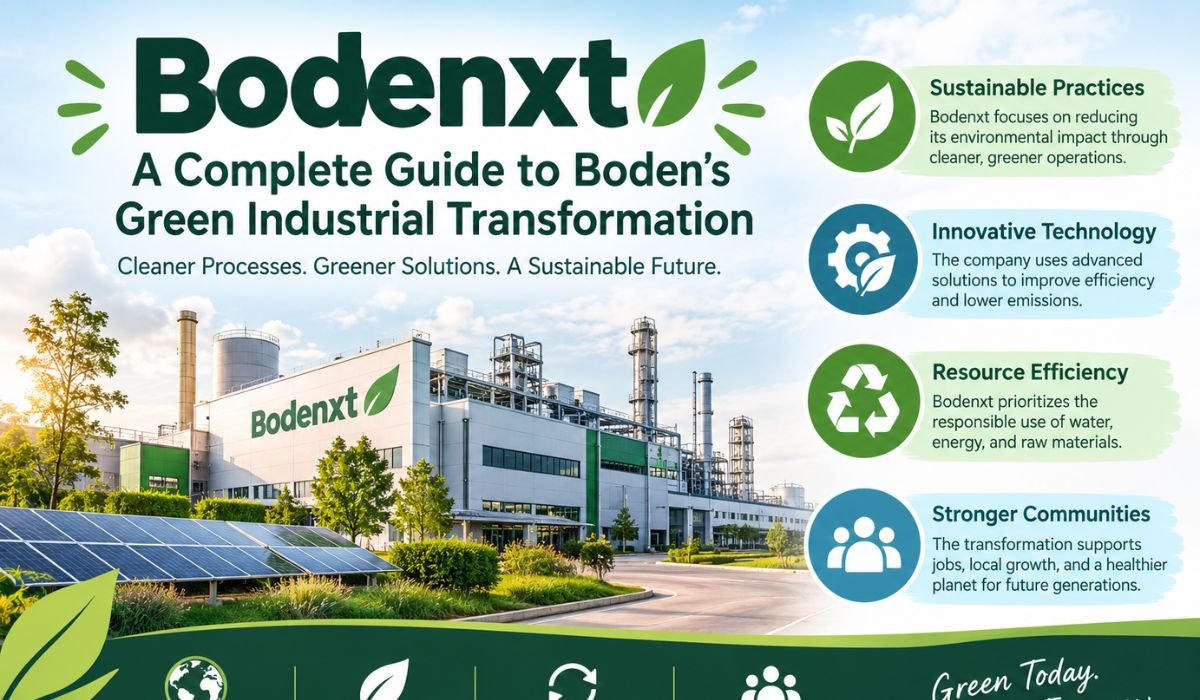
Bodenxt is becoming an important name in the story of Boden, Sweden, as the municipality moves through one of the biggest periods of industrial and social change in its modern history. The term does not simply describe a steel factory. Bodenxt is the Municipality of Boden’s platform for managing the wider green transformation of society, with a focus on skills, housing, business development, and infrastructure. Stegra’s large green steel project is an important accelerator, but the transformation reaches far beyond one industrial site.
The scale of change is significant. Boden Municipality says the development taking place over the coming years is comparable to around 20 years of social development happening within a much shorter period. At the same time, northern Sweden is attracting major investment connected with green reindustrialisation. This makes Bodenxt relevant not only to people searching for Bodenxt Sweden, but also to readers interested in green industry, sustainable development, green steel, hydrogen, jobs, housing, and the future of northern Sweden.
What Is Bodenxt?
Bodenxt is the Municipality of Boden’s platform for the municipality’s major green transition. Official municipal information describes it as a way of coordinating the transformation of the entire society in Boden. Its structure brings together four main areas: skills supply, living and housing, business development, and infrastructure above and below ground.
This approach matters because a large industrial investment affects much more than production. New factories require workers, workers need homes, growing populations need schools and services, companies require transportation and utilities, and local businesses need opportunities to participate in new economic activity. Bodenxt is designed around these connections rather than treating every issue as a separate department or project.
Bodenxt In Simple Terms
In simple words, Bodenxt is about preparing Boden for rapid growth while trying to make that growth sustainable over the long term. The municipality created a structure that crosses traditional administrative boundaries so that housing, infrastructure, skills, business development, and other needs can be handled together.
This is particularly important because industrial transformation can happen faster than normal municipal planning cycles. If thousands of new jobs appear but homes are unavailable, recruitment becomes harder. If new residents arrive without enough schools or services, community pressure can increase. If industrial companies cannot access suitable logistics or utilities, investment can become more difficult. Bodenxt therefore focuses on the wider system around industrial growth.
Where Is Boden, Sweden?
Boden is a municipality in Norrbotten, in northern Sweden. Its northern location is one reason it has become closely connected with Sweden’s green industrial transformation. The area has access to renewable electricity, industrial land, transportation infrastructure, natural resources, and an existing industrial environment.
Boden is also part of a broader regional transformation rather than an isolated project. The municipality describes northern Sweden as an intensive inward-investment region, with large-scale investment associated with green reindustrialisation. This wider setting helps explain why Boden has become a significant location for discussions about green steel, renewable energy, hydrogen, and sustainable industrial development.
Quick Bio Information
| Information | Details |
|---|---|
| Name | Bodenxt |
| Location | Boden, Norrbotten, Northern Sweden |
| Country | Sweden |
| Main Focus | Green societal transformation |
| Main Organisation | Municipality of Boden |
| Industrial Accelerator | Stegra’s Boden project |
| Main Areas | Skills, Housing, Business, Infrastructure |
| Industrial Area | Boden Industrial Park |
| Industrial Park Size | About 550 hectares |
| Major Industry | Green Steel |
| Key Technology | Green Hydrogen |
| Hydrogen Facility | 700 MW planned electrolyzer |
| Green Steel Target | Up to 5 million tonnes annually by 2030, according to Stegra’s current plan |
| Population | 28,624 at the end of 2025 |
| 2025 Forecast | 28,248 residents |
| Railway | Boden Industrial Park connection inaugurated in 2026 |
| Housing Issue | Very low rental vacancy reported in 2026 |
| Education Response | New Engineering Programme from autumn 2026 |
| Sustainability Focus | Environmental, Economic, and Social Development |
The figures above reflect information available in 2026 and should be understood in context because some industrial figures are future targets rather than current production.
Why Is Boden Experiencing A Green Industrial Transformation?
Several factors have helped make Boden attractive for new industrial development. Renewable electricity is especially important because modern low-carbon industrial processes can require very large amounts of electricity. Stegra says its Boden project was located in northern Sweden because of access to clean electricity, the power grid, raw materials, logistics infrastructure, and a local and regional talent pool.
The wider change is part of a larger effort to reduce emissions from heavy industry. Steelmaking has traditionally relied heavily on fossil fuels, particularly coal in conventional blast-furnace processes. New technologies can use renewable electricity and hydrogen to reduce reliance on fossil fuels.
Boden therefore sits at the intersection of several trends: renewable energy, industrial investment, technological development, logistics, workforce migration, and regional economic growth.
Bodenxt And Sweden’s Green Industry
The phrase green industry covers more than one technology. It can include cleaner manufacturing, renewable energy, electrification, hydrogen, resource efficiency, circular production, and new industrial processes designed to reduce emissions.
Bodenxt connects this industrial movement with community development. The Municipality of Boden describes Boden as a place where industry and commerce interact within an ecosystem designed to attract talent and support future development. Its industrial areas are intended not only for factories but also for wider activities connected with circularity, food production, energy, and business development.
This makes Bodenxt different from a normal industrial project. The industrial investment is one driver, while Bodenxt is concerned with how the whole municipality responds.
The Role Of Green Steel In Boden’s Transformation
Green steel is central to Boden’s current transformation because Stegra is constructing a large integrated facility combining green hydrogen, green iron, and green steel. Stegra says the Boden plant is designed to use renewable electricity and green hydrogen instead of coal-based reduction methods. The company currently describes a long-term target of producing 5 million tonnes of green steel annually by 2030.
The process begins with electrolysis. Electricity is used to split water into hydrogen and oxygen. The hydrogen can then be used to remove oxygen from iron ore, producing direct-reduced iron. That iron can subsequently be melted and processed into steel.
Stegra says its process is designed to reduce CO₂ emissions by up to 95% compared with traditional steelmaking. This is a company-reported figure and describes the intended technology and performance of the project rather than an already completed production result.
Major Green Industrial Development In Boden
Stegra’s Boden plant is the most visible industrial project connected with Boden’s green transformation. The planned facility covers about 270 hectares and includes a large hydrogen plant, direct-reduction facilities, steelmaking, casting, and rolling operations. Stegra says its hydrogen facility has a planned capacity of 700 megawatts.
The project has also continued to move through construction milestones during 2026. Stegra reported that all 37 electrolyzer modules had been installed by April 2026, while the direct-reduction tower reached its final planned height of 145 metres in June. In April, the company also announced an agreement in principle for €1.4 billion in new financing to complete construction and commissioning.
These developments are important to Bodenxt because a project of this size creates requirements far beyond the factory itself.
Jobs And Workforce Development In Boden
Workforce development is one of the core parts of Bodenxt. A modern industrial economy needs engineers, electricians, technicians, operators, construction specialists, logistics workers, project managers, digital specialists, and many other professionals. At the same time, population growth creates demand for teachers, healthcare workers, retail employees, hospitality workers, and other service professionals.
Boden Municipality has responded by expanding education and training. In autumn 2026, Björknäsgymnasiet is scheduled to introduce an Upper Secondary Engineering Programme designed around industrial design and product development, with project work and workplace-based learning. The programme is intended to respond to changing technical skill requirements in industry and defence.
The municipality also highlights Lärcentrum, Boden Business Park, and collaborations between industry and education as part of developing the skills needed for the transformation.
Housing And Population Growth In Boden
Housing has become one of the clearest challenges associated with Boden’s growth. Official municipal statistics show that Boden ended 2025 with 28,624 residents, which was 376 above the municipality’s forecast of 28,248. The municipality also reported that 2,067 people moved to Boden during 2025, compared with 1,516 the previous year.
However, population growth creates a practical problem when housing supply cannot keep pace. In May 2026, Boden Municipality reported that the vacancy rate for rental apartments was close to zero. The municipality said the shortage could make it harder for new residents to move to Boden and could also affect companies trying to recruit employees.
This illustrates an important point about Bodenxt: industrial growth and housing development have to progress together. Jobs can attract people, but homes help determine whether those people can actually settle in the community.
Infrastructure For Boden’s Growth
Infrastructure is another central part of Bodenxt. Industrial transformation requires roads, rail, electricity, water, wastewater systems, communications networks, and logistics connections.
One major development reached an important milestone in 2026 when the railway connection to Boden Industrial Park was officially inaugurated. The municipality describes the project as an important infrastructure investment, while Stegra has also arranged freight logistics involving Green Cargo and several regional ports.
Below-ground infrastructure is equally important. In April 2026, work began on expanding Boden’s Svedjan wastewater treatment plant. The expansion is intended to increase capacity for a growing population and respond to stricter treatment requirements.
These projects show why infrastructure can be easy to overlook when discussing green industry. A factory cannot operate successfully without reliable systems surrounding it.
Local Business And Economic Opportunities
The economic effects of Boden’s transformation extend beyond major industrial companies. New workers and industrial projects create demand for restaurants, transportation, construction, engineering, maintenance, accommodation, retail, consulting, and other services.
Boden Municipality has already documented examples of local businesses benefiting from the new industrial activity. In 2026, a local food-truck operation at Boden Industrial Park developed into a restaurant business, creating additional employment and commercial activity.
The municipality is also exploring opportunities connected with waste heat, residual materials, and industrial by-products. These developments point toward a more circular economic model in which materials and energy that might otherwise be treated as waste can become resources for another activity.
Sustainability In The Bodenxt Transformation
Sustainability in Boden should be understood through environmental, economic, and social perspectives. Environmental sustainability concerns lower-emission industry, renewable energy, efficient resource use, and protection of the surrounding environment.
Economic sustainability means creating opportunities that can remain valuable beyond one construction project. A diversified business community, skilled workforce, strong infrastructure, and new companies can make the local economy more adaptable.
Social sustainability is equally important. Housing, education, public services, community life, safety, and opportunities for families all influence whether population growth becomes a lasting transformation.
This wider interpretation is central to Bodenxt because the municipality describes the initiative as a transformation of the entire society rather than simply an industrial development programme.
Hydrogen And Renewable Energy In Boden
Hydrogen is a key part of the green steel process planned at Boden. Stegra explains that its hydrogen will be produced through electrolysis using renewable electricity. The hydrogen then acts as the reducing agent that transforms iron ore into direct-reduced iron.
The planned electrolyzer has a capacity of 700 megawatts, and Stegra describes it as Europe’s largest green hydrogen production facility. In April 2026, the company announced that all 37 electrolyzer modules had been installed, although further commissioning work remained.
This is why electricity supply is so important to Boden’s green industrial future. Hydrogen production at this scale requires substantial power, making renewable electricity, grid access, and long-term energy agreements important parts of the industrial ecosystem.
Challenges Facing Boden’s Transformation
Rapid growth also brings pressure. Housing is already a major concern, and the municipality has warned that the shortage can affect both residents and employers. Skills are another challenge because industrial expansion requires specialized workers while population growth simultaneously increases demand for public and service-sector employees.
Infrastructure must also expand at the right speed. Water, wastewater, transport, electricity, and other systems require significant investment and long planning periods. At the same time, major industrial projects involve financial and market risks, meaning long-term community planning has to remain flexible.
For Bodenxt, the challenge is therefore not simply attracting investment. It is managing the speed and consequences of that investment while maintaining a functioning community.
Community Life And Local Participation
A successful transformation is ultimately about people. Boden needs to remain a place where residents can work, raise families, participate in sports and cultural activities, and build long-term connections.
The arrival of international workers has already added new expertise and diversity to the community. Boden Municipality has highlighted initiatives aimed at accompanying partners and families, recognizing that relocation decisions often involve entire households rather than individual employees.
Community development also involves environmental quality and local identity. Projects such as research into water quality in Lake Svartbyträsket show that environmental issues remain part of the wider transformation rather than being separate from economic development.
What Other Regions Can Learn From Bodenxt
Bodenxt offers a useful case study because it treats industrial transformation as a connected community issue. Other regions considering renewable energy, advanced manufacturing, data centres, electric-vehicle production, or other large investments can examine how Boden is linking employment, housing, education, infrastructure, and business development.
The most practical lesson is the importance of planning early. A new factory may be the most visible part of an investment, but the surrounding systems determine whether workers can relocate, businesses can operate, and communities can absorb growth.
Boden’s experience also shows why economic diversification matters. Major industrial projects can create substantial opportunities, but local businesses, education, infrastructure, and public services help determine whether those opportunities produce broader and lasting regional benefits.
Bodenxt And The Future Of Sustainable Cities
The Bodenxt approach connects with a larger question facing cities around the world: how can communities grow quickly without losing long-term resilience?
Future industrial regions may need to combine clean electricity, low-carbon manufacturing, digital technology, housing, transportation, education, and public services in a much more coordinated way.
Boden provides a real-world example of this challenge. The municipality is not only preparing land for industry; it is also working on housing, education, infrastructure, business development, wastewater capacity, and community services.
That makes the Bodenxt story broader than green steel. It is also a story about how an existing community adapts when the economic environment around it changes rapidly.
Bodenxt Current Status In 2026
As of 2026, Boden’s transformation is actively underway rather than being only a future proposal. The population reached 28,624 at the end of 2025, the railway serving Boden Industrial Park has been inaugurated, new education programmes are being introduced, wastewater infrastructure is being expanded, and Stegra’s industrial site continues to advance through construction and commissioning stages.
Stegra also announced in April 2026 that it had agreed in principle on €1.4 billion of additional financing, while the company’s June 2026 updates recorded further construction progress. These developments provide a current picture of an industrial project moving through major construction milestones, while the municipality continues to address the wider social effects.
Final Thoughts
Bodenxt provides a useful way to understand what is happening in Boden, Sweden. The story is not simply about constructing a green steel plant. It is about what happens to an entire community when major industrial investment arrives and creates new demands for workers, homes, infrastructure, businesses, education, utilities, and public services.
The scale of the transformation is already visible. Boden’s population exceeded its 2025 forecast, the railway to the industrial park has been inaugurated, new technical education is being introduced, housing availability has become a serious concern, and Stegra’s green steel project continues to advance.
For readers searching for Bodenxt Sweden, the most important point is that Bodenxt represents a broader transformation than any single factory. It connects green industry with the practical work of building a community that can support long-term economic and social development.
Boden’s experience will continue to evolve. What makes it especially interesting is the attempt to manage industrial growth and community development at the same time. As northern Sweden becomes an increasingly important centre for green industry, the lessons emerging from Boden may provide valuable insight into how other regions approach their own sustainable industrial transitions.
FAQs About Bodenxt
What Is Bodenxt?
Bodenxt is the Municipality of Boden’s platform for managing the municipality’s major green societal transformation. Its work covers skills supply, housing, business development, and infrastructure, with Stegra’s industrial establishment acting as an important accelerator.
Is Bodenxt A Company?
Bodenxt is presented by the Municipality of Boden as a municipal platform and governance structure for the wider transformation. It should therefore not be confused with Stegra, the company developing the large green steel plant in Boden.
Is Bodenxt The Same As Green Steel?
No. Green steel is one important part of Boden’s industrial transformation. Bodenxt covers the broader societal response, including housing, skills, infrastructure, business development, and community planning.
Why Is Boden Important For Green Industry?
Boden offers access to renewable electricity, industrial land, logistics infrastructure, raw materials, and a regional workforce. These factors have helped attract major green-industry investment.
What Is Stegra Building In Boden?
Stegra is developing an integrated plant combining green hydrogen, direct-reduced iron, and green steel production. The company says the planned facility is designed to eventually produce up to 5 million tonnes of green steel annually by 2030.
Why Is Housing Important To Bodenxt?
Housing is necessary for workers and families who want to move to Boden. In 2026, the municipality reported that rental vacancy was close to zero, showing how population and employment growth can create immediate pressure on housing supply.
How Is Boden Preparing Its Workforce?
Boden is expanding education and training connected with future employment needs. A new Upper Secondary Engineering Programme is scheduled to begin at Björknäsgymnasiet in autumn 2026, combining technical education with project and workplace-based learning.
What Is The Future Of Bodenxt?
The future of Bodenxt will depend on how effectively Boden manages industrial development alongside housing, skills, infrastructure, business growth, public services, and environmental goals. The transformation is already underway, but its long-term outcome will depend on how these different parts of the community develop together.
Learn more and explore exciting content on: Laura Cover: Biography, Career, Family, and Life Story











Leave a Reply