
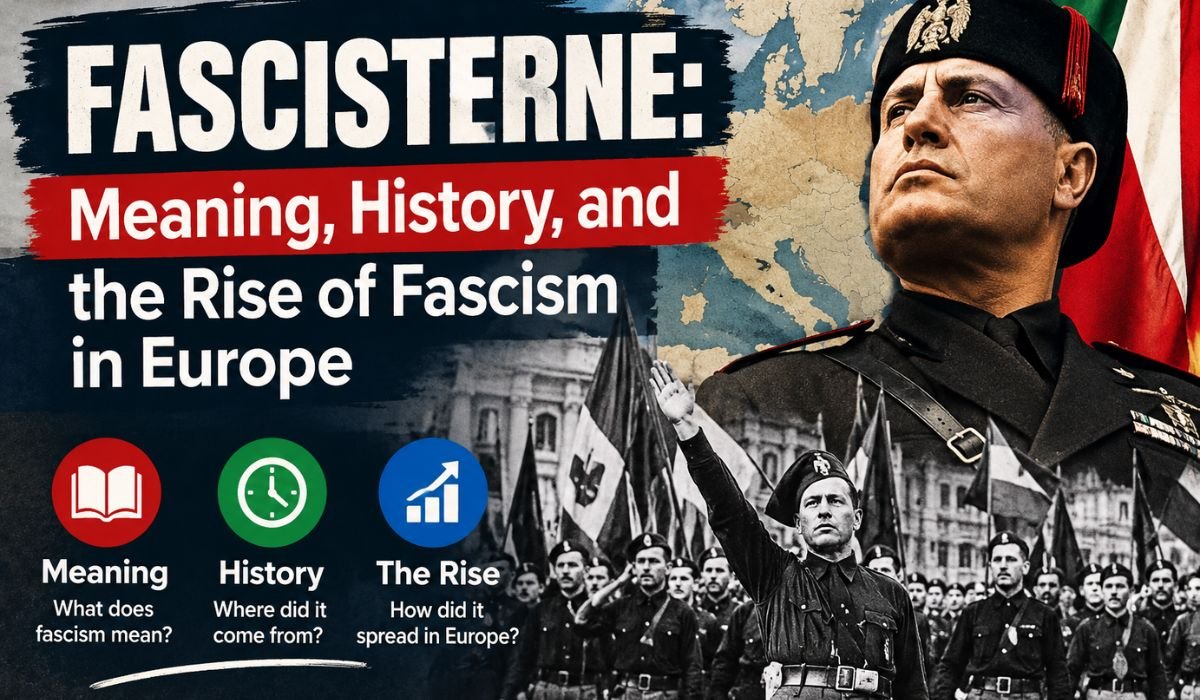
The Word Fascisterne May Look Unfamiliar To English Speakers, But It Has A Clear Meaning In Danish: “The Fascists.” The Term Refers To People Who Support Or Belong To Fascist Movements, An Important Part Of European History During The Early Twentieth Century. Today, Fascisterne Is Relevant To Readers Exploring Danish Language, Political Ideologies, World War II, And The Rise Of Authoritarian Governments.
To Understand Fascisterne Properly, It Helps To Look Beyond Its Translation. The Word Is Closely Connected To Fascism, A Political Ideology That Emphasizes Extreme Nationalism, Strong Leadership, And Loyalty To The State. Fascist Movements Gained Support In Several European Countries After World War I And Played A Major Role In The Events That Led To World War II.
Denmark Also Has A Connection To This History Through Its Own Fascist Political Movement And The German Occupation From 1940 To 1945. Understanding These Events Explains Why The Word Can Carry Different Meanings Depending On Its Historical And Political Context.
Quick Bio Information About Fascisterne
|
Detail |
Information |
|---|---|
|
Danish Term |
Fascisterne |
|
English Translation |
The Fascists |
|
Related Ideology |
Fascism |
|
Danish Word For Fascism |
Fascisme |
|
Word Type |
Definite Plural Noun |
|
Historical Period Of Major Growth |
Early Twentieth Century |
|
Country Where Modern Fascism First Took Power |
Italy |
|
Key Italian Leader |
Benito Mussolini |
|
Italian Fascist Movement Founded |
1919 |
|
National Fascist Party Established |
1921 |
|
Mussolini Became Prime Minister |
1922 |
|
Key Nazi Leader |
Adolf Hitler |
|
Hitler Became Chancellor |
January 30, 1933 |
|
Danish Fascist/Nazi-Oriented Party |
DNSAP |
|
DNSAP Founded |
1930 |
|
German Invasion Of Denmark |
April 9, 1940 |
|
Rescue Of Danish Jews |
October 1943 |
|
German Occupation Of Denmark Ended |
May 1945 |
|
Main Historical Significance |
Understanding Fascism And European History |
What Does Fascisterne Mean?
Fascisterne Is The Danish Definite Plural Form Of The Word Fascist. In Simple English, It Means “The Fascists.” It Usually Refers To A Particular Group Of People Who Support Fascist Beliefs, Rather Than Describing The Ideology Itself. The Exact Meaning Depends On The Sentence Or Historical Situation In Which The Word Appears.
The Danish Language Uses Different Word Forms To Express Whether A Person Or Group Is Being Discussed Generally Or Specifically. Fascist Refers To A Fascist Person, Fascisten Means “The Fascist,” Fascister Means “Fascists,” And Fascisterne Means “The Fascists.” Meanwhile, Fascisme Is The Danish Word For Fascism. Understanding These Differences Helps Readers Interpret Danish Historical Documents, News Reports, And Political Discussions More Accurately.
Fascisterne Is Not The Name Of One Particular Political Party. Depending On The Context, It Could Refer To Supporters Of Mussolini In Italy, Members Of Nazi-Oriented Movements, Danish Fascists, Or Other Groups Associated With Fascist Ideology. This Distinction Is Important Because The Word Describes People, While Fascism Describes Their Political Ideology.
What Is Fascism?
Fascism Is An Authoritarian Political Ideology That Places Extreme Importance On National Identity, Unity, And Strength. Fascist Movements Generally Reject Liberal Democracy, Oppose Independent Political Opposition, And Support Concentrating Power In The Hands Of A Strong Leader Or Ruling Party. They Often Present The Nation As Being In Danger And Promise To Restore Its Greatness Through Discipline, Loyalty, And Forceful Leadership.
Fascism Does Not Have One Universal Definition Accepted In Every Detail By All Historians. However, Common Features Include Extreme Nationalism, Opposition To Liberal Democracy, Political Repression, Militarism, And The Belief That Individual Interests Should Be Subordinated To National Goals. Many Fascist Movements Also Blamed Minority Groups Or Political Opponents For National Problems.
It Is Important To Understand That Fascism Was Not Simply Another Name For A Strong Government. Fascist Leaders Often Worked To Destroy Democratic Checks On Their Power, Control Public Information, And Silence Critics. These Actions Made It Difficult For Citizens To Challenge Government Decisions Or Replace Their Leaders Through Free And Fair Elections.
The Rise Of Fascism In Europe
Fascism Gained Momentum After World War I, Which Ended In 1918. The War Had Caused Enormous Human Losses, Economic Disruption, And Political Uncertainty Across Europe. Many Soldiers Returned Home To Countries Struggling With Unemployment, Inflation, Social Conflict, And Disappointment About The Results Of The War.
In Italy, Nationalists Felt That Their Country Had Not Received All The Territorial Rewards They Expected After The War. Economic Difficulties And Strikes Also Created Fear Among Business Owners, Landowners, And Parts Of The Middle Class. Fascist Leaders Used These Concerns To Present Their Movement As A Solution To Disorder And National Weakness.
The Russian Revolution Of 1917 And The Growth Of Socialist And Communist Movements Increased Fear Of A Similar Revolution In Other European Countries. Fascist Organizations Exploited These Fears By Presenting Themselves As Defenders Of National Unity And Traditional Social Structures. Their Promises Attracted Some People Who Had Lost Confidence In Existing Political Parties.
However, Fascism Did Not Develop In Exactly The Same Way Everywhere. Local Political Conditions, National Traditions, Economic Problems, And Individual Leaders Shaped Each Movement. Understanding These Differences Helps Explain Why Fascism Became A Government System In Some Countries While Remaining A Smaller Political Force In Others.
Benito Mussolini And Fascist Italy
Benito Mussolini Played A Central Role In The Development Of Modern Fascism. In 1919, He Founded The Fasci Italiani Di Combattimento, A Movement That Later Developed Into The National Fascist Party In 1921. Mussolini Promoted Nationalism, Political Discipline, Opposition To Communism, And The Idea That Italy Needed Strong Leadership.
In October 1922, Fascists Organized The March On Rome, A Political Demonstration Intended To Pressure The Italian Government. King Victor Emmanuel III Appointed Mussolini Prime Minister. Although Mussolini Initially Entered Office Through A Constitutional Appointment, He Gradually Weakened Democratic Institutions And Consolidated His Authority.
During The Following Years, His Government Restricted Political Opposition, Censored The Press, And Established A Dictatorship. Fascist Organizations Promoted Loyalty To Mussolini And The State Through Public Rallies, Education, Youth Organizations, And Propaganda. The Government Also Pursued Imperial Expansion, Including The Invasion Of Ethiopia In 1935.
Mussolini’s Regime Became An Important Model For Other Fascist Movements In Europe. Nevertheless, Fascist Governments Were Not Identical, And Their Policies Varied According To Local Conditions. Italy’s Experience Demonstrates How A Political Movement Can Enter Government Through Existing Institutions And Then Gradually Undermine Those Institutions.
Adolf Hitler And Nazi Germany
Adolf Hitler And The National Socialist German Workers’ Party, Commonly Known As The Nazi Party, Became Another Major Force In European Fascism. Germany Faced Serious Political And Economic Problems Following World War I. The Great Depression, Which Began In 1929, made These Difficulties Worse And Increased Public Support For Extremist Political Movements.
Hitler Became German Chancellor On January 30, 1933. His Government Quickly Destroyed Democratic Checks, Banned Political Opposition, And Established A Dictatorship. Nazi Authorities Used Propaganda, Secret Police, Imprisonment, And Violence To Control Society And Eliminate Resistance.
Nazism Shared Important Characteristics With Italian Fascism, Including Extreme Nationalism, Authoritarian Leadership, Militarism, And Hostility Toward Liberal Democracy. However, Racial Ideology And Antisemitism Were Central To Nazi Beliefs. The Regime Persecuted Jewish People And Other Targeted Groups, Eventually Carrying Out The Holocaust, In Which Six Million Jews Were Murdered.
Nazi Germany Also Pursued Territorial Expansion, Contributing Directly To The Outbreak Of World War II In Europe In September 1939. Studying Nazi Germany Alongside Fascist Italy Helps Explain Both The Shared Characteristics Of Fascist Movements And The Specific Dangers Of Nazi Racial Ideology.
The Main Characteristics Of Fascism
Extreme Nationalism Is One Of The Most Recognizable Features Of Fascism. Fascist Movements Often Claim That Their Nation Has Been Humiliated, Weakened, Or Threatened By Internal And External Enemies. They Promise National Renewal And Encourage Citizens To Put Collective National Goals Above Personal Freedom. National Pride Alone Does Not Make A Movement Fascist; The Wider Ideology And Its Treatment Of Democratic Rights Also Matter.
Authoritarian Leadership Is Another Important Feature. Fascist Governments Concentrate Political Power In A Leader Or Ruling Party And Treat Opposition As A Threat To National Unity. Independent Institutions, Political Parties, And Journalists May Face Restrictions Or Be Eliminated Entirely. This Makes It Difficult For Citizens To Hold Leaders Accountable.
Propaganda Helps These Governments Shape Public Opinion. Newspapers, Radio, Posters, Speeches, Films, And Public Gatherings Can Be Used To Promote Government Messages And Present Leaders As National Heroes. Censorship And Political Repression Prevent Alternative Views From Receiving Equal Attention. Fascist Governments May Also Celebrate Military Strength And Use Scapegoating To Blame Minority Groups For National Problems.
Racial Ideology Was Particularly Important In Nazi Germany, Where Antisemitism Became The Basis For Systematic Discrimination, Deportation, And Mass Murder. Other Fascist Movements Had Different Relationships With Race And Ethnicity, So Their Policies Should Be Examined Individually. What They Often Shared Was The Belief That Some Groups Could Be Excluded From The Nation Or Treated As Enemies Of The State.
Fascisterne In Denmark
Denmark Developed Its Own Fascist And Nazi-Oriented Political Movement During The Interwar Period. The Most Prominent Organization Was Danmarks Nationalsocialistiske Arbejderparti, Usually Abbreviated As DNSAP. Founded In 1930, The Party Drew Inspiration From Hitler’s National Socialist Movement In Germany And Promoted Nationalism, Authoritarian Leadership, And Antisemitic Ideas.
Frits Clausen Became The Party’s Leader In 1933. Despite Its Ideological Connections To Nazi Germany, DNSAP Failed To Win Enough Electoral Support To Take Control Of The Danish Government. Its Limited Success Shows That Fascist Movements Did Not Enjoy The Same Level Of Public Support In Every European Country.
The Word Fascisterne Can Appear In Danish Historical Discussions About DNSAP Members, Supporters Of Fascist Ideology, And People Who Cooperated With Nazi Authorities. However, These Categories Are Not Always Identical. Someone Who Collaborated With An Occupying Power, For Example, Was Not Necessarily A Member Of DNSAP.
Denmark’s Experience Is An Important Part Of The Broader History Of Fascism Because It Shows How A Country Could Face Nazi Occupation Without Having An Established Fascist Government Before The War. The Political Circumstances In Denmark Were Different From Those In Italy And Germany, And That Difference Should Remain Clear In Any Historical Explanation.
Denmark During World War II
Germany Invaded Denmark On April 9, 1940. Denmark’s Government Initially Continued To Operate Under German Occupation, Retaining Limited Autonomy While German Authorities Controlled Important Aspects Of The Country’s Security And Foreign Relations. This Arrangement Continued Until Growing Tensions Led To Its Collapse In August 1943, After Which German Authorities Imposed More Direct Military Control.
The Occupation Affected Daily Life, Politics, And Public Safety. Danish Citizens Faced Restrictions, Economic Pressures, And The Threat Of German Reprisals. Some People Cooperated With The Occupying Authorities, While Others Resisted Them. The Reasons For Individual Choices Varied, And Historical Accounts Need To Recognize This Complexity.
Danish Resistance Groups Carried Out Sabotage, Collected Intelligence, Distributed Illegal Publications, And Helped People Escape Persecution. Resistance Activities Increased As The Occupation Continued. The Experience Also Demonstrated That Collaboration And Resistance Could Take Different Forms, From Political Cooperation To Secret Operations Against German Interests.
German Occupation Of Denmark Ended In May 1945. Understanding This Period Helps Explain Why Fascisterne Can Carry Strong Historical Associations In Denmark, Particularly When Used In Discussions About Fascist Supporters, Nazi Collaboration, And The Struggle Against Occupation.
The Danish Resistance And The Rescue Of Jewish People
One Of The Most Remarkable Events In Denmark’s Wartime History Occurred In October 1943, When German Authorities Prepared To Arrest And Deport The Country’s Jewish Population. News Of The Planned Operation Reached Danish Officials And Citizens, Allowing Many Jewish Families To Seek Safety Before The Arrests Began.
Thousands Of People Helped Jewish Neighbors And Families Reach The Danish Coast, Where Fishermen And Boat Owners Transported Them Across The Water To Neutral Sweden. Resistance Networks, Ordinary Citizens, And Other Helpers Played Important Roles. The Operation Required Secrecy And Courage Because Those Caught Helping Could Face Severe Punishment.
Approximately 7,200 Danish Jews Escaped To Sweden, Along With Hundreds Of Non-Jewish Relatives. Around 470 Jews Were Deported To The Theresienstadt Ghetto. The Rescue Was Not Completely Successful, But It Saved The Vast Majority Of Denmark’s Jewish Population From Deportation At That Time.
This Event Remains A Significant Example Of Collective Civilian Action During The Holocaust. It Also Shows Why Studying Fascism And Nazi Occupation Involves More Than Examining Political Leaders. The Choices Made By Ordinary People, Local Communities, And Resistance Networks Could Have Life-Changing Consequences For Those Facing Persecution.
Fascism Vs. Nazism Vs. Communism
Fascism, Nazism, And Communism Are Different Political Ideologies, Although Their Historical Experiences Sometimes Overlap. Fascism Generally Emphasizes Extreme Nationalism, Strong Leadership, And The Subordination Of Individual Rights To The Nation. It Rejects Liberal Democracy And Often Treats Political Opposition As A Threat.
Nazism Was The Ideology Of Hitler’s National Socialist Movement In Germany. It Shared Many Characteristics With Fascism But Made Antisemitism And A Hierarchy Of So-Called Races Central To Its Worldview. Its Policies Led To The Holocaust, Aggressive War, And The Persecution Of Millions Of People.
Communism, By Contrast, Is A Broad Tradition Concerned With Class Inequality And Collective Ownership Of Productive Resources. Some Governments That Claimed To Be Communist Established One-Party Dictatorships And Repressed Political opposition. However, Communism And Fascism Have Different Ideological Foundations, And Not Every Authoritarian Government Is Fascist.
These Distinctions Matter Because Using The Terms Interchangeably Can Obscure Their Historical Meaning. A Careful Comparison Looks At Each Movement’s Goals, Beliefs, Institutions, And Actions Rather Than Judging It By One Feature Alone.
What Happened To Fascist Movements After World War II?
The Defeat Of The Axis Powers In 1945 Destroyed The Fascist Regimes In Italy And Germany. Mussolini’s Government Collapsed In 1943, And He Was Killed In April 1945 After A Period Of German Backing In Northern Italy. Hitler Died By Suicide In Berlin In April 1945, Shortly Before Germany’s Surrender.
After The War, Allied Authorities And National Governments Pursued Prosecutions For War Crimes And Collaboration. Nazi Leaders Faced International Trials At Nuremberg, While Other Trials Took Place In Different Countries. These Proceedings Helped Establish A Historical And Legal Record Of The Crimes Committed By The Regimes.
Fascist Organizations Lost Much Of Their Former Power, Although Far-Right And Neo-Fascist Movements Did Not Disappear Completely. Some Later Groups Adopted New Names Or Changed Their Public Messages. Their Ideologies And Political Influence Varied, Making It Important To Evaluate Modern Organizations Individually Rather Than Assuming They Are All Identical To Historical Fascist parties.
Postwar Europe also saw renewed efforts to strengthen democratic institutions, protect human rights, and promote international cooperation. Museums, memorials, schools, and historical research continue to preserve evidence of the period and help new generations understand the consequences of dictatorship and persecution.
Why Fascisterne Still Matters Today
Fascisterne Remains Relevant Because People Continue To Study European History, The Danish Language, And The Political Movements That Shaped The Twentieth Century. In Historical Writing, The Term Can Refer To Fascist Supporters Or Members Of Particular Movements. In Modern Debate, It Sometimes Appears As A Description Of Political Behavior And Sometimes As A General Insult.
The Difference Between These Uses Is Important. Historians And Political Researchers Examine A Combination Of Characteristics, Such As Extreme Nationalism, Hostility Toward Democratic Institutions, Political Violence, And The Treatment Of Opposition, When Assessing Whether A Movement Is Fascist. One Policy Or A Single Authoritarian Action Is Not Enough To Establish That Classification.
Understanding Fascisterne Also Encourages Readers To Look Critically At Political Language. Words Carry Historical Memories, And Using Them Carefully helps people discuss the past without oversimplifying it. Studying fascism is not only about understanding old regimes; it is also about recognizing how propaganda, political intimidation, and the rejection of democratic limits affected societies in the past.
Final Thoughts
Fascisterne Is A Simple Danish Word With A Significant Historical Background. Its Direct Translation, “The Fascists,” Connects It To The Rise Of Fascism, The Growth Of Authoritarian Governments, And The Events That Transformed Europe During The Twentieth Century.
Understanding The Term Requires More Than Learning Its English Meaning. It Also Means Examining Mussolini’s Italy, Hitler’s Germany, Denmark’s Fascist Political Movement, And The Experiences Of People Who Lived Under Occupation. These Stories Show Both The Dangers Of Political Extremism And The Importance Of Individual Choices During Difficult Times.
The History Of Fascisterne Remains Valuable Because It Helps Readers Understand How Political Movements gain power, how democratic institutions can be weakened, and how ordinary people can be affected by persecution and conflict. By Studying These Events Carefully And Using Historical Terms Accurately, We Can Develop A Clearer Understanding Of Europe’s Past And The Values That Help Protect Society Today.
FAQs About Fascisterne
What Does Fascisterne Mean In English?
Fascisterne Is A Danish Word That Means “The Fascists.” It Refers To A Group Of People Who Support Or Belong To Fascist Movements. The Word Is Different From Fascisme, Which Means Fascism, The Political Ideology.
Is Fascisterne The Same As Fascism?
No. Fascisterne Refers To People, While Fascism Refers To Their Political Ideology. Fascism Is Generally Associated With Extreme Nationalism, Authoritarian Leadership, Opposition To Liberal Democracy, And The Suppression Of Political Opposition.
What Is The Difference Between Fascisterne And Nazisterne?
Fascisterne Means “The Fascists,” While Nazisterne Means “The Nazis.” The First Is A Broader Term For People Associated With Fascism. The Second Specifically Refers To Members Or Supporters Of Hitler’s National Socialist Movement In Germany.
Who Founded Modern Fascism?
Benito Mussolini Is Widely Recognized As The Founder Of Modern Fascism. He Established The Fasci Italiani Di Combattimento In 1919 And Became Prime Minister Of Italy In 1922. He Later Established A Dictatorship That Influenced Other Fascist Movements.
Did Denmark Have A Fascist Government During World War II?
Denmark Did Not Establish A Fascist Government Comparable To Those Of Italy Or Nazi Germany. However, It Had A Nazi-Oriented Political Party Called DNSAP, Led By Frits Clausen. The Party Failed To Gain Enough Electoral Support To Take Control Of The Danish Government.
Why Is Denmark Associated With Fascisterne?
Denmark Is Associated With The Term Because It Had A Fascist Political Movement And Experienced German Occupation From 1940 To 1945. The Word Can Appear In Historical Discussions About Danish Fascists, Nazi Supporters, And Collaborators, Although These Groups Were Not Necessarily The Same.
What Happened To Fascism After World War II?
The Defeat Of Italy And Germany In 1945 Ended Their Fascist And Nazi Regimes. Many Leaders And Collaborators Faced Prosecution, And European Countries Began Rebuilding Their Political Institutions. Far-Right And Neo-Fascist Movements Continued To Exist In Later Decades, But Their Beliefs And Influence Varied.
Why Is It Important To Understand Fascisterne Today?
Understanding Fascisterne Helps Readers Interpret Danish Language And Learn About The History Of Fascism In Europe. It Also Explains How Authoritarian Movements Used Nationalism, Propaganda, And Repression To Gain And Maintain Power. Historical Knowledge Encourages More Accurate Political Discussion And A Better Understanding Of Democracy And Human Rights.
Learn more and explore exciting content on: Kelly Tisdale: Her Life, Career, Family, And Marriage To Mike Myers





Leave a Reply