
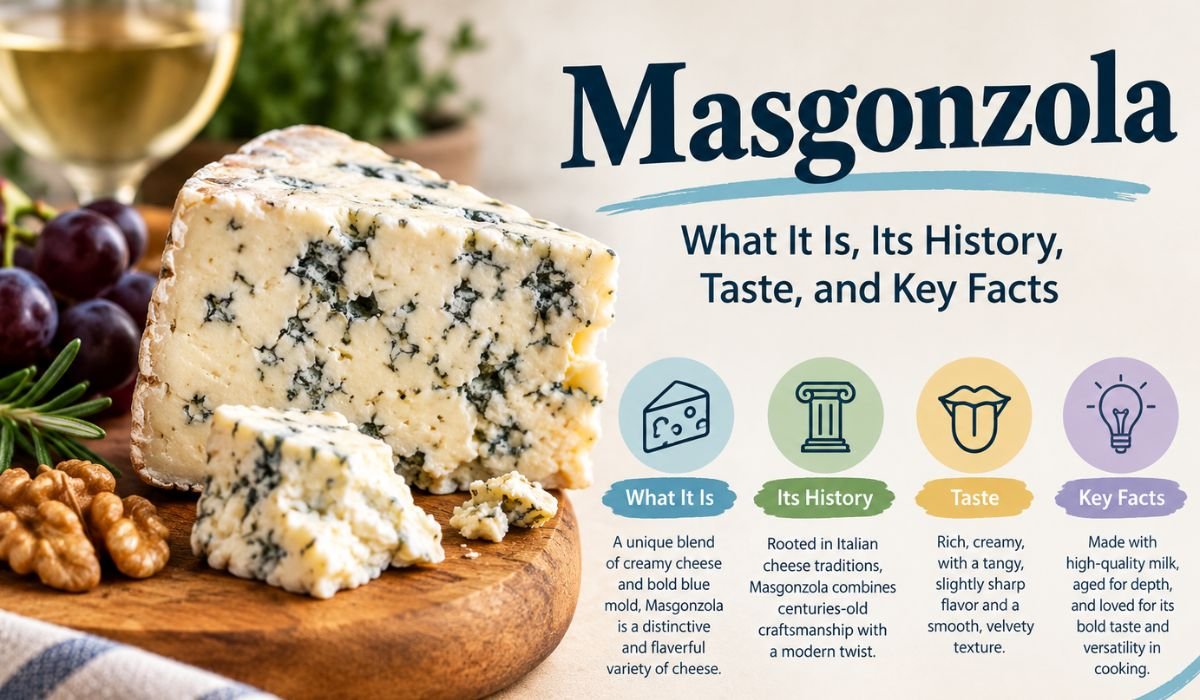
Masgonzola is one of those food names that can make people stop and ask a simple question: what exactly is it? The name sounds like a traditional Italian cheese, yet it is not as familiar as Gorgonzola, Mascarpone, Parmesan, or Mozzarella. The answer is especially interesting because Masgonzola is generally used for a creamy combination of Gorgonzola and Mascarpone, bringing together the bold character of blue cheese with the smooth richness of Mascarpone. Culinary sources, including Betty Bossi recipes, use Masgonzola as a convenient substitute for separate Gorgonzola and Mascarpone in dishes such as risotto.
This distinction matters because some online descriptions incorrectly present Masgonzola as an ancient, independently protected blue cheese. The better-supported explanation is more straightforward: Masgonzola is a Gorgonzola-Mascarpone specialty or combination, rather than a separately protected cheese with its own standardized production rules. Gorgonzola itself has a long history and protected DOP status in Italy and the European Union.
Quick Bio Information
Name: Masgonzola
Main Ingredients: Gorgonzola And Mascarpone
Food Type: Creamy Cheese Combination
Main Cheese Component: Gorgonzola
Creamy Component: Mascarpone
Flavor: Creamy, Tangy, Salty, Rich, And Mildly Pungent
Texture: Soft, Smooth, And Spreadable
Appearance: Creamy White With Blue-Green Gorgonzola Veining
Italian Connection: Strongly Associated With Italian Cheese Traditions
Protected DOP Status: No Separate Masgonzola DOP Has Been Established
Related Protected Cheese: Gorgonzola DOP
Best Known Uses: Pasta, Risotto, Bread, Crackers, Sauces, Pizza, And Cheese Boards
Main Dairy Allergen: Milk
Storage: Refrigerated
Nutrition: Varies According To The Gorgonzola-To-Mascarpone Ratio
Best Flavor Partners: Pears, Figs, Grapes, Walnuts, Honey, And Bread
Main Appeal: Blue-Cheese Flavor Combined With Extra Creaminess
What Is Masgonzola?
Masgonzola is generally understood as a combination of Gorgonzola and Mascarpone. The name itself appears to bring together part of “Mascarpone” and part of “Gorgonzola.” Rather than being an entirely separate cheese made according to one universal formula, it is better described as a specialty or preparation that combines the two dairy products.
The idea is easy to understand. Gorgonzola provides the blue-cheese character, including its salty, tangy and sometimes pungent flavor. Mascarpone contributes a very soft, rich and creamy texture with a much milder dairy taste. When they are brought together, the result is smoother and less aggressive than many people expect from blue cheese.
This combination is not merely an internet invention. Betty Bossi specifically uses Masgonzola as an alternative to separate Gorgonzola and Mascarpone in its Gorgonzola risotto recipe. That provides useful evidence for how the term is used in real culinary practice.
Why The Name Masgonzola Is Interesting
The name becomes much easier to understand when its two components are recognized. “Mas” points toward Mascarpone, while “Gonzola” points toward Gorgonzola. It is essentially a convenient name for a combination of two Italian dairy specialties.
This also explains why Masgonzola is sometimes misunderstood online. A reader who encounters the word without context could reasonably assume that it describes a centuries-old cheese variety. However, reliable evidence supports a more cautious description.
Gorgonzola has a documented historical identity, production rules, geographical connection, and DOP recognition. Masgonzola does not have the same separate protected status. The official Gorgonzola Consortium identifies Gorgonzola as a protected Italian cheese produced under regulated conditions.
The History Behind Masgonzola
The history of Masgonzola is best understood through the histories of its two principal ingredients rather than through an unsupported story about an ancient Masgonzola tradition.
Gorgonzola has deep roots in northern Italy. The official Gorgonzola Consortium traces its history back many centuries and states that the cheese is linked with territories in Lombardy and Piedmont. It was formally recognized as a designation of origin in Italy in 1955 and registered by the European Union as a DOP product in 1996.
Mascarpone is a very different type of dairy product, known for its exceptionally creamy texture and mild taste. Combining the two creates a practical culinary contrast: one ingredient supplies character and blue-cheese flavor, while the other adds richness and softness.
Therefore, rather than claiming that Masgonzola has an ancient independent history, it is more accurate to say that its identity comes from the meeting of two established Italian dairy traditions.
Is Masgonzola The Same As Gorgonzola?
No. This is one of the most important facts to understand.
Gorgonzola is a specific Italian blue cheese with DOP protection and established production requirements. The official consortium describes it as a creamy, soft, blue-veined cheese with mild and spicy styles. Gorgonzola Dolce is aged for at least 50 days and up to 150 days, while Gorgonzola Piccante is aged for at least 80 days and up to 270 days.
Masgonzola is different because it incorporates Mascarpone. This changes the texture, richness, and overall flavor balance.
So, although the names are closely connected, they should not be treated as interchangeable. Calling Masgonzola simply “another name for Gorgonzola” misses the important role played by Mascarpone.
What Does Masgonzola Taste Like?
Masgonzola generally offers a more balanced blue-cheese experience. The Gorgonzola contributes saltiness, tang, savory depth, and the characteristic flavor associated with blue-veined cheese. Mascarpone then adds a buttery, creamy quality that softens the overall impression.
The exact flavor can vary depending on the ingredients and proportions used. A preparation containing more Gorgonzola may taste stronger and more pungent, while a preparation with more Mascarpone can be softer and creamier.
This makes Masgonzola appealing to people who enjoy the idea of blue cheese but do not necessarily want the full intensity of a strongly flavored aged cheese.
Texture And Appearance
Texture is arguably one of Masgonzola’s biggest attractions. Gorgonzola can be creamy or firmer depending on its style, while Mascarpone is naturally soft and rich. Combining them produces a preparation that can be exceptionally smooth and easy to spread.
The appearance can also be distinctive. Depending on how the product is prepared, you may see pale creamy Mascarpone alongside the blue-green veining associated with Gorgonzola. Some preparations may look more blended, while others can show a stronger contrast between the two components.
The result is visually interesting without needing artificial colors or complicated presentation.
How Is Masgonzola Made?
There is no single universal production formula for Masgonzola in the same way that there are regulated requirements for Gorgonzola DOP. The basic concept is much simpler: Gorgonzola and Mascarpone are combined to produce a creamy cheese specialty.
Some versions may use a layered arrangement, while others may combine the cheeses more thoroughly. The ratio can also influence the final result. More Mascarpone generally means more creaminess and a softer dairy character, while more Gorgonzola increases the blue-cheese influence.
This is why it is important to check the individual product label when buying Masgonzola. The name alone does not necessarily tell you the exact proportions, ingredients, or nutritional values.
Masgonzola And Gorgonzola Compared
The simplest way to understand the difference is to think about intensity versus creaminess. Gorgonzola is the established blue cheese itself. Masgonzola adds Mascarpone to that foundation.
Gorgonzola has a defined identity under the DOP system, whereas Masgonzola does not have an equivalent separate protected designation. The official consortium also emphasizes that authentic Gorgonzola production is regulated and tied to its designated production area.
Masgonzola, meanwhile, is useful when a cook wants the flavor of Gorgonzola with an especially creamy texture. It can therefore be viewed as a culinary combination rather than a direct competitor to traditional Gorgonzola.
Masgonzola And Mascarpone Compared
Mascarpone alone is mild, rich, and creamy. It is famous in Italian desserts but can also be used in savory recipes.
Masgonzola has a much stronger personality because Gorgonzola introduces blue-cheese flavor. The Mascarpone then changes how that flavor is experienced by making the overall mixture richer and softer.
For someone who loves creamy dairy products but wants more savory character, Masgonzola offers a useful middle ground. For someone seeking the strongest traditional blue-cheese experience, plain Gorgonzola may be the more appropriate choice.
How To Use Masgonzola In Cooking
Masgonzola can be particularly useful in dishes where a creamy sauce or rich cheese flavor is desired. It can be spread over bread or crackers, melted into pasta sauces, stirred through risotto, or added to pizza and flatbreads.
Risotto is an especially clear example. Betty Bossi’s recipe combines Gorgonzola and Mascarpone in the finished risotto and specifically suggests replacing the two ingredients with 200 grams of Masgonzola.
Its rich flavor also works well with sweet ingredients. Pears, figs, grapes, honey, and walnuts can provide sweetness and freshness that balance the salty and tangy character of the cheese.
Masgonzola On A Cheese Board
A small amount of Masgonzola can bring plenty of personality to a cheese board. Because it combines creaminess with blue-cheese flavor, it can sit comfortably alongside milder cheeses without making the entire board taste overly pungent.
Fresh fruit is particularly useful. Pears and grapes add moisture and sweetness, while figs and honey create a deeper sweet-and-savory contrast. Walnuts can contribute a pleasant nutty texture.
Bread, crackers, and lightly toasted crostini are simple choices because their neutral flavor allows the cheese to remain the focus.
Masgonzola Nutrition And Health Considerations
There is no single universal nutritional profile for Masgonzola because it is not one standardized recipe. The nutritional value can change according to the amount of Gorgonzola and Mascarpone used.
For example, one documented 50/50 Gorgonzola-Mascarpone product provides approximately 369 calories, 35 grams of fat, 23 grams of saturated fat, 12 grams of protein, 1.5 grams of carbohydrates, and 0.7 grams of salt per 100 grams. These numbers should be treated as an example rather than a universal Masgonzola nutrition label.
This makes portion size worth considering. Masgonzola can provide protein and dairy nutrients, but it can also be rich in calories and saturated fat. People who need to limit sodium, saturated fat, or total calories should check the nutrition label of the particular product they purchase.
Milk allergy is another important consideration because both main ingredients are dairy products. Lactose tolerance can vary as well, so anyone following a lactose-restricted diet should check the specific product rather than assuming every Masgonzola preparation has the same lactose content.
How To Store Masgonzola
Because Masgonzola contains perishable dairy ingredients, refrigeration is important. Keep it chilled and follow the storage instructions printed on the package.
For an opened product, clean handling is especially important. Use clean utensils, avoid leaving the cheese at room temperature for unnecessarily long periods, and keep it properly wrapped or covered according to the manufacturer’s instructions.
The exact shelf life should not be treated as one fixed number because different products can have different formulations and packaging. The package’s use-by or best-before information is therefore more reliable than a general internet estimate.
What Makes Masgonzola Worth Trying?
The appeal of Masgonzola is its balance. Gorgonzola supplies the distinctive flavor that blue-cheese lovers recognize, while Mascarpone brings a soft and luxurious texture.
That combination also gives it practical value in cooking. A cook can use it to add richness to risotto, create a creamy pasta sauce, spread it on bread, or pair it with fruit on a cheese board.
Its unusual name also makes it an interesting food discovery. Once the connection between Mascarpone and Gorgonzola is understood, Masgonzola becomes much less mysterious.
Final Thoughts
Masgonzola is best understood as a creamy Gorgonzola-and-Mascarpone specialty, not as a mysterious ancient cheese with an independently established DOP tradition. That distinction makes the topic more interesting, not less.
Gorgonzola brings centuries of Italian cheesemaking heritage, a protected identity, characteristic blue-green veining, and a distinctive savory flavor. Mascarpone contributes exceptional creaminess and a mild dairy character. Together, they create a combination that can be rich, smooth, tangy, salty, and easier to approach than a strongly pungent blue cheese.
For anyone discovering Masgonzola in 2026, the most useful advice is simple: look at the actual ingredients and nutrition label, understand that formulations can vary, and try it in foods where its creamy character can shine. Whether spread on bread, folded into risotto, melted into pasta, or paired with fruit and nuts, Masgonzola offers a practical way to enjoy the meeting of two very different Italian dairy traditions.
FAQs About Masgonzola
What Is Masgonzola?
Masgonzola generally refers to a combination of Gorgonzola and Mascarpone. Gorgonzola contributes blue-cheese flavor and character, while Mascarpone adds richness and a soft, creamy texture. Culinary sources such as Betty Bossi use Masgonzola as a substitute for separate Gorgonzola and Mascarpone in recipes.
Is Masgonzola A Protected Italian Cheese?
No separate Masgonzola DOP designation has been established. Gorgonzola, however, is an officially protected Italian DOP cheese with regulated production and a defined geographical area. This is why Masgonzola should be described as a specialty or combination rather than as another protected Gorgonzola variety.
Is Masgonzola The Same As Gorgonzola?
No. Gorgonzola is the traditional Italian blue cheese, while Masgonzola generally combines Gorgonzola with Mascarpone. The addition of Mascarpone makes the preparation richer and creamier and can soften the intensity of the blue-cheese flavor.
What Does Masgonzola Taste Like?
Masgonzola can taste creamy, rich, salty, tangy, buttery, and mildly pungent. Its exact flavor depends on the ratio of Gorgonzola to Mascarpone and the characteristics of the particular product. A higher Gorgonzola content generally gives the mixture a stronger blue-cheese character.
How Can You Eat Masgonzola?
Masgonzola can be spread on bread or crackers, melted into pasta sauces, stirred into risotto, added to pizza, or served with fruit and nuts. Its creamy texture makes it particularly useful in recipes where you want both cheese flavor and richness.
Is Masgonzola High In Calories?
It can be. Because Mascarpone is rich in fat and Gorgonzola is also a calorie-dense dairy food, Masgonzola can contain substantial calories and saturated fat. One documented 50/50 product contains about 369 calories and 35 grams of fat per 100 grams, although other products may differ considerably.
Does Masgonzola Contain Milk?
Yes. Masgonzola contains dairy ingredients, generally Gorgonzola and Mascarpone, so it is not suitable for people with a milk allergy. Anyone with lactose intolerance or another dietary restriction should check the specific product label before eating it.
How Should Masgonzola Be Stored?
Masgonzola should be kept refrigerated because it is a perishable dairy product. Once opened, keep it properly covered, handle it with clean utensils, and follow the storage and use-by instructions supplied by the producer. Because products differ, there is no single shelf-life rule that applies to every Masgonzola product.
Learn more and explore exciting content on: Kian William Jarrahy: Biography, Family, Early Life, and Facts






Leave a Reply