
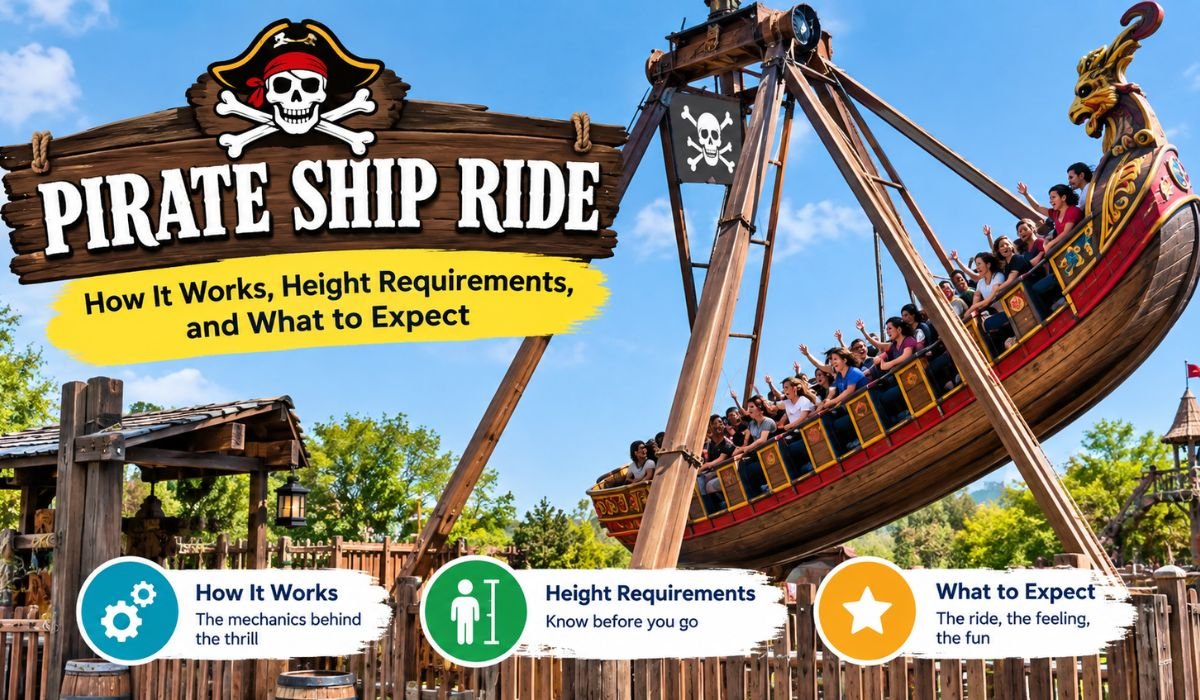
A Pirate Ship Ride is one of the most recognizable attractions at amusement parks, theme parks, and traveling fairs. Designed like a large pirate or Viking ship, the ride swings backward and forward while passengers sit inside the ship-shaped gondola. As the swing becomes higher, riders experience a stronger feeling of height, motion, and changing forces.
Although the basic idea is simple, modern Pirate Ship Rides come in many sizes and designs. Some are compact attractions for family parks, while larger models can carry dozens of passengers and swing through a wide arc. Manufacturers also offer different themes, lighting systems, ride cycles, and restraint arrangements.
This guide explains how a Pirate Ship Ride works, how high it can swing, what height requirements mean, what riders can expect, and how different versions compare. It also looks at major manufacturers, popular models, safety considerations, and unusual variations.
Quick Bio Information
| Fact | Information |
|---|---|
| Ride Type | Swinging Amusement Ride |
| Common Name | Pirate Ship Ride |
| Other Names | Swinging Ship, Viking Ship, Swing Boat |
| Main Movement | Back-and-Forth Pendulum Motion |
| Typical Theme | Pirate or Viking |
| Passenger Area | Open Boat-Shaped Gondola |
| Main Attraction Feature | Large Swinging Arc |
| Standard Ride Direction | Forward and Backward |
| Standard Inversion | No |
| Specialized Inversion | Possible on Related Designs |
| Example Manufacturer | HUSS |
| HUSS Model | Pirate Ship |
| Example Manufacturer | Zamperla |
| Zamperla Model | Galleon |
| Example Manufacturer | Chance Rides |
| Chance Model | Pharaoh’s Fury |
| Example Galleon Height | 14 Meters / 45.1 Feet |
| Example HUSS Full-Swing Height | 19.5 Meters |
| Example Galleon Capacity | 42 or 54 Seats |
| Main Requirement | Follow the Specific Park’s Current Rules |
What Is a Pirate Ship Ride?
A Pirate Ship Ride is a type of swinging amusement ride built around a boat-shaped passenger gondola. Instead of traveling along a track like a roller coaster, the ship moves backward and forward around a central pivot. The result is similar to a very large pendulum.
The design is often associated with pirates, but many parks use a Viking Ship Ride theme instead. The underlying ride concept can be very similar even when the appearance and name are completely different.
Modern examples can be surprisingly large. HUSS Park Attractions describes its Pirate Ship as a family-thrill attraction whose ship-shaped gondola can swing up to 75 degrees to either side. Its published specifications give a full-swing height of 19.5 meters and passenger capacities of 50 or 60, depending on configuration.
How Does a Pirate Ship Ride Work?
The basic movement of a Pirate Ship Ride is a controlled swinging motion. The passenger gondola is connected to a supporting structure around a central pivot. A mechanical drive system helps the ship build and maintain its movement.
At the beginning of a cycle, the ship normally starts with relatively small swings. The mechanical system increases the motion until the gondola reaches its programmed operating range. As the ship climbs toward one side, gravity slows its upward movement. It then changes direction and accelerates downward before climbing toward the opposite side.
This repeated motion creates the characteristic feeling of a swinging ship. Riders are not simply being lifted and lowered; their bodies are constantly responding to changes in direction and acceleration.
Different manufacturers use different engineering approaches. For example, Chance Rides describes its Pharaoh’s Fury as using an electric drive system and swinging passengers through a large arc. The manufacturer says the attraction can carry 40 adults or up to 60 children in its standard configuration.
What Does a Pirate Ship Ride Feel Like?
The experience changes throughout the ride. When the ship is near the middle of its swing, the motion can feel relatively controlled. As it climbs toward either end, the sensation of height becomes much more noticeable.
The highest portions of the swing are often where riders become most aware of the ride’s height. The ship slows as it approaches the end of its movement, changes direction, and begins its descent. That transition can produce the familiar stomach-drop sensation that many people associate with amusement rides.
The exact experience depends on the ride’s size, operating cycle, seating position, and design. Larger attractions can produce a more dramatic sense of height and motion, while smaller versions may feel more suitable for families.
How High Does a Pirate Ship Ride Go?
There is no single height for every Pirate Ship Ride. The dimensions depend on the manufacturer and specific model.
For example, Zamperla’s Galleon has a listed structure height of 14 meters, or about 45.1 feet. Its technical information lists a 19-by-8-meter footprint and a 42-adult instant capacity for the current configuration shown by the manufacturer.
HUSS lists its current Pirate Ship with a full-swing height of 19.5 meters. Chance Rides, meanwhile, describes its Pharaoh’s Fury as swinging in an arc more than 43 feet high on its product information.
These figures show why it is important to distinguish between the physical height of the ride structure and the height reached by the passenger gondola during its swing.
Pirate Ship Ride Height Requirements
Height requirements are not universal. Each attraction can have its own rules based on its design, restraint system, seating arrangement, and local operating requirements.
For example, Zamperla currently lists a minimum height of 105 centimeters, or about 42 inches, for its Galleon, with riders at 120 centimeters, or about 48 inches, able to ride unaccompanied according to the manufacturer’s published specifications.
HUSS lists an allowable passenger size of 1.10 to 1.95 meters for its current Pirate Ship model.
These figures should not be treated as a universal Pirate Ship Ride requirement. An individual amusement park may establish different restrictions. Before visiting, readers should always check the specific attraction’s current height rules and posted instructions.
Is a Pirate Ship Ride Safe?
Pirate Ship Rides are engineered amusement attractions with specific operating procedures, restraint systems, inspections, and passenger restrictions. However, the safety rules for one ride should not automatically be applied to another.
The U.S. Consumer Product Safety Commission identifies ASTM standards covering areas such as amusement-ride operation, maintenance, inspection, manufacturing, construction, dynamic characteristics, and design. Manufacturer documentation can also specify passenger loading, restraint use, inspections, and operating restrictions.
For riders, the most important practical step is to follow the instructions for the specific attraction. Passengers should use the required restraint correctly, remain in the assigned position, and follow directions from operators and attendants. Loose belongings should be handled according to the park’s rules.
Who Should Be Cautious on the Ride?
Every Pirate Ship Ride has its own posted warnings and restrictions. These may cover height, body size, restraint fit, seating arrangements, and other rider conditions.
People who are uncomfortable with heights or strong swinging motion may also want to understand the experience before boarding. The attraction can produce noticeable changes in motion as the ship climbs and descends.
Rather than assuming that every Pirate Ship Ride has identical requirements, visitors should read the attraction’s signs and listen to the operator. The specific ride’s rules are the most relevant source of information for that attraction.
Pirate Ship vs. Viking Ship vs. Swing Boat
The names can sometimes make these rides seem more different than they really are. A Pirate Ship and Viking Ship may use essentially the same basic swinging concept while having completely different themes.
A Swing Boat is a related term that is often used for smaller versions or designs where riders can have a role in creating the swinging movement. The term can therefore describe an attraction that looks simpler than a large mechanically driven amusement-park Pirate Ship.
The key difference is usually the design and operating system rather than the basic idea of a boat moving backward and forward. Parks and manufacturers can also give individual attractions their own names.
Different Types of Pirate Ship Rides
Pirate Ship Rides are available in permanent and portable forms. Permanent installations are commonly designed as major attractions inside amusement parks and can include extensive theming, lighting, and landscaping.
Traveling fairs use portable versions that can be transported and assembled at different locations. These rides need to be designed with transportation and setup in mind.
Some European fairground attractions also use unusual passenger arrangements. Certain versions allow riders to stand in specialized cages near the ends of the ship. These designs can swing dramatically without necessarily performing a full inversion.
The result is a broad family of attractions rather than one standardized machine.
Pirate Ship Ride Manufacturers
Several manufacturers have produced or continue to support swinging-ship-style attractions. Important names associated with this ride category include HUSS, Chance Rides, Fabbri, Intamin, SBF Visa, Zamperla, Zierer, SDC, and others.
Manufacturers often give their versions distinctive commercial names. Chance Rides, for example, offers Pharaoh’s Fury, which can also be themed as a Sea Dragon. The company describes the ride as a large swinging attraction with an electric drive system.
Zamperla calls its version Galleon and describes it as an all-time classic swinging ship. Its current published model information includes 42- and 54-seat configurations.
HUSS uses the name Pirate Ship for its current park version and emphasizes customization through theming, lighting, ride cycles, and special effects.
Pirate Ship Ride Capacity and Size
Capacity varies considerably between models. A smaller attraction may accommodate fewer passengers, while large commercial versions can carry dozens of people during each cycle.
Zamperla’s current Galleon information lists 42 or 54 seats depending on the configuration and gives a theoretical hourly capacity of up to 630 passengers for the listed model.
HUSS lists 50 or 60 passengers for its current Pirate Ship and theoretical maximum capacities of 1,500 or 1,800 passengers per hour, depending on configuration.
Chance Rides states that its Pharaoh’s Fury uses ten simultaneously loading seats and can accommodate 40 adults or 60 children in its standard configuration.
These numbers are manufacturer specifications, so actual park operations can vary.
Famous Pirate Ship Rides Around the World
One reason Pirate Ship Rides remain recognizable is their presence across many types of amusement venues. Different attractions may be called Pirate, Galleon, Sea Dragon, Bounty, Viking Ship, Ocean Motion, or another locally chosen name.
Some well-known examples include themed swinging ships at major amusement parks such as Chessington World of Adventures, Kings Island, Canada’s Wonderland, Efteling, Europa-Park, Knott’s Berry Farm, Cedar Point, and Legoland Windsor.
The names and installations can change over time, so current park information is more reliable than an old attraction list. A ride that appears in historical records may have been renamed, relocated, removed, or replaced.
Pirate Ship Ride Variations and Advanced Designs
The traditional Pirate Ship Ride normally swings without turning completely upside down. However, related attractions have pushed the concept much further.
One example is the Looping Starship, which combines the swinging motion of a ship-style attraction with full inversions. This creates a substantially different experience from a standard Pirate Ship.
Another related design is the Shuttle Boat, which uses a half-pipe-style track rather than relying solely on the conventional pendulum arrangement. Concepts related to this design later influenced attractions such as the Rockin’ Tug.
These variations demonstrate how manufacturers can take the basic idea of a swinging boat and create very different ride experiences.
Can a Pirate Ship Ride Go Upside Down?
A conventional Pirate Ship Ride does not normally go upside down. It swings backward and forward through an arc, reaching a high point on each side before changing direction.
Specialized rides can be different. A Looping Starship-style attraction is designed to perform inversions, so it should not be confused with a standard swinging ship.
This distinction is important because the term Pirate Ship Ride describes a broad ride family. The exact movement depends on the manufacturer and model.
Pirate Ship Rides at Amusement Parks vs. Traveling Fairs
Permanent amusement parks can build large Pirate Ship attractions with custom foundations, elaborate scenery, lighting, sound effects, and themed environments. These rides can become visual landmarks within a park.
Traveling fairs have different requirements because attractions must be transported and assembled repeatedly. Portable versions are therefore designed around practical installation and transportation considerations.
Despite those differences, both types provide the same basic appeal: a boat-shaped passenger carrier moving through a large swinging arc.
Why Are Pirate Ship Rides So Popular?
The appeal of a Pirate Ship Ride comes from its simple but effective combination of movement and height. Riders can see the ship climbing higher with every swing, creating anticipation before each descent.
Unlike a roller coaster, the attraction does not require a long track or a sequence of different elements. The repeated swinging motion becomes the central experience.
Themed designs also make a difference. A well-designed pirate ship can look like an adventure attraction even before anyone boards it. Modern manufacturers use custom theming, lighting, and effects to help parks create a stronger visual identity. Zamperla specifically promotes customized theming for its Galleon, while HUSS highlights theming and lighting options for its Pirate Ship.
What to Expect on Your First Pirate Ship Ride
A first ride usually begins with passengers entering the gondola and taking their assigned seats. Operators then check the loading area and required restraints before the cycle begins.
The first swings may be relatively modest. The movement gradually becomes larger, and the ship climbs higher on each side. Near the highest points, the ship changes direction before accelerating back toward the center.
As the cycle continues, riders may notice stronger sensations of height and changing acceleration. Eventually, the operating system reduces the motion and brings the gondola back toward its normal loading position.
The best preparation is simple: follow the attraction’s instructions, use the restraint as directed, keep the required seating position, and secure personal belongings according to the park’s rules.
Final Thoughts
The Pirate Ship Ride has remained a popular amusement attraction because its concept is easy to understand but surprisingly exciting to experience. A boat-shaped gondola swings through a large arc, creating changing sensations of height, acceleration, and direction without requiring a conventional roller-coaster track.
Modern versions show just how much the concept has developed. HUSS offers a large customizable Pirate Ship, Zamperla produces the Galleon in multiple configurations, and Chance Rides offers the Pharaoh’s Fury with different thematic possibilities.
For visitors, the most important point is that there is no single Pirate Ship Ride specification. Height, capacity, restraint systems, movement, and rider requirements can all differ. Checking the specific attraction’s current rules is therefore essential.
Whether it appears as a pirate vessel, Viking ship, galleon, or another themed boat, the basic attraction continues to offer a memorable combination of motion, height, anticipation, and classic amusement-park fun.
Frequently Asked Questions About Pirate Ship Rides
What Is a Pirate Ship Ride?
A Pirate Ship Ride is a boat-shaped amusement attraction that swings backward and forward around a central pivot. It is commonly themed as a pirate or Viking ship and can range from smaller family attractions to large amusement-park rides.
How Does a Pirate Ship Ride Work?
The ship is connected to a supporting structure and moves through a controlled swinging arc. A mechanical drive system helps produce the motion while gravity affects the ship as it climbs and descends.
How High Does a Pirate Ship Ride Go?
There is no universal height. For example, Zamperla lists its Galleon at 14 meters, while HUSS lists a 19.5-meter full-swing height for its current Pirate Ship. Individual models can therefore be substantially different.
What Is the Height Requirement for a Pirate Ship Ride?
Height requirements depend on the specific ride and park. Zamperla currently lists 105 centimeters as the minimum for its Galleon and 120 centimeters for unaccompanied riders. Other attractions can have different requirements.
Does a Pirate Ship Ride Go Upside Down?
A standard Pirate Ship Ride normally does not go upside down. It swings backward and forward. Specialized related attractions, such as Looping Starship-style rides, can perform inversions.
How Many People Can Ride a Pirate Ship?
Capacity depends on the model. Zamperla’s Galleon is offered in configurations with 42 or 54 seats, while HUSS lists 50 or 60 passengers for its current Pirate Ship. Chance Rides lists 40 adults or 60 children for its Pharaoh’s Fury configuration.
Is a Pirate Ship Ride Safe?
These attractions are designed with specific operating, inspection, restraint, and passenger procedures. Safety requirements differ by ride and jurisdiction, so riders should always follow the attraction’s posted restrictions and operator instructions. Industry standards cover areas including ride design, operation, maintenance, inspection, and restraint systems.
Is a Viking Ship the Same as a Pirate Ship Ride?
They can be essentially the same type of swinging attraction with different themes. One park may use a pirate theme while another uses a Viking theme, even though the underlying ride mechanism is similar.
Learn more and explore exciting content on: Jodi Lynn Calaway: Everything to Know About The Undertaker’s First Wife









Leave a Reply