
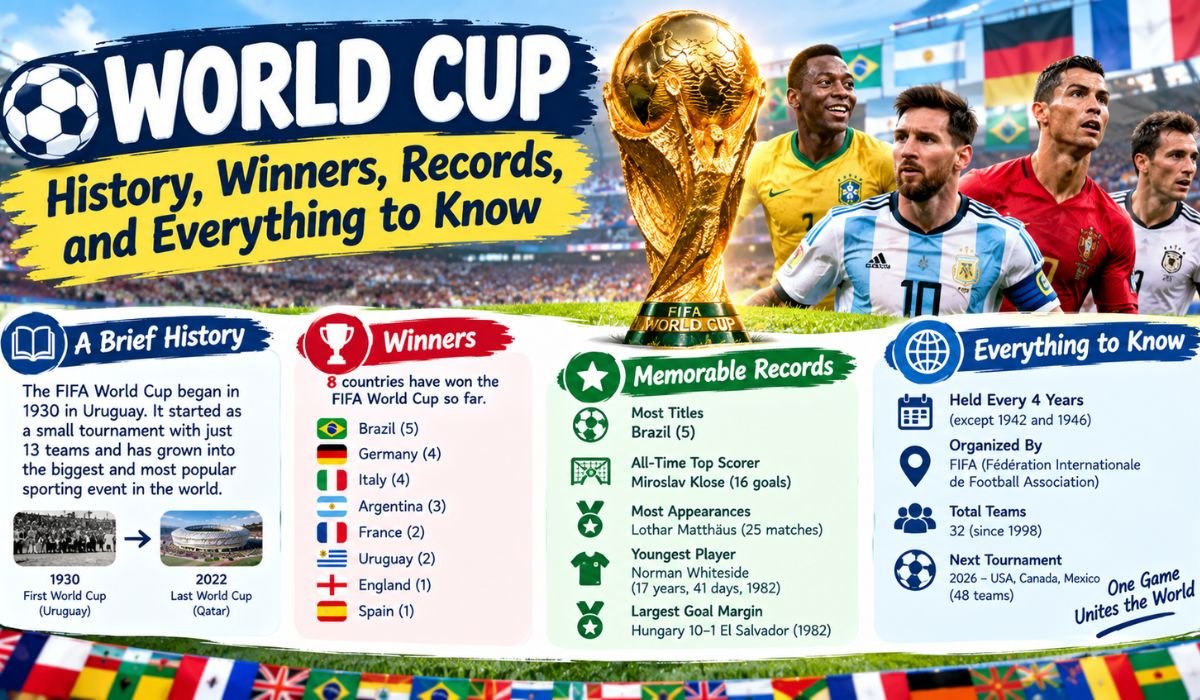
The World Cup Is One Of The Biggest Events In International Sports, Bringing Together National Football Teams And Millions Of Fans From Around The World. Every Four Years, Countries Compete For The Chance To Lift One Of The Most Recognized Trophies In Sports. For Players, Winning The World Cup Can Become The Greatest Achievement Of Their Careers, While For Supporters, It Creates Memories That Last A Lifetime.
Organized By The Fédération Internationale De Football Association (FIFA), The Men’s FIFA World Cup Began In 1930 And Has Grown From A Small International Competition Into A Global Sporting Celebration. Its History Includes Legendary Players, Dramatic Finals, Unexpected Victories, And Remarkable Records. Brazil Has Won The Most Men’s World Cup Titles, While Countries Such As Germany, Italy, Argentina, France, Uruguay, Spain, And England Have Also Written Important Chapters In The Tournament’s History.
The 2026 World Cup Marks A New Era With 48 Teams And Three Host Countries: The United States, Canada, And Mexico. Whether You Want To Learn About World Cup History, Past Champions, Tournament Rules, Famous Players, Or The Latest Format, This Guide Explains The Essential Details In Simple Language.
What Is The World Cup?
The FIFA World Cup Is An International Football Tournament In Which Senior Men’s National Teams Compete To Become World Champions. Unlike Club Competitions, Where Players Represent Professional Teams, The World Cup Brings Together Players Selected To Represent Their Countries. FIFA Organizes The Competition And Works With Regional Football Confederations To Manage Qualification And Other Tournament Arrangements.
The Men’s World Cup Is Usually Held Every Four Years. National Teams Must Generally Earn Their Places Through Regional Qualifying Competitions, Although Host Qualification Depends On FIFA’s Rules For Each Edition. The Tournament Is More Than A Series Of Football Matches. It Is A Global Event That Brings Together Different Cultures, Traditions, And Styles Of Play. Although This Article Focuses On The Men’s FIFA World Cup, FIFA Also Organizes The Separate Women’s World Cup, Which Has Its Own History, Champions, And Records.
Quick Bio Information

FIFA World Cup
Essential Tournament Facts
The World’s Leading Men’s International Football Championship
Organizing Body
FIFA
First Edition
1930
First Host
Uruguay
First Champion
Uruguay
Usual Frequency
Every Four Years
2026 Teams
48
2026 Hosts
USA, Canada, Mexico
Most Titles
Brazil, Five
2026 Matches
104
First Final Score
Uruguay 4–2 Argentina
Original Trophy Era
Jules Rimet Trophy
Current Trophy Introduced
1974
Qualification System
Regional Competitions
Competition Type
National Teams
Wartime Cancellations
1942 And 1946
Tournament Length
About One Month
History Of The World Cup
The Story Of The World Cup Began Long Before The First Tournament. International Football Was Developing Rapidly In The Late Nineteenth And Early Twentieth Centuries, But There Was No Dedicated Championship For The World’s Senior National Teams. The Olympic Games Helped Build Interest In International Competition, And Uruguay Won Olympic Football Gold In 1924 And 1928. These Victories demonstrated The Strength Of South American Football And Helped Build Support For A Separate World Championship. In 1928, FIFA Decided To Organize Its Own Tournament, And Uruguay Was Selected To Host The First Edition In 1930.
The First World Cup In 1930
The First FIFA World Cup Took Place In Uruguay And Featured 13 National Teams. Travel Was Expensive, Particularly For European Teams Crossing The Atlantic During The Great Depression, So Participation Was More Limited Than It Is Today. France And The United States Won The First Two Matches, Played On July 13, 1930. French Player Lucien Laurent Scored The First Goal In World Cup History. The Final Was Played At Estadio Centenario In Montevideo, Where Uruguay Defeated Argentina 4–2 In Front Of A Huge Crowd. Uruguay’s Victory Established The First Champion And Created A Tradition That Would Grow Into One Of The World’s Most Recognized Sporting Events.
How The World Cup Has Changed
The World Cup Has Expanded Considerably Since 1930. Early Editions Featured Relatively Few Teams, And International Travel Made Participation Difficult. The 1934 And 1938 Tournaments Continued The Competition In Europe, But World War II Forced FIFA To Cancel The Planned 1942 And 1946 Editions. The Tournament Returned In Brazil In 1950. Over The Following Decades, More Countries Qualified, Television Brought Matches Into Homes Around The World, And International Football Became More Commercially Important. The Finals Expanded To 24 Teams In 1982 And Then To 32 Teams In 1998. In 2026, The Men’s World Cup Reached Another Major Milestone By Expanding To 48 Teams.
How World Cup Qualification Works
Qualifying For The World Cup Is A Major Achievement Because FIFA’s Member Associations compete for a limited number of places in the finals. Regional confederations, including UEFA in Europe, CONMEBOL in South America, CAF in Africa, AFC in Asia, CONCACAF in North and Central America and the Caribbean, and OFC in Oceania, organize qualification according to the rules for each edition. Teams may play home-and-away matches, group fixtures, or playoffs, depending on their region. Results determine which countries advance, while the host arrangements and any intercontinental playoffs follow FIFA’s published regulations. Qualification can take several years, making the journey to the World Cup an important part of the tournament’s story.
The World Cup Tournament Format
The 2026 World Cup uses a format with 48 teams divided into 12 groups of four. Each team plays three group matches, earning three points for a win and one for a draw. Group position is determined using the official competition rules, including relevant tiebreakers. The top two teams from each group and the eight best third-placed teams progress to the Round of 32. From that point, the tournament uses knockout matches, meaning a team that loses is eliminated. If a knockout match is tied after normal time, extra time and, when necessary, a penalty shootout determine the winner. The surviving teams progress through the Round of 16, quarter-finals and semi-finals before the final decides the champion.
World Cup 2026 Hosts And Highlights
The 2026 World Cup was jointly hosted by the United States, Canada, and Mexico, making it the first men’s edition staged across three countries. The tournament featured 48 teams, 104 matches, and 16 host cities. Its expanded format gave more national teams the opportunity to compete on football’s biggest stage, while creating new travel and scheduling demands for teams and supporters. The final took place on July 19, 2026, at New York New Jersey Stadium, where Spain defeated Argentina 1–0 after extra time. Ferran Torres scored the decisive goal in the 106th minute, giving Spain its second men’s World Cup title after its 2010 triumph.
World Cup Winners By Year
The list of World Cup winners tells the story of changing football powers and different generations of players. Uruguay won the first title in 1930 and again in 1950. Italy won consecutive tournaments in 1934 and 1938, while Brazil became a dominant force with victories in 1958, 1962, and 1970. England won its only men’s World Cup in 1966, and Argentina lifted the trophy in 1978 and 1986 before adding another title in 2022. Germany won in 1954, 1974, 1990, and 2014, counting West Germany’s pre-reunification victories. France became champion in 1998 and 2018, while Spain won in 2010 and 2026. Italy’s later titles came in 1982 and 2006, and Brazil added championships in 1994 and 2002.
Countries With The Most World Cup Titles
Brazil leads the men’s World Cup standings with five championships, making it the most successful nation in the tournament’s history. Its winning teams across different eras became famous for skill, creativity, attacking football, and exceptional players. Germany and Italy have four titles each, reflecting decades of competitive consistency. Argentina has three championships, including its dramatic victory in Qatar in 2022. France, Spain, and Uruguay have two titles each, while England has one. These totals help explain the tournament’s historical balance, but title counts do not tell the whole story. Some countries have produced memorable teams without winning the final, while others have built their reputations through repeated appearances in the knockout stages.
Memorable World Cup Moments
World Cup history is filled with moments that remain part of football culture long after the final whistle. Argentina’s 1986 victory is remembered for Diego Maradona’s extraordinary performances, including two famous goals against England in the quarter-final. Brazil’s 1970 team became an enduring example of attacking football, while Italy’s 2006 triumph was decided by a penalty shootout against France. The 2014 semi-final, in which Germany defeated Brazil 7–1 on Brazilian soil, shocked fans around the world. More recently, Argentina’s victory over France in the 2022 final delivered a dramatic contest featuring goals, extra time, and a penalty shootout. These matches show why the World Cup is remembered for emotion and drama as much as for statistics.
Famous Players Who Made World Cup History
Great players often become global icons through their World Cup performances. Pelé helped Brazil win three titles in 1958, 1962, and 1970, although injury limited his contribution in 1962. Diego Maradona inspired Argentina’s 1986 championship with outstanding creativity and leadership. Lionel Messi captained Argentina to victory in 2022 after years of World Cup campaigns, adding the missing major international title to his career. Other influential players include Ronaldo Nazário, who helped Brazil win in 1994 and 2002; Zinedine Zidane, a key figure in France’s 1998 triumph; and Miroslav Klose, the men’s tournament’s all-time leading scorer with 16 goals. Kylian Mbappé has also made a major impact, scoring a hat-trick in the 2022 final despite France losing to Argentina on penalties.
World Cup Records And Statistics
World Cup records help explain the extraordinary achievements of players and national teams. Brazil is the only country to have participated in every men’s tournament through the 2022 edition, and it holds the record for the most titles. Germany’s Miroslav Klose leads the all-time scoring chart with 16 goals, ahead of Brazil’s Ronaldo Nazário with 15. Just Fontaine of France holds the record for the most goals in a single men’s World Cup, scoring 13 in 1958. Records also cover appearances, clean sheets, youngest and oldest players, and team performances. These statistics must be compared carefully because the number of matches, participating teams, and tournament formats have changed over time. The 2026 edition added new opportunities for records because it included more teams and matches than any previous World Cup.
World Cup Host Countries And Stadiums
Hosting the World Cup is a major responsibility that requires suitable stadiums, transport networks, accommodation, security, and planning for large crowds. Uruguay hosted the first tournament in 1930, and the competition has since visited countries across Europe, South America, North America, Asia, and Africa. South Africa became the first African host in 2010, while Qatar hosted the tournament in 2022. The 2026 edition brought together Canada, Mexico, and the United States. Famous stadiums have become part of World Cup history because they provide the setting for unforgettable matches. Hosting can bring tourism and international attention, but it can also involve significant public spending and long-term maintenance costs. A balanced assessment considers both the economic opportunities and the demands placed on local communities.
The FIFA World Cup Trophy
The World Cup trophy represents the highest prize in men’s international football. The original trophy was named the Jules Rimet Trophy in honor of the FIFA president who helped establish the competition. Brazil permanently kept that trophy after winning its third title in 1970, in accordance with the rules then in force. The original trophy was later stolen in Brazil in 1983 and was never recovered. The current FIFA World Cup Trophy was introduced in 1974. Made of gold, it depicts two human figures holding up the Earth. The trophy is distinct from the replicas and commemorative items associated with the tournament. Its design and history have made it one of the most recognizable symbols in global sport.
Why The World Cup Matters Beyond Football
The World Cup influences culture, business, travel, and national identity. During the tournament, fans gather in homes, public spaces, stadiums, and viewing venues to support their teams. The competition can introduce audiences to unfamiliar countries and football traditions, helping create shared experiences across borders. Hosting nations may benefit from tourism, hospitality spending, international exposure, and improvements to infrastructure. However, these benefits are not guaranteed and must be weighed against costs, construction pressures, and the use of public funds. Technology has also changed how fans experience the event. High-definition broadcasts, goal-line technology, video assistant referees, and digital coverage have transformed both match decisions and the way supporters follow the action. The World Cup’s significance therefore extends well beyond the 90 minutes played on the pitch.
Men’s World Cup And Women’s World Cup
The men’s FIFA World Cup and the FIFA Women’s World Cup are separate international competitions organized by FIFA. They have different histories, participating teams, champions, and tournament records. The men’s tournament began in 1930, while the first Women’s World Cup was held in 1991 in China. The women’s competition has expanded over time, with the 2023 edition featuring 32 teams for the first time. Both tournaments provide national teams with an opportunity to compete for a world championship and represent their countries on an international stage. Keeping their statistics separate is important when discussing titles, scoring records, appearances, and historic achievements. Together, the competitions reflect the global growth of football and the increasing visibility of the women’s game.
Final Thoughts
The World Cup Has Grown From A 13-Team Tournament In 1930 Into A Global Football Event Featuring 48 Teams In 2026. Its History Connects Generations Of Players And Supporters Through Historic Finals, Remarkable Records, Unexpected Victories, And National Celebrations. Brazil’s Five Titles, Argentina’s Recent Success Before 2026, And Spain’s Latest Championship All Show How The Competition Continues To Create New Chapters In Football History.
Beyond The Trophy, The World Cup Represents National Pride, International Competition, And The Ability Of Sport To Bring People Together. Its Formats And Technology Will Continue To Evolve, But The Central Goal Remains The Same: To Determine Which National Team Can Rise Above The Rest And Become World Champion. For Football Fans, That Combination Of History, Talent, Pressure, And Uncertainty Is What Makes The World Cup So Special.
FAQs About The World Cup
How Often Is The World Cup Held?
The men’s FIFA World Cup is normally held every four years. This schedule gives national teams time to complete qualification and prepare for the finals. The 1942 and 1946 tournaments were cancelled because of World War II, but the competition resumed in 1950.
Which Country Has Won The Most World Cups?
Brazil holds the record with five men’s FIFA World Cup titles. Its championships came in 1958, 1962, 1970, 1994, and 2002. Brazil remains one of the most successful and widely recognized national teams in football history.
Who Won The First World Cup?
Uruguay won the first FIFA World Cup in 1930. The host nation defeated Argentina 4–2 in the final in Montevideo, establishing itself as the competition’s inaugural champion.
Who Won The 2026 World Cup?
Spain won the 2026 men’s FIFA World Cup by defeating Argentina 1–0 after extra time in the final on July 19, 2026. Ferran Torres scored the winning goal in the 106th minute, securing Spain’s second World Cup title.
How Many Teams Play In The World Cup?
The 2026 men’s World Cup featured 48 national teams, an increase from the 32-team format used between 1998 and 2022. The teams competed in 12 groups before progressing to the knockout rounds.
Who Has Scored The Most World Cup Goals?
Germany’s Miroslav Klose holds the men’s FIFA World Cup all-time scoring record with 16 goals across four tournaments, from 2002 through 2014. His record reflects consistent performance across multiple editions.
Is The World Cup The Same As The Women’s World Cup?
No. The men’s FIFA World Cup and the FIFA Women’s World Cup are separate tournaments. Both are organized by FIFA, but they have different histories, championship records, and participating national teams.
Learn more and explore exciting content on: Russian Manicure: What It Is, How It Works, and Is It Safe?






Leave a Reply