
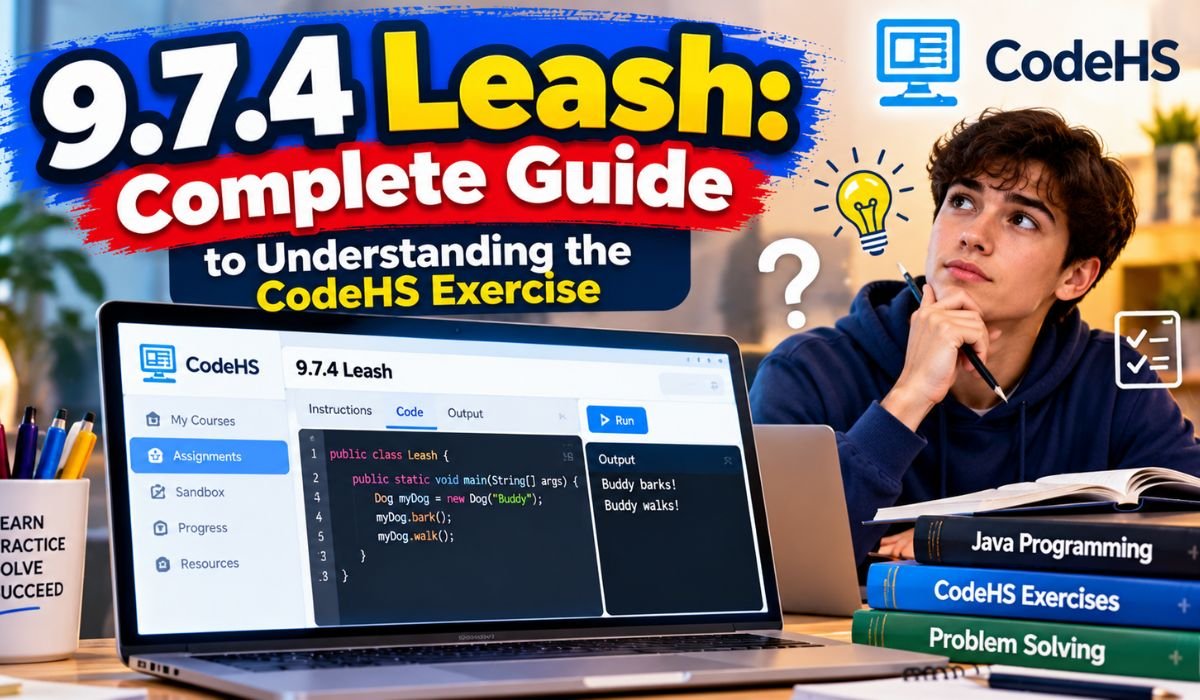
The 9.7.4 Leash exercise is a programming topic that students may encounter while working through CodeHS lessons. When an assignment has an unfamiliar name or number, understanding what the task requires can be just as challenging as writing the code itself. Students may wonder which programming concepts they need, how to approach the instructions, and what to do when their program does not behave as expected.
CodeHS is an educational platform that helps students learn programming through interactive lessons, coding exercises, and practice activities. Its courses introduce different concepts depending on the selected language and curriculum. However, the exact meaning of 9.7.4 Leash must be confirmed through the relevant lesson instructions because course versions can differ.
This guide explains how to approach the 9.7.4 Leash exercise, understand its requirements, recognize common programming mistakes, and test a solution effectively. Rather than relying on an unverified answer, it focuses on practical methods that help beginners understand their code and develop stronger programming skills.
Quick Bio Information: CodeHS And The Leash Exercise
The following reference table summarizes useful background information for students researching 9.7.4 Leash.
| Detail | Information |
|---|---|
| Exercise Name | 9.7.4 Leash |
| Educational Platform | CodeHS |
| Main Subject | Computer Programming |
| Intended Readers | Students And Beginners |
| Exact Course | Requires Verification |
| Programming Language | Requires Verification |
| Assignment Requirements | Defined By The Official Instructions |
| Starter Code | Check The Assigned Lesson |
| Main Learning Goal | Understand And Complete The Required Task |
| Possible Language Concepts | Variables, Functions, And Methods |
| Possible Graphics Concepts | Objects, Coordinates, And Events |
| Possible Java Concepts | Classes, Constructors, And Methods |
| Common Challenge | Understanding The Requirements |
| Debugging Method | Inspect, Test, And Correct |
| Testing Method | Compare Results With Expected Behavior |
| Recommended Resource | Official CodeHS Lesson Materials |
| Best Learning Approach | Solve The Task In Small Steps |
| Accuracy Consideration | Course Versions May Differ |
These details provide a starting point rather than a verified specification of the assignment. The exact language, learning objective, and required methods should be taken from the student’s actual CodeHS lesson.
What Is 9.7.4 Leash In CodeHS?
The name 9.7.4 Leash appears to identify a particular programming exercise, but the title alone does not establish its exact requirements. The number may represent a lesson or activity within a particular CodeHS course. The word Leash may describe the program being created or the programming concept being practiced.
The most reliable way to identify the exercise is to open the relevant CodeHS course and read its instructions. Students should examine the lesson title, programming language, starter code, and expected output. These details help establish whether the task involves graphics, object-oriented programming, or another subject.
This distinction matters because two exercises with similar names can require different approaches. A JavaScript graphics activity might involve moving objects or responding to mouse movement, while a Java assignment might involve creating a class and defining its methods. The correct explanation must match the actual lesson rather than assume that every version uses the same code.
What Is The Main Goal Of The Leash Assignment?
The main goal of any programming exercise is defined by its instructions, not simply by its title. Students should identify what the program must accomplish, what information it needs, and what behavior the finished solution should demonstrate.
For example, a graphics assignment might require an object to respond to user interaction. A class-based assignment might require a programmer to store information and provide methods for accessing or changing it. These examples illustrate different programming possibilities, not confirmed requirements for 9.7.4 Leash.
Once the assignment is open, read every instruction carefully before changing the starter code. Look for specific requirements, restrictions, expected results, and examples. If the lesson includes a sample output or diagram, compare it with the program you are expected to create. Understanding the intended result first makes it easier to plan the code and avoid unnecessary changes.
Which Programming Language Does The Exercise Use?
CodeHS offers courses in several programming languages, including JavaScript and Java. The language used for 9.7.4 Leash should therefore be confirmed directly in the relevant course.
JavaScript is commonly used for interactive web programming and educational graphics. Depending on the environment, students may work with variables, functions, objects, coordinates, and event handlers. Java, by contrast, is an object-oriented language in which students may practice classes, constructors, methods, and data types.
These languages have different syntax and programming conventions. A method call that works in one environment may not exist in another, even if the underlying idea is similar. Students should check the starter code and lesson instructions before searching for examples or adapting a solution. Matching the programming language and course version is an important first step toward finding accurate help.
Understanding The Assignment Instructions Step By Step
A useful way to approach the 9.7.4 Leash exercise is to break the instructions into smaller tasks. Start by reading the complete description without editing the code. Then identify the objects, variables, methods, or behaviors explicitly mentioned in the assignment.
Next, examine the starter code. Existing functions and declarations may show where new instructions belong. Comments can also explain what a particular section is expected to do. If the program already contains working code, preserve it unless the instructions clearly require a change.
After understanding the requirements, describe the expected behavior in plain language. This simple step turns an unfamiliar coding task into a problem that can be solved gradually. Work through one requirement at a time and compare the result with the original instructions. If something remains unclear, revisit the lesson instead of guessing what the exercise expects.
Important Programming Concepts Behind The Leash Exercise
The concepts required for 9.7.4 Leash depend on the verified assignment version. However, several common programming fundamentals are useful when approaching beginner exercises.
Variables store information that a program may need later. Functions group instructions into reusable sections, while methods perform actions associated with particular objects or classes. Parameters allow information to be passed into functions and methods, and return values allow computations to provide results.
If the exercise uses graphics, coordinates may determine where an object appears on the screen. Event handlers can respond to actions such as mouse movement or keyboard input. If the task uses Java classes, students may need to understand instance variables, constructors, getters, setters, and object creation.
The important lesson is to identify which concepts actually appear in the assignment. Learning a small number of relevant ideas in context is usually more effective than trying to understand every programming concept at once.
How To Approach The 9.7.4 Leash Exercise
Begin by reviewing the supplied code and determining which parts already work. Then establish what the assignment asks you to add, modify, or complete. This prevents unnecessary rewriting and helps preserve the intended structure of the program.
Before writing a complicated solution, think about the order in which the program should operate. Determine what information must be available first, which instructions depend on earlier steps, and what should happen when the program runs. If the assignment includes user interaction, consider what should happen before and after the interaction.
Make changes in small stages. Run the program after completing a meaningful section, then check whether the result matches your expectations. When an error appears, focus on the most recent change and investigate it before making additional edits. This method makes problems easier to isolate and gives students a clearer understanding of how their code works.
Understanding The Code Structure And Key Methods
Reading code carefully is an important skill for completing any CodeHS programming assignment. Instead of treating the starter code as a collection of unfamiliar symbols, examine how its different parts relate to one another.
In a JavaScript program, a variable might hold an object’s reference, a function might control its behavior, and an event handler might determine when that function runs. In a Java program, a class defines the structure of an object, while constructors and methods determine how objects are created and used.
Method names should be checked against the documentation or examples provided by the relevant course. Pay attention to capitalization, argument order, and expected data types. A method may be correctly spelled but still produce an incorrect result if it receives the wrong information.
Understanding these relationships is more valuable than memorizing a particular solution. Once students understand why a method is called and what information it uses, they can apply the same reasoning to other exercises.
Common Mistakes Students May Encounter
Beginners frequently encounter syntax errors, logic errors, and misunderstandings about assignment requirements. Syntax errors occur when code does not follow the language’s rules. Missing parentheses, unmatched braces, incorrect punctuation, and misspelled identifiers are common examples.
Logic errors are different because the program may run without displaying an error, yet produce the wrong result. A calculation may use the wrong variable, a condition may be incorrect, or an instruction may execute at the wrong time. These problems require checking the program’s behavior rather than simply correcting its syntax.
Another common mistake is copying code from a different course version. Even when an example appears similar, its methods or environment may differ from those used in the current exercise. Students should compare examples with their own starter code and confirm that the instructions match. Careful checking is usually more productive than repeatedly pasting alternative solutions.
How To Debug The Leash Programming Assignment
Debugging means finding and correcting problems in a program. For the 9.7.4 Leash exercise, begin by identifying exactly what is going wrong. Determine whether the code fails to run, produces an unexpected result, or behaves incorrectly only under certain conditions.
Read the error message carefully. It may identify a line number, an undefined variable, or a problem with a method call. The message does not always reveal the complete cause, but it can provide a useful starting point. Inspect the indicated line and the surrounding code to understand what information is being used.
If the program runs but behaves incorrectly, test the relevant section separately when possible. Check variable values, conditions, object properties, and method arguments. Change one thing at a time and run the program again. Keeping track of each change helps reveal which adjustment improves the result and which creates another problem.
How To Test Whether Your Solution Works
A program that runs successfully is not necessarily a correct solution. Students must also verify that it meets the assignment’s requirements. Begin by comparing the result with the expected behavior described in the lesson.
If the program accepts input, try different valid inputs rather than testing only one example. If it involves graphics or interaction, test the relevant actions in different positions or sequences. If it uses a class, check that its constructors and methods behave as intended.
Testing should also include situations that may expose mistakes. For example, consider what happens when a value changes, when an object is created with different information, or when an expected interaction occurs more than once. Only test conditions that make sense for the actual assignment.
Before submitting, review the original instructions again. Confirm that required behaviors are present, the program does not produce unexpected errors, and any restrictions have been followed. This final review can catch problems that are easy to overlook during coding.
Tips For Completing CodeHS Exercises Successfully
Successful programming begins with understanding the problem. Students should read the full assignment, examine the starter code, and identify the expected result before making changes. This habit reduces confusion and helps them recognize which programming concepts are relevant.
It is also useful to keep code organized and use meaningful variable names when the assignment permits them. Clear names make it easier to understand the purpose of a value and identify mistakes later. Students should follow the course’s required naming conventions whenever the instructions specify them.
Use available hints and learning materials to understand difficult concepts. When reviewing an example, focus on why each instruction is necessary rather than memorizing the final code. Practice explaining the solution in your own words. If you can describe what the program does and why it works, you are more likely to apply the same knowledge to future exercises.
What To Do If Your CodeHS Solution Is Not Working
When a solution fails, avoid assuming that the entire program needs to be rewritten. First, confirm that you are working in the correct lesson and programming language. Then compare your code with the original instructions to identify missing requirements or incorrect assumptions.
If the program displays an error, inspect the message and the relevant code. If it runs but produces the wrong output, review the logic, conditions, values, and order of operations. Restore an earlier working version if recent changes have made the problem harder to understand.
When the cause remains unclear, consult the course’s examples or ask a specific question about the section that is not working. Sharing the relevant instructions, code, and exact error message makes it easier for someone to provide useful help. Avoid sharing personal account information. The goal is to identify the underlying problem and understand how to correct it independently.
Final Thoughts On The 9.7.4 Leash Exercise
The 9.7.4 Leash exercise is best approached by first confirming the exact assignment and then working through its requirements systematically. The title alone is not enough to establish the programming language, expected output, or specific methods required.
Students can make progress by examining the starter code, identifying the relevant concepts, implementing changes gradually, and testing the results. When errors occur, careful debugging can turn a frustrating experience into an opportunity to understand programming more deeply.
Most importantly, learning to solve an exercise is about more than obtaining a correct result. It involves understanding how instructions, variables, functions, objects, and methods work together. These skills become increasingly valuable as programming tasks grow more complex.
FAQs About 9.7.4 Leash
What Is 9.7.4 Leash?
9.7.4 Leash is the name used to identify a programming exercise associated with CodeHS. Its exact requirements should be confirmed in the relevant course because the title alone does not establish what students must build or demonstrate.
Which Programming Language Does It Use?
The language must be checked in the assigned lesson. CodeHS offers courses in languages such as JavaScript and Java, and different languages require different syntax, methods, and approaches. Always use examples that match your course version.
How Can I Understand The Assignment More Easily?
Read the complete instructions, examine the starter code, and identify the expected behavior. Break the task into smaller steps and work through them individually. This makes it easier to understand the purpose of each change and recognize errors.
Why Is My Code Not Working?
Your code may contain a syntax error, an incorrect condition, a misspelled identifier, or a misunderstanding of the requirements. Read the error message, inspect the relevant lines, and test one correction at a time.
How Can I Check Whether My Solution Is Correct?
Compare your program with the assignment instructions and test every required behavior. Try relevant inputs or interactions, inspect unexpected results, and confirm that the solution follows any restrictions specified by the course.
Can I Use Code From Another Leash Exercise?
Another example can help explain a concept, but it should not automatically be treated as the correct solution. Confirm that the programming language, course version, and requirements match before adapting any code.
Where Can I Find Reliable Help For 9.7.4 Leash?
Start with the official CodeHS lesson, its instructions, starter code, and available learning materials. These sources are more reliable for identifying the exact task than discussions about exercises with similar names. When asking for help, include the relevant instructions and error message.
What Should I Learn From This Exercise?
The main lesson is to understand a programming problem, follow instructions carefully, and test your work systematically. The specific concepts depend on the verified assignment, but problem-solving, debugging, and reading code are useful skills across programming languages.
Learn more and explore exciting content on: Allysplay.com: A Complete Guide to Its Gaming Features and Content










Leave a Reply