
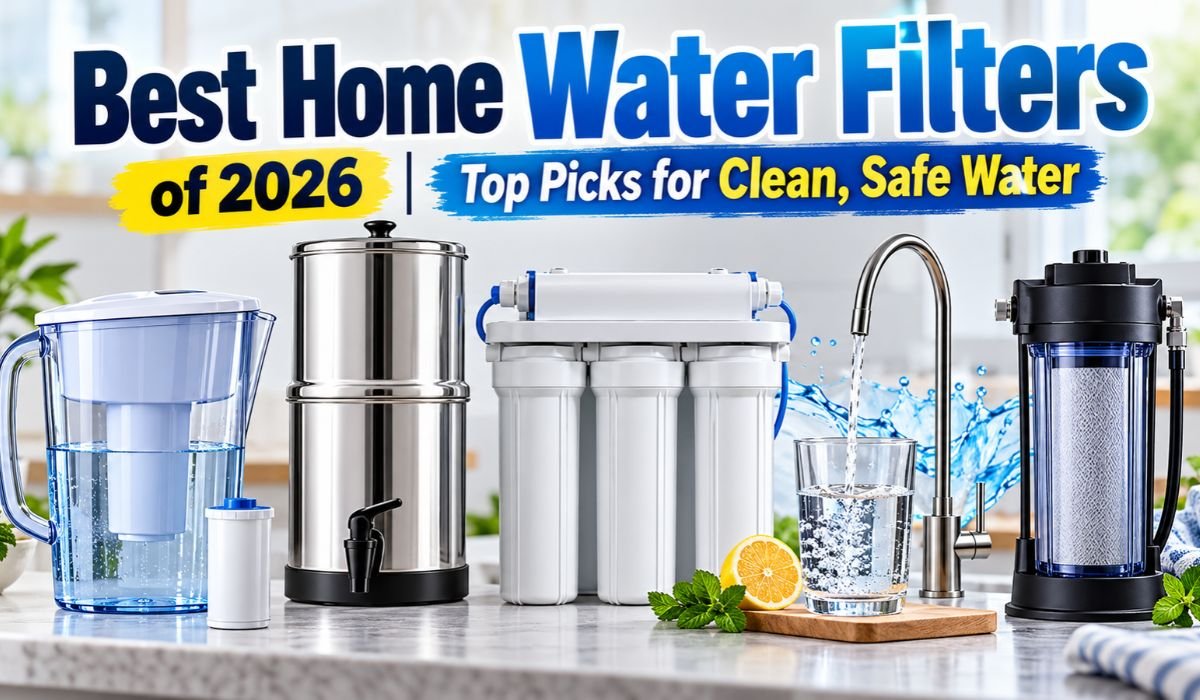
Clean drinking water is something every household deserves. Even when tap water looks perfectly clear, it may contain chlorine, sediment, dissolved minerals, or unwanted chemicals. While many public water supplies meet safety standards, some households need additional filtration to address specific water quality concerns. Choosing one of the Best Home Water Filters can help improve drinking water quality, reduce certain contaminants, and make everyday water use more convenient.
In 2026, homeowners have more filtration choices than ever, from affordable water filter pitchers to advanced reverse osmosis systems and whole-house filters. However, not every filter works the same way. Some improve taste and odor, while others target lead, PFAS, or dissolved substances. This guide explores leading filtration systems, their features, maintenance needs, and practical benefits to help you find the right solution.
What Are Home Water Filters and How Do They Work?
Home water filters are devices designed to reduce specific impurities in household water. They use materials such as activated carbon, specialized filtration media, or semipermeable membranes to separate unwanted substances from water.
Activated carbon filters commonly reduce chlorine-related tastes and odors. Reverse osmosis systems push water through a specialized membrane that can reduce many dissolved contaminants. Sediment filters capture particles such as sand, dirt, and rust, while ion exchange systems target certain dissolved ions.
The right technology depends on your water source and the contaminants you want to address. A pitcher filter may be sufficient for improving drinking water taste, while a household with confirmed contamination may need a more specialized system.
Before buying, review your local water quality report or arrange appropriate water testing. This helps you choose a filter that addresses actual concerns rather than paying for unnecessary features.
Best Home Water Filters of 2026: Quick Comparison
Several filtration systems stand out in the 2026 comparison published by WaterFilterGuru. Its reported evaluations consider contaminant reduction, design, filtration speed, installation, maintenance, and company policies.
The AquaTru Carafe leads the comparison with an overall score of 9.57 out of 10. Culligan ZeroWater follows among pitcher filters with 9.33, while Cloud RO scores 9.24 for under-sink reverse osmosis.
Other notable options include Waterdrop G3 P800 for tankless filtration, Clearly Filtered 3-Stage for non-RO under-sink treatment, and British Berkefeld for gravity filtration. SpringWell CF and Kind E-3000 address whole-house needs, while Weddell Duo specializes in shower water.
These scores come from the published third-party comparison, not testing conducted for this article. Because the products serve different purposes, the highest overall score does not automatically identify the best system for every home.
Quick Bio Information About Home Water Filters
| Feature | Helpful Information |
|---|---|
| Main Purpose | Reduce specific water contaminants |
| Popular Filter Type | Activated Carbon |
| Advanced Technology | Reverse Osmosis |
| Best Overall Pick | AquaTru Carafe |
| Best Pitcher Pick | Culligan ZeroWater |
| Best Under-Sink RO | Cloud RO |
| Best Tankless RO | Waterdrop G3 P800 |
| Best Non-RO Under-Sink | Clearly Filtered 3-Stage |
| Best Gravity Filter | British Berkefeld |
| Best Whole-House Tank Filter | SpringWell CF |
| Best Whole-House Cartridge Filter | Kind E-3000 |
| Best Shower Filter | Weddell Duo |
| Common Water Concerns | Chlorine, Lead, PFAS, Sediment |
| Important Certification | NSF/ANSI 53 |
| RO System Standard | NSF/ANSI 58 |
| Typical Installation | Pitcher, Countertop, Under-Sink, Whole-House |
| Maintenance | Cleaning And Filter Replacement |
| Main Buying Factor | Verified Contaminant Reduction |
AquaTru Carafe: Best Overall Home Water Filter
The AquaTru Carafe is a strong option for households seeking advanced drinking water filtration without installing equipment beneath the kitchen sink. It uses countertop reverse osmosis technology to reduce a broad range of contaminants.
In WaterFilterGuru’s published comparison, the AquaTru Carafe earned 9.57 out of 10, with particularly strong contaminant-reduction results. The review also reports IAPMO certification supporting the manufacturer’s contaminant-reduction claims.
Its countertop design makes it appealing to renters and homeowners who prefer a portable system. However, buyers should consider its purchase price, water capacity, electricity requirements, and replacement filters. Like other reverse osmosis devices, it also produces a wastewater stream.
For households prioritizing drinking water treatment over whole-house coverage, AquaTru Carafe deserves consideration.
Culligan ZeroWater: Best Water Filter Pitcher
Culligan ZeroWater offers a straightforward approach to improving drinking water without plumbing changes or complicated installation. Its pitcher-style design makes it suitable for apartments, small kitchens, and households with limited space.
The system uses multiple filtration processes, including ion exchange, to reduce dissolved substances. WaterFilterGuru awarded it 9.33 out of 10 and reported excellent results against health-related contaminants present in its tested water sample.
One important distinction is that low total dissolved solids readings do not automatically prove water is free from every harmful contaminant. Consumers should check the specific model’s certified reduction claims.
Replacement cartridge expenses also deserve attention because filter lifespan can vary significantly depending on the mineral content of incoming water.
Cloud RO: Best Under-Sink Reverse Osmosis System
Cloud RO is designed for households wanting filtered drinking water directly from a dedicated kitchen faucet. Its under-sink reverse osmosis system combines membrane filtration with remineralization.
According to the published review, Cloud RO earned 9.24 out of 10 and holds NSF/ANSI 58 certification for reverse osmosis performance. Its filtration approach targets a range of dissolved contaminants, while remineralization adds selected minerals after treatment.
This can improve the taste of water that might otherwise seem unusually flat.
However, installation requires suitable plumbing connections and enough cabinet space. Buyers should also account for cartridge changes, membrane maintenance, and wastewater production.
Cloud RO is particularly appealing to homeowners seeking a permanent drinking water filtration system.
Waterdrop G3 P800: Best Tankless Reverse Osmosis Filter
The Waterdrop G3 P800 offers a modern alternative to conventional reverse osmosis systems with separate storage tanks.
Its tankless design can save cabinet space while providing filtered water through an integrated system. The product received a reported score of 9.21 out of 10 in WaterFilterGuru’s comparison.
A notable feature is its advertised 3:1 pure-water-to-wastewater ratio under specified operating conditions. Actual efficiency may vary depending on water pressure, temperature, and incoming water quality.
Tankless systems can offer convenient water delivery, but they generally require electricity and specialized replacement cartridges. Buyers should compare certified contaminant reduction, filter availability, and long-term costs before deciding.
Clearly Filtered 3-Stage: Best Non-RO Under-Sink Filter
Not every household needs reverse osmosis. The Clearly Filtered 3-Stage system offers under-sink treatment without relying on an RO membrane.
It received a reported score of 9.18 out of 10 and was highlighted for its relatively simple installation process.
Its multi-stage filtration approach is designed to reduce selected contaminants while avoiding the wastewater stream typically associated with reverse osmosis.
Another advantage of many non-RO systems is that they retain more naturally occurring dissolved minerals.
However, mineral retention should not be confused with guaranteed contaminant removal. Buyers should review the manufacturer’s performance data and independent certifications for the exact model.
This system may suit households wanting convenient kitchen filtration without the additional complexity of reverse osmosis.
British Berkefeld: Best Gravity Water Filter
British Berkefeld provides an alternative for households that prefer filtration without permanent plumbing connections.
Gravity filters work by allowing water to pass through filtration elements using gravity rather than household water pressure. This makes them useful in certain off-grid settings and kitchens where installation flexibility matters.
The British Berkefeld system received a reported score of 9.08 out of 10. The source review identifies NSF/ANSI 42, 53, and 401 certifications for the evaluated configuration.
Filtration speed, however, depends on the filter elements, water conditions, and maintenance. Gravity systems also require manual refilling and regular cleaning.
Importantly, users should not assume every gravity filter makes microbiologically unsafe water safe to drink. Verified performance against the specific hazard remains essential.
SpringWell CF: Best Whole-House Water Filter
SpringWell CF is designed for households wanting filtration across multiple water outlets rather than only at the kitchen sink.
Installed near the main water supply entry, the system treats incoming water before distribution throughout the property.
The SpringWell CF earned a reported score of 8.52 out of 10. The reviewed system features a stated media capacity of up to one million gallons and an estimated ongoing treatment cost of $0.0013 per gallon.
Whole-house filtration may help address chlorine-related taste and odor concerns throughout the home, depending on the media and incoming water.
However, installation usually requires plumbing work, and the system must be sized for household water demand. It is also important to understand that whole-house filtration is not necessarily equivalent to water softening.
Kind E-3000: Best Whole-House Cartridge Filter
The Kind E-3000 is another whole-house filtration option, but it uses replaceable cartridges rather than relying entirely on a large media tank.
The reviewed model received a score of 8.51 out of 10 and offers a reported flow rate of 15 gallons per minute.
Flow rate is especially important in homes where several showers, faucets, and appliances may operate simultaneously.
Cartridge systems can simplify certain maintenance tasks, although replacement frequency depends on water usage, sediment levels, and manufacturer recommendations.
Homeowners should consider installation space, replacement cartridge availability, pressure loss, and ongoing expenses.
The Kind E-3000 may appeal to households seeking a cartridge-based approach to whole-house water treatment.
Weddell Duo: Best Shower Water Filter
Shower filters serve a different purpose from drinking water filtration systems. They primarily address selected substances in water used for bathing.
The Weddell Duo received a reported score of 9.19 out of 10 and is described as NSF/ANSI 177 certified.
That standard concerns free available chlorine reduction in shower filtration devices. It should not be interpreted as certification for removing every possible shower water contaminant.
Reducing chlorine may improve water odor and the showering experience, but claims about treating skin conditions or preventing hair loss require stronger evidence.
Before purchasing, check showerhead compatibility, operating flow rate, cartridge replacement requirements, and the exact certified performance claims.
Different Types of Home Water Filtration Technologies
Understanding filtration technology makes comparing the Best Home Water Filters much easier.
Activated carbon is widely used to improve taste and odor by adsorbing certain substances. Reverse osmosis membranes can reduce many dissolved contaminants, although performance varies by system.
Sediment filters capture suspended particles but generally do not remove dissolved chemicals. Ion exchange systems use specialized resins to exchange selected ions, making them useful for particular water treatment needs.
Ultraviolet treatment works differently. Properly designed UV systems can inactivate microorganisms, but they do not remove dissolved metals, chemicals, or sediment.
Some household systems combine several technologies to address multiple water quality concerns.
The most effective approach is to match the filtration method with verified test results rather than assuming that more filtration stages always mean better water.
How to Choose the Best Home Water Filter
Choosing the right filter begins with understanding your household’s water supply.
For municipal water, review the utility’s consumer confidence report and investigate any concerns related to plumbing or local contamination. Private well owners should arrange appropriate testing because well water is not routinely monitored like public water supplies.
Next, consider how much filtered water your household needs. Pitchers may be practical for limited drinking water use, while under-sink systems provide greater convenience. Whole-house systems serve broader treatment needs but require more space and investment.
Certifications are another important consideration. NSF/ANSI 42 addresses aesthetic effects, NSF/ANSI 53 covers specified health-related contaminant reduction claims, and NSF/ANSI 58 applies to reverse osmosis systems.
Always verify the exact model and contaminant claims rather than relying on a general certification logo.
Home Water Filter Costs, Installation, and Maintenance
The purchase price of a filtration system tells only part of the story. Replacement cartridges, installation, electricity, water usage, and occasional servicing can influence total ownership costs.
Pitcher filters generally require little setup, while under-sink systems may involve plumbing connections and dedicated faucets. Whole-house filtration often benefits from professional installation.
Maintenance is equally important. Filter cartridges have limited service lives, and their replacement intervals depend on water quality, usage, and manufacturer instructions.
Ignoring maintenance can reduce filtration performance and create hygiene concerns.
When comparing systems, estimate the total cost over several years rather than focusing only on the initial price. A more expensive system with longer-lasting media may sometimes cost less to operate than a cheaper alternative requiring frequent cartridge changes.
Are Home Water Filters Worth It?
Home water filters can be worthwhile when they solve a clearly identified water quality problem.
For some households, a simple carbon filter may improve unpleasant chlorine taste. Others may need certified filtration for lead, PFAS, or other confirmed contaminants.
However, many public water supplies already meet applicable drinking water standards. Extensive treatment is not automatically necessary for every home.
Filtration also has limitations. A device designed for taste improvement should never be assumed to make contaminated well water microbiologically safe.
The best investment is therefore not necessarily the most expensive system. It is the one that offers verified performance, manageable maintenance, and appropriate capacity for the household’s needs.
Final Thoughts
Finding the Best Home Water Filters of 2026 is ultimately about choosing reliable filtration for your household’s specific needs. AquaTru Carafe, Culligan ZeroWater, Cloud RO, and other leading systems offer different approaches to improving water quality, from portable drinking water treatment to comprehensive whole-house filtration.
The smartest decision starts with knowing what is in your water. Once you understand your water quality, compare independently verified contaminant reduction, maintenance requirements, installation needs, and long-term expenses.
A good home water filter should do more than promise cleaner water. It should provide dependable performance, fit naturally into your daily routine, and address the water quality concerns that actually matter in your home.
FAQs About Best Home Water Filters
What Is the Best Home Water Filter in 2026?
The AquaTru Carafe earned the highest overall score in the supplied WaterFilterGuru comparison. However, the best choice depends on water quality, budget, installation preferences, and required contaminant reduction.
Do Home Water Filters Remove Lead?
Some filters are specifically certified to reduce lead. Look for an appropriate contaminant-specific certification, such as an applicable NSF/ANSI 53 claim, rather than assuming every water filter removes lead.
Is Reverse Osmosis Better Than Carbon Filtration?
Reverse osmosis can reduce a wider range of dissolved contaminants, while activated carbon is often effective for selected chemicals and taste-related concerns. Neither technology is universally better for every household.
How Often Should Home Water Filters Be Replaced?
Replacement intervals vary by model, water quality, and usage. Follow manufacturer instructions and replace cartridges when their rated capacity or recommended service period is reached.
Are Whole-House Water Filters Worth Buying?
They can be worthwhile when treatment is needed throughout the property. However, they involve higher installation expenses and should be selected according to household flow requirements and confirmed water quality concerns.
Can Home Water Filters Remove PFAS?
Certain certified filtration systems can reduce specific PFAS compounds. Check the exact model’s independently verified reduction claims, because performance varies between technologies and products.
Do Water Filters Remove Healthy Minerals?
Reverse osmosis can reduce dissolved minerals such as calcium and magnesium. Many carbon-based filters retain most dissolved minerals. The nutritional importance of these changes depends on a person’s overall diet.
Learn more and explore exciting content on: Antarvafna Explained: Meaning, Inner Conflict, and Self-Awareness











Leave a Reply