
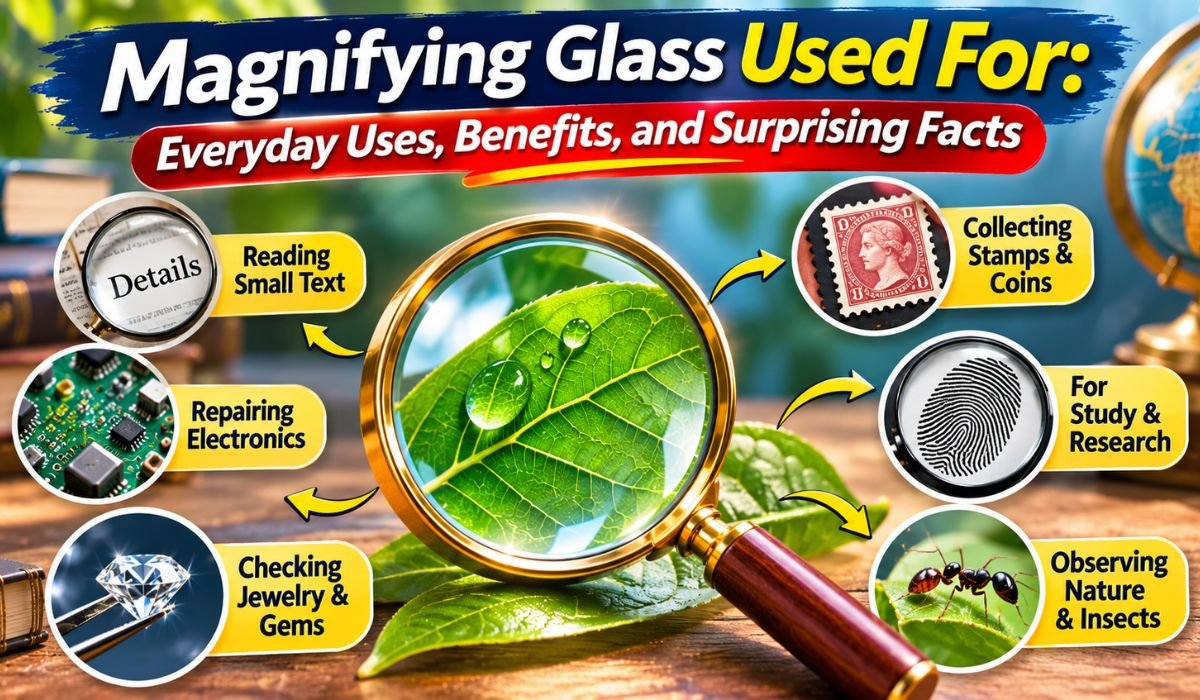
Have you ever struggled to read tiny letters on a medicine bottle or noticed beautiful details on a coin that were almost impossible to see? A magnifying glass makes these everyday discoveries easier. This simple optical tool helps people examine small objects, read fine print, and explore details that the naked eye might miss.
Understanding what a Magnifying Glass Used For can reveal how useful this familiar invention remains today. From classrooms and scientific laboratories to jewelry shops and household activities, magnifying glasses serve many practical purposes. Although modern technology offers advanced imaging devices, traditional magnifiers remain popular because they are affordable, portable, and easy to operate.
A magnifying glass is more than a reading tool. It also introduces important scientific ideas about light, lenses, and vision. Its history stretches back to ancient civilizations, while its familiar shape has become a universal symbol of searching and discovery.
What Is a Magnifying Glass?
A magnifying glass is an optical instrument that uses a convex lens to make nearby objects appear larger. A traditional model has a transparent lens mounted inside a frame, usually attached to a handle.
The convex lens bends incoming light, allowing the viewer to see an enlarged image when the object is positioned correctly. This makes small writing, delicate patterns, and fine surface details easier to examine.
Magnifying glasses come in different shapes and sizes. Some have large lenses for reading, while others are compact enough to fit inside a pocket. Modern designs may include LED lights, adjustable stands, or electronic displays.
Unlike microscopes, ordinary magnifying glasses are intended for relatively low-powered observation. Their simplicity makes them useful for students, collectors, professionals, and everyday readers.
Quick Bio Information About Magnifying Glass
Device Name
Magnifying Glass
Device Category
Optical Instrument
Main Purpose
Enlarging Apparent Images
Lens Type
Convex Lens
Optical Principle
Light Refraction
Typical Magnification
2× to 6×
Image Type
Upright Virtual Image
Traditional Design
Lens, Frame, Handle
Lens Materials
Glass or Plastic
Common Shape
Circular
Power Requirement
None for Basic Models
Lighting Option
Built-in LED
Early History
Classical Antiquity
Historical Contributor
Ibn al-Haytham
Medieval Researcher
Roger Bacon
Common Applications
Reading and Inspection
Specialized Alternative
Jeweler’s Loupe
Thin Lens Alternative
Fresnel Magnifier
Digital Symbol
Search and Zoom
Main Safety Concern
Concentrated Sunlight
What Is a Magnifying Glass Used For?
The main purpose of a magnifying glass is to help people see small details more clearly. It enlarges the apparent size of objects, making close inspection easier without requiring complicated equipment.
People commonly use magnifying glasses to read small labels, inspect coins, examine stamps, and observe natural objects. They are also helpful when checking tiny markings on electronic components or studying delicate jewelry.
In education, magnifiers allow children to explore insects, leaves, rocks, and other natural materials. Professionals use specialized magnifying lenses to inspect workmanship and identify visible defects.
The best magnifying glass depends on the task. A large reading magnifier provides a wider viewing area, while a smaller, more powerful lens is better suited to examining fine details.
How Does a Magnifying Glass Work?
A magnifying glass works through a scientific process called refraction. Refraction occurs when light changes direction as it passes between materials with different optical properties.
A convex lens is thicker in the middle than at its edges. Its curved surfaces bend light rays, allowing the lens to produce an enlarged view of a nearby object.
When an object is placed closer to the lens than its focal length, the lens creates an upright virtual image. The viewer perceives this image as larger than the original object.
The distance between the object, lens, and eye affects how clearly the image appears. Moving the lens gradually helps locate the sharpest viewing position.
This principle explains why a magnifying glass can make tiny letters readable without changing their actual physical size.
Everyday Uses of a Magnifying Glass at Home
Magnifying glasses are particularly useful for ordinary household activities. Reading product instructions, checking expiration dates, and examining small labels become easier with appropriate magnification.
People who enjoy sewing or crafting may use magnifiers to inspect stitching, identify small imperfections, or work with detailed patterns. Collectors often use them to study stamps, coins, and miniature objects.
A magnifying glass can also help identify tiny screws, examine watch markings, and inspect surface damage on household items.
For people with reduced near vision, magnifiers may provide additional assistance with reading. However, they cannot correct every vision problem, and some individuals benefit more from prescription glasses or specialized low-vision aids.
Magnifying Glass Uses in Science and Education
Magnifying glasses introduce students to scientific observation by making natural details easier to study.
Children can examine leaf veins, flower structures, insect features, and rock textures. These activities encourage curiosity and help develop careful observation skills.
Teachers frequently use magnifiers during introductory science lessons because students can operate them without complicated instructions.
In environmental education, handheld lenses help learners compare soil particles, plant surfaces, and natural materials.
Magnifying glasses are especially useful for examining visible structures, but they cannot reveal cells or microorganisms in the way a suitable microscope can.
Their educational value comes from encouraging students to look closely, ask questions, and connect observations with scientific explanations.
Professional Uses of a Magnifying Glass
Magnifying tools remain important in professions that require detailed visual inspection.
Jewelers use specialized loupes to examine gemstones, settings, and surface imperfections. Watchmakers rely on magnification when inspecting delicate mechanical components.
Electronics technicians use magnifiers to check solder connections, circuit boards, and small printed markings. Art conservators may examine paint surfaces, fine cracks, and restoration details.
Magnification also supports certain forensic examinations by helping investigators inspect visible marks, fibers, and material surfaces.
Professionals often choose advanced magnifiers with improved optical correction or integrated lighting. These features make detailed inspection more comfortable and reliable.
Although digital cameras and microscopes provide additional capabilities, optical magnifiers remain useful because they offer immediate visual access.
Different Types of Magnifying Glasses
Traditional handheld magnifying glasses are the most recognizable type. They usually feature a circular lens and handle, making them convenient for reading and casual inspection.
Illuminated magnifiers include built-in lighting that helps users see details under poor lighting conditions. Stand magnifiers hold the lens above an object, reducing the need to maintain a steady hand.
Jeweler’s loupes are compact magnifiers designed for examining gemstones, watches, and small manufactured objects. High-quality loupes may contain several lens elements to improve image clarity.
Fresnel sheet magnifiers use thin, concentric lens structures. Their lightweight design makes them convenient for enlarging printed material, although image quality varies.
Digital magnifiers use cameras and screens rather than relying only on direct optical viewing. Some models offer adjustable enlargement, contrast settings, and image capture.
Understanding Magnifying Glass Power
Magnification describes how much larger an object appears through a lens under specified viewing conditions.
A magnifier labeled 2× provides relatively modest enlargement, while a 10× magnifier is designed for more detailed observation. However, these ratings depend on the measurement convention and viewing arrangement.
Higher magnification generally reduces the visible area and may require the lens to be positioned closer to the object.
Lens quality also matters. Poorly designed lenses may produce blurred edges, color fringes, or distorted images.
For ordinary reading, moderate magnification with a larger viewing area is often more practical than extremely high power.
Understanding magnification helps buyers choose a device that balances image size, clarity, and comfort.
Benefits of Using a Magnifying Glass
One major benefit of a magnifying glass is its simplicity. Traditional models work without batteries, charging, or software.
Magnifiers are also portable and generally affordable, making them accessible to students, hobbyists, and everyday users.
They help people inspect details that would otherwise require uncomfortable close viewing. For certain tasks, this can improve accuracy and reduce unnecessary visual effort.
Magnifying glasses also encourage exploration. A familiar leaf, coin, or piece of fabric can reveal unexpected patterns when viewed through a lens.
Their usefulness extends across generations because they combine basic scientific principles with practical everyday convenience.
How to Use a Magnifying Glass Correctly
Using a magnifying glass effectively begins with proper positioning. Hold the lens between your eye and the object you want to examine.
Move the lens slowly until the image becomes clear and comfortable to view. For many tasks, keeping the object near the lens’s focal distance provides a convenient viewing arrangement.
Good lighting improves visibility. Position a lamp so the object is illuminated without creating distracting reflections.
Avoid choosing excessive magnification when a lower-powered lens provides enough detail. Higher magnification can make focusing more difficult and reduce the viewing area.
Keeping the lens clean also improves image quality. Use a suitable soft lens cloth rather than rough materials that could scratch the surface.
How to Choose the Right Magnifying Glass
Choosing a magnifying glass depends mainly on how you intend to use it.
For reading books and labels, a larger lens with moderate magnification often provides a comfortable viewing experience. Detailed inspection may require a compact loupe with greater magnifying power.
Lens material is another consideration. Glass lenses can offer excellent optical quality and scratch resistance, while plastic lenses are generally lighter and may be more resistant to breakage.
Built-in lighting can be helpful for people who work in dim environments. A comfortable handle or adjustable stand may also improve usability.
The best choice is not necessarily the most powerful or expensive magnifier. It is the one that provides clear images at a comfortable working distance.
Magnifying Glass vs. Microscope
A magnifying glass and a microscope both enlarge the appearance of objects, but they serve different purposes.
A magnifying glass typically uses a simple optical arrangement to help users inspect visible details. It is portable, inexpensive, and easy to operate.
A compound microscope uses multiple optical components to achieve much greater magnification and reveal structures that ordinary magnifiers cannot resolve.
For example, a magnifying glass may reveal the surface pattern of a leaf, while a suitable microscope can reveal individual plant cells.
Microscopes generally require more careful focusing, lighting, and specimen preparation.
For everyday inspection, a magnifying glass is often sufficient. For studying microscopic structures, a microscope is the appropriate instrument.
History and Invention of the Magnifying Glass
The history of magnifying lenses stretches back thousands of years. Ancient civilizations used shaped transparent materials and explored how curved surfaces affected light.
Greek writer Aristophanes referred to burning lenses in his play The Clouds, performed in 424 BC. Roman philosopher Seneca later described how a water-filled glass globe could enlarge small writing.
During the medieval period, scholars made important advances in understanding optics.
Ibn al-Haytham’s Book of Optics helped establish a more systematic scientific approach to light and vision. Roger Bacon later discussed the optical properties of lenses in thirteenth-century Europe.
Advances in lensmaking eventually contributed to the development of spectacles and more sophisticated optical instruments.
Because magnification developed gradually across different cultures, no single person can confidently be identified as the inventor of the magnifying glass.
Surprising Facts About Magnifying Glasses
A magnifying glass can do more than enlarge objects. A convex lens can concentrate sunlight into a small area, producing enough heat to damage materials or potentially start a fire.
Another interesting fact is its connection with detective fiction. Magnifying glasses became associated with careful investigation and the search for hidden clues.
This association eventually influenced digital design. Today, the magnifying glass symbol commonly represents search functions on websites, computers, and smartphones.
Magnifying lenses also share fundamental optical principles with other inventions, including spectacles, telescopes, and microscopes.
Despite their simple appearance, magnifying glasses demonstrate scientific ideas that helped shape modern optical technology.
Safety Tips and Limitations of Magnifying Glasses
Magnifying glasses are generally safe when used properly, but some precautions are important.
Never look directly at the Sun through a magnifying glass. Concentrated sunlight can cause serious eye damage.
A convex lens can also focus sunlight onto nearby materials, creating a burn or fire hazard. Magnifiers should not be left where direct sunlight can pass through them onto flammable surfaces.
Children should receive appropriate supervision when using magnifiers outdoors.
Optical limitations are also worth understanding. Higher-powered lenses may have narrow viewing areas, short working distances, and noticeable distortion.
For prolonged reading or specialized visual needs, an appropriate optical aid may provide better comfort than a basic handheld magnifier.
Why Is the Magnifying Glass a Symbol of Search?
The magnifying glass became associated with searching because it allows people to examine details that are difficult to notice.
Detective stories strengthened this connection by portraying investigators using magnifying lenses to study clues. Sherlock Holmes is particularly associated with the broader imagery of careful observation and investigation.
As computers became more common, software designers adopted the magnifying glass as a recognizable search symbol.
Today, the familiar icon appears in browsers, applications, online stores, and digital interfaces.
Its meaning has expanded beyond physical magnification. It now represents finding information, exploring content, and examining something more closely.
Final Thoughts
Understanding what a Magnifying Glass Used For shows how valuable a simple optical instrument can be. From reading fine print and studying nature to inspecting jewelry and electronic components, magnifying glasses support a remarkable range of activities.
Their usefulness comes from a straightforward scientific principle: a convex lens bends light to create an enlarged view of nearby objects. Over centuries, this principle has contributed to advances in education, scientific observation, and optical technology.
Even in 2026, when digital imaging devices are widely available, traditional magnifying glasses remain practical because they are portable, affordable, and easy to use.
Whether you’re exploring a hobby, completing a detailed task, or simply satisfying your curiosity, the right magnifying glass can help you notice details that might otherwise remain unseen.
FAQs About Magnifying Glass Used For
What Is a Magnifying Glass Mainly Used For?
A magnifying glass is mainly used to enlarge the apparent size of small objects and fine details. Common applications include reading small text, examining coins, inspecting jewelry, and observing natural materials. Specialized magnifiers are also used in professional inspection and educational activities.
How Does a Magnifying Glass Make Things Look Bigger?
A magnifying glass uses a convex lens to bend light through refraction. When an object is positioned within the lens’s focal length, the viewer sees an enlarged, upright virtual image. The object itself does not change size.
What Type of Lens Is Used in a Magnifying Glass?
A traditional magnifying glass uses a convex lens, which is thicker in the center than around its edges. This shape bends light in a way that allows nearby objects to appear larger when viewed from the correct position.
Who Invented the Magnifying Glass?
There is no universally accepted single inventor of the magnifying glass. Evidence of magnifying lenses exists from antiquity, while scholars such as Ibn al-Haytham and Roger Bacon contributed to the scientific understanding of optics during the medieval period.
Can a Magnifying Glass Help With Reading?
Yes. A magnifying glass can make small printed letters appear larger, helping some people read labels, books, and instructions more comfortably. However, individuals with significant vision difficulties may need specialized low-vision devices or professional eye care.
What Is the Difference Between a Magnifying Glass and a Microscope?
A magnifying glass is generally used for low-powered observation of visible objects. A microscope provides greater magnification and resolution, allowing users to examine much smaller structures, including cells when the instrument is suitable.
Can a Magnifying Glass Start a Fire?
Yes. A convex lens can concentrate sunlight onto a small area, creating intense heat. Under suitable conditions, this can ignite flammable materials. For safety, magnifying glasses should never be used to focus sunlight onto people, animals, or combustible objects.
Why Is a Magnifying Glass Used as a Search Symbol?
A magnifying glass represents searching because it helps people examine objects and discover details. Its association with investigation made it a natural choice for digital search icons, where it now symbolizes finding information and exploring content.
Learn more and explore exciting content on: Messi Argentina Age: Biography, Early Life, Career, and Untold Facts













Leave a Reply