
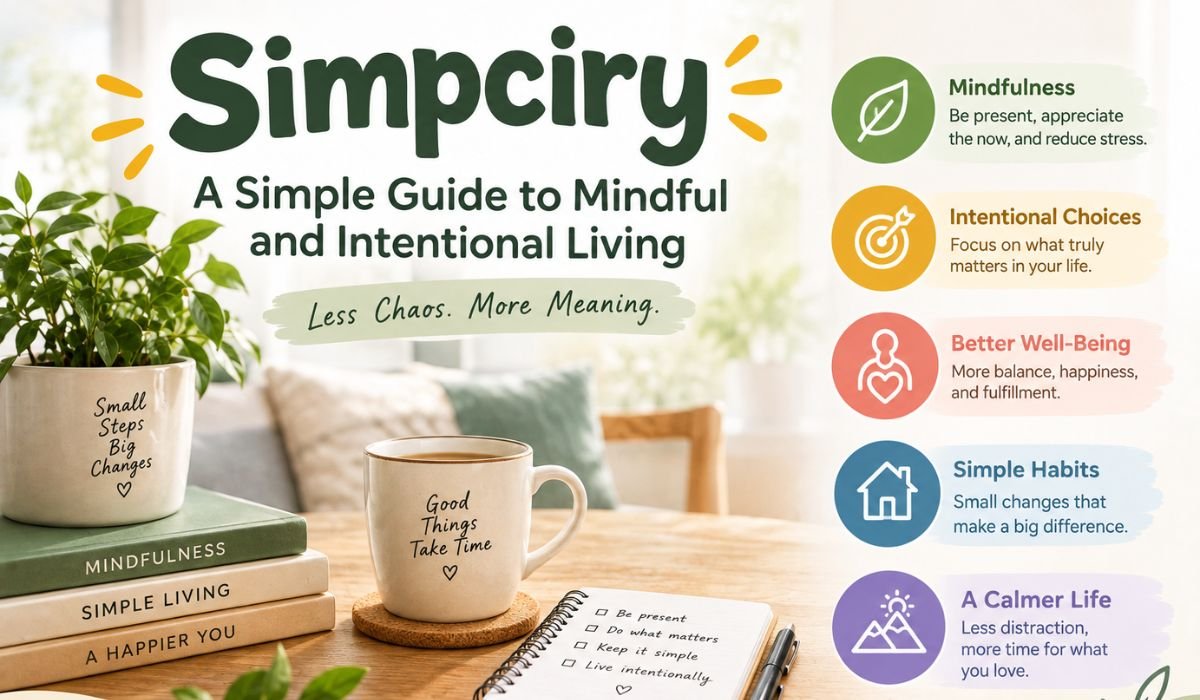
Modern life often feels crowded. There are endless notifications to answer, products to buy, tasks to finish, messages to read, and expectations to manage. Even when everything seems convenient, daily life can still feel complicated. This is where the idea of Simpciry offers an interesting way to think about Simple Living, Mindful Living, and Intentional Living.
Simpciry can be understood as an approach to reducing unnecessary complexity while giving greater attention to the things that genuinely matter. It is not about throwing away everything you own, avoiding technology, or refusing to enjoy modern comforts. Instead, it encourages people to become more deliberate about their time, possessions, attention, spending, relationships, and routines.
The term is not an established academic philosophy with one universally accepted definition. In modern online discussions, however, it is used to describe ideas that overlap with Minimalism, Mindfulness, Digital Simplicity, and intentional living. That distinction matters because it allows us to understand Simpciry as a flexible lifestyle concept rather than a strict set of rules.
Quick Bio Information
| Information | Details |
|---|---|
| Concept Name | Simpciry |
| Main Theme | Simplified Living |
| Related Idea | Intentional Living |
| Related Practice | Mindful Living |
| Physical Focus | Reducing Unnecessary Clutter |
| Digital Focus | Reducing Digital Distractions |
| Financial Focus | More Thoughtful Spending |
| Social Focus | Meaningful Relationships |
| Lifestyle Approach | Flexible And Personal |
| Main Goal | Greater Clarity And Purpose |
| Common Connection | Minimalism |
| Another Connection | Mindfulness |
| Philosophical Connection | Stoicism |
| Modern Connection | Digital Detox |
| Environmental Connection | Conscious Consumption |
| Daily Application | Simple Habits And Routines |
| Key Question | What Truly Matters? |
| Approach | Gradual Rather Than Extreme |
What Is Simpciry?
At its simplest, Simpciry means creating a life with less unnecessary complexity. The focus is not simply on having fewer things. It is on understanding what deserves your attention and removing distractions that add little value.
Imagine having a home where everything has a purpose, a schedule that leaves enough room for important responsibilities and rest, a phone that does not constantly interrupt you, and spending habits based on actual needs rather than impulse. These are examples of the kind of choices associated with a Simpciry Lifestyle.
The idea also involves awareness. Before saying yes to another commitment, buying another product, or spending another hour scrolling, a person can pause and ask whether that choice supports the life they actually want.
Simpciry Meaning: What Does It Represent?
The Simpciry Meaning becomes clearer when it is viewed through several connected ideas. Simplicity is about reducing unnecessary complications. Mindfulness is about paying attention to the present experience. Intentional living involves making choices based on personal values rather than automatically following habits or outside pressure.
Simpciry brings these ideas together. It can involve simplifying a physical environment, but it can also involve simplifying a calendar, digital life, spending habits, or social commitments.
There is no requirement to live in an empty house or follow a particular aesthetic. Someone may own many useful possessions and still practice intentional living. Another person may prefer a highly minimalist home. Both approaches can fit the broader principle of choosing deliberately.
The Core Principles of Simpciry
A Simpciry Lifestyle begins with one basic question: Does this add meaningful value to my life? The question can apply to objects, activities, subscriptions, habits, purchases, and even digital content.
This approach places quality before unnecessary quantity. It encourages people to protect their attention, spend money thoughtfully, make room for important relationships, and avoid adding commitments simply because everyone else seems to be doing so.
Another important principle is flexibility. Simplicity should support real life rather than become another source of pressure. A parent, student, business owner, retiree, or busy professional may all define a simple life differently. The goal is not perfection but greater alignment between daily choices and personal priorities.
Simpciry Vs. Minimalism
Simpciry And Minimalism have considerable overlap, but they do not have to mean exactly the same thing. Minimalism is often associated with reducing possessions and keeping only what is useful or meaningful. Simpciry can include this physical approach while extending the idea into other areas of life.
For example, someone might have a minimalist bedroom but still maintain an overloaded calendar and spend hours checking social media. A broader Simpciry approach would look at the entire lifestyle and ask whether the person’s time and attention are also being used intentionally.
This makes Simpciry less about a particular appearance and more about decision-making. The objective is not to make a home look empty for photographs. It is to make everyday life more manageable and meaningful.
How Mindfulness Connects With Simpciry
Mindfulness is closely connected to the idea because both encourage greater awareness. Instead of moving automatically from one task to another, mindful living creates opportunities to notice what is happening.
Scientific research on mindfulness is promising but should be described carefully. A 2026 systematic review and meta-analysis of 17 randomized controlled trials involving 1,641 participants examined mindfulness-based interventions and perceived stress. The researchers found evidence supporting stress-related benefits, while also noting the limits of the available research.
Earlier reviews have also found evidence for small to moderate improvements in some areas of psychological stress, although results differ depending on the outcome being studied. Research does not support treating mindfulness as a solution for every problem, and claims about improved attention or other cognitive abilities remain mixed.
For Simpciry, the practical lesson is straightforward: slowing down and paying attention can help people become more conscious of their habits and choices.
Simpciry And Intentional Living
Intentional Living means making choices with awareness instead of allowing every decision to be controlled by habit, advertising, social pressure, or convenience.
Start with personal values. One person may value family time above everything else. Another may care deeply about creativity, education, financial independence, travel, or community. Once those priorities are clearer, it becomes easier to recognize activities that support them and activities that simply consume time.
This does not mean every moment has to be productive. Rest, entertainment, hobbies, and spontaneous experiences can all be valuable. Intentional living simply means understanding why something has a place in your life.
Simpciry At Home
The home is one of the easiest places to begin. Instead of attempting a dramatic decluttering project, look at what you actually use. Items that are broken, duplicated, forgotten, or kept only because of guilt may deserve another look.
A simpler home is not necessarily a completely empty home. Family photographs, books, decorations, collections, and sentimental objects can have genuine value. The important question is whether your possessions serve your needs or create unnecessary work.
Environmental guidance also supports thinking beyond simply throwing things away. The U.S. Environmental Protection Agency recommends approaches such as refusing unnecessary items, reducing consumption, reusing products, repairing damaged items, and recycling when reduction, reuse, or repair are not possible.
Simplifying Your Daily Schedule
Time can become cluttered just as easily as a room. Meetings, errands, social events, notifications, unfinished tasks, and constant multitasking can leave little space for rest or concentration.
A simpler schedule begins with recognizing what genuinely needs your attention. Some activities may be essential, while others can be postponed, delegated, shortened, or removed.
Creating a realistic daily rhythm is often more useful than trying to fill every hour. A short period of quiet in the morning, focused work without constant notifications, and enough time between commitments can make a schedule feel less crowded.
Simpciry And Digital Simplicity
Digital clutter is one of the defining challenges of modern life. A phone can contain hundreds of applications, constant notifications, social media feeds, emails, advertisements, and messages. The technology itself is not necessarily the problem; the problem can arise when it continuously captures attention without serving a clear purpose.
Digital Simplicity means deciding how technology fits into your life. Turning off unnecessary notifications, removing unused applications, organizing digital files, and creating periods without social media can be practical starting points.
A device-free meal or a short period without checking messages can also create space for conversation and concentration. The goal is not to reject technology. It is to make technology serve your priorities rather than automatically controlling your attention.
Intentional Spending And Conscious Consumption
Simpciry can also influence the way people shop. Before buying something, pause and consider whether it is genuinely needed, whether it will be used regularly, and whether there is already something similar at home.
The Federal Trade Commission recommends comparison shopping, checking total costs, reading product details, examining reviews carefully, and understanding return policies before buying online.
This fits naturally with conscious consumption. Thoughtful purchasing can reduce unnecessary spending while also reducing the number of unwanted products entering the home. It can also encourage people to consider durability, repairability, reuse, and long-term value instead of focusing only on an immediate discount.
Simpciry And Meaningful Relationships
A simple lifestyle is not a lonely lifestyle. In fact, simplifying commitments can sometimes create more time for relationships that matter.
Meaningful relationships require attention. Being present during a conversation, sharing a meal without constantly checking a phone, remembering important moments, and making time for family or close friends can be more valuable than maintaining a huge number of weak social connections.
Simpciry therefore applies to social life by encouraging quality and presence rather than treating the number of contacts, invitations, or online followers as a measure of a successful life.
Benefits Of A Simpciry-Inspired Lifestyle
The potential benefits depend heavily on how a person applies the concept. A less cluttered environment may make household tasks easier. A simpler schedule may make priorities easier to see. More deliberate shopping can help prevent unnecessary purchases, while digital boundaries can create periods of uninterrupted attention.
There is also a psychological dimension. Mindfulness research provides evidence that certain mindfulness interventions can help with aspects of stress, although the strength of evidence varies across outcomes and populations.
It is better to view these as possible benefits rather than guaranteed results. Simpciry is a lifestyle framework, not a medical treatment or a promise of constant happiness.
How Simpciry Can Support Mental Clarity
Mental clutter can come from many sources. A crowded environment, unfinished tasks, constant notifications, financial worries, and too many commitments can all compete for attention.
Simplifying these areas may create a greater sense of order. For example, knowing the three most important tasks for tomorrow can be more useful than keeping a long list of everything that could possibly be done.
The important point is to avoid exaggeration. A simpler lifestyle cannot eliminate every source of stress. Work, family responsibilities, financial challenges, and unexpected events will still exist. Simpciry is better understood as a way of managing unnecessary complexity where you have some control.
Simple Simpciry Habits You Can Start Today
Starting small is often easier than attempting a complete lifestyle transformation. You might clean one drawer, unsubscribe from unwanted emails, remove unnecessary phone notifications, or postpone a purchase for a day before deciding.
Another useful habit is to create a short daily pause. A few quiet minutes can provide an opportunity to ask what deserves attention today and what can safely wait.
Over time, these small decisions can become habits. The objective is not to make life rigid. It is to make everyday choices more deliberate.
Common Mistakes With Simple Living
One common mistake is turning simplicity into another competition. There is no prize for owning the fewest possessions or having the emptiest room.
Another mistake is assuming that everyone must follow the same lifestyle. A large family will naturally need different possessions from a person living alone. Someone working remotely may need equipment that another person does not. Someone who enjoys cooking may reasonably own more kitchen tools than someone who rarely cooks.
Simplicity becomes counterproductive when it creates guilt, unnecessary restriction, or anxiety. The purpose should be to remove unnecessary complexity, not to create new rules that make life harder.
How To Create Your Own Simpciry Lifestyle
Creating your own version of Simpciry starts with observation. Look at your home, schedule, spending, digital habits, and relationships. Notice where you feel unnecessary pressure or where your attention repeatedly disappears.
Then choose one area. Making one meaningful change is often more sustainable than changing everything simultaneously.
You can review the result after a few weeks. If the change makes life easier, keep it. If it does not, adjust it. This experimental approach recognizes that simplicity is personal and can change as circumstances change.
Is Simpciry Right For Everyone?
There is no universal version of a simple life. People have different responsibilities, cultures, financial circumstances, careers, families, interests, and living environments.
For one person, simplicity might mean owning fewer clothes. For another, it might mean reducing unnecessary meetings. Someone else may focus primarily on digital boundaries or more thoughtful spending.
The most useful interpretation of Simpciry is therefore flexible. It should help people identify unnecessary complexity without forcing them into an unrealistic lifestyle.
Simpciry In The Modern World
The idea is particularly relevant in an environment where people have access to more information, products, entertainment, and communication than ever before. Convenience can save time, but constant availability can also create new forms of distraction.
Online shopping is a good example. Modern consumers can compare thousands of products within minutes, but the sheer number of choices can also encourage unnecessary purchasing. The FTC advises consumers to compare products and prices, check reviews critically, understand total costs, and examine return policies before buying.
Simpciry responds to this environment by encouraging a pause between desire and action. That pause can be surprisingly useful.
Final Thoughts
Simpciry: A Simple Guide To Mindful And Intentional Living is ultimately about making room for what matters. Its value does not come from having an empty home, following strict rules, or rejecting modern life. Instead, it comes from becoming more deliberate about the things that receive your time, money, energy, and attention.
A simpler life can look different for everyone. For one person, it may mean fewer possessions. For another, it may mean fewer digital interruptions, a calmer schedule, more careful spending, or more meaningful time with family.
The most useful question is therefore not, “How little can I have?” It is, “What genuinely deserves a place in my life?” That question captures the heart of Simpciry. By answering it honestly and making small changes over time, people can create a lifestyle that feels clearer, more purposeful, and better aligned with their own values.
FAQs About Simpciry
What Does Simpciry Mean?
Simpciry is used to describe an approach to simplified and intentional living. It focuses on reducing unnecessary complexity while giving greater attention to meaningful priorities. The concept can include physical decluttering, mindful habits, digital simplicity, conscious consumption, and meaningful relationships.
Is Simpciry The Same As Minimalism?
Not exactly. Minimalism commonly focuses on reducing possessions and unnecessary material consumption, while Simpciry can be broader. It may include simplifying time, technology, spending, relationships, and mental distractions as well as physical belongings.
How Can I Practice Simpciry Every Day?
Start with one small area of life. You could reduce unnecessary notifications, organize one part of your home, review your daily schedule, or pause before making nonessential purchases. Small changes are easier to maintain than extreme lifestyle changes.
Does Simpciry Mean Owning Fewer Things?
Not necessarily. Owning fewer things can be part of Simpciry, but the broader idea is intentionality. Useful, meaningful, or necessary possessions can remain part of a simple lifestyle.
Can Simpciry Reduce Digital Distractions?
It can provide a framework for reducing unnecessary digital interruptions. Turning off nonessential notifications, limiting social media, removing unused applications, and creating screen-free periods are practical examples of Digital Simplicity.
Is Simpciry A Philosophy Or A Lifestyle?
The term is best treated as a modern lifestyle concept rather than a formally established philosophical school with one universally accepted definition. It overlaps with established ideas such as Minimalism, Mindfulness, and Stoicism.
Can Simpciry Save Money?
It can encourage more thoughtful consumption by making people pause before buying unnecessary products. However, savings are not guaranteed. The financial effect depends on individual habits, circumstances, and spending decisions.
How Do I Start Living A Simpler Life?
Begin by identifying one area that feels unnecessarily complicated. Choose a small change, try it consistently, and review the result. The goal is not to create a perfect lifestyle but to gradually make daily life more intentional.
Learn more and explore exciting content on: Charlotte Hopkins: Biography, Career, Movies, TV Shows, and Known Credits




Leave a Reply