
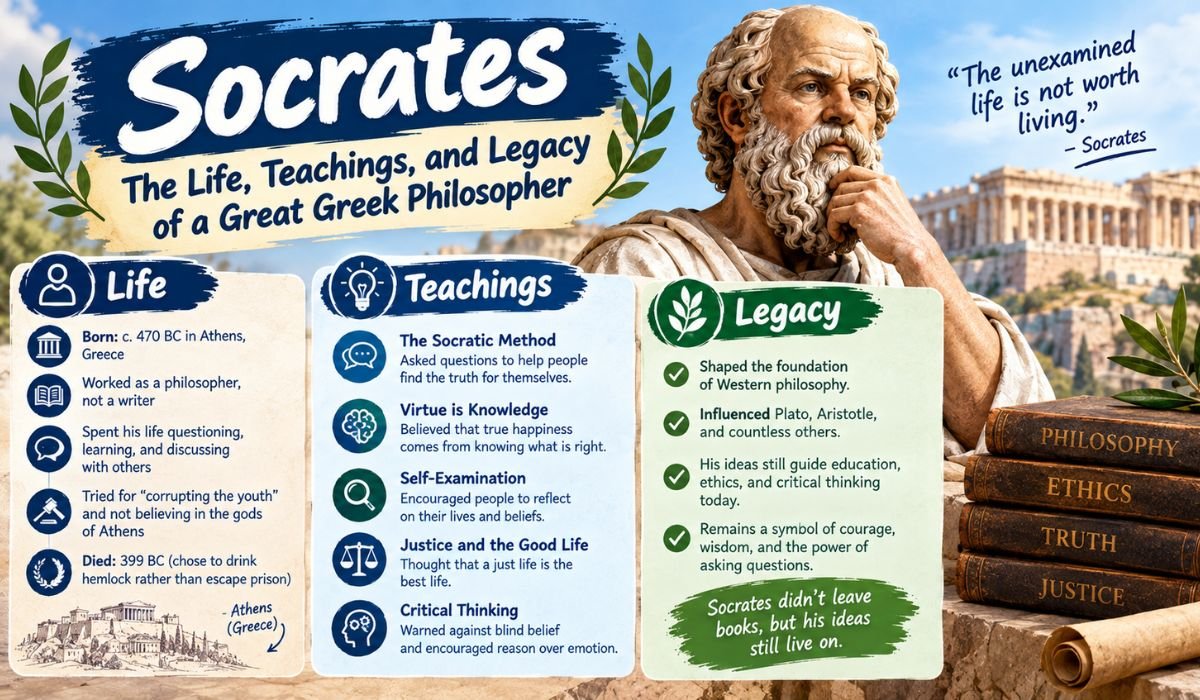
Socrates Was One Of The Most Influential Thinkers In Ancient Greek History. Born Around 470 BC In Athens, Greece, He Changed The Way People Thought About Knowledge, Morality, Justice, And The Meaning Of A Good Life. Unlike Many Famous Philosophers, Socrates Did Not Leave Behind Any Books Of His Own. Instead, His Ideas Survived Through The Writings Of His Students And Other Ancient Authors, Especially Plato And Xenophon.
What Made Socrates Different Was His Way Of Teaching. Rather Than Simply Giving People Answers, He Asked Questions That Encouraged Them To Think More Carefully About Their Beliefs. He Challenged Politicians, Poets, Craftspeople, And Ordinary Citizens To Explain What They Claimed To Know. Through These Conversations, He revealed How Easily Confidence Could Be Mistaken For Genuine Understanding.
His Commitment To Questioning Established Beliefs Eventually Brought Him Into Conflict With Athenian Authorities. In 399 BC, Socrates Was Tried, Found Guilty Of Impiety And Corrupting The Youth, And Sentenced To Death. His Story Became One Of The Most Famous Examples Of The Conflict Between Individual Conscience, Public Opinion, And Political Authority.
More Than Two Thousand Years Later, Socrates Remains An Important Figure In Philosophy, Education, And Critical Thinking. His Life Offers Valuable Lessons About Intellectual Honesty, Personal Responsibility, And The Courage To Question What Everyone Else Accepts As True.
Quick Bio Information
| Biography Detail | Information |
|---|---|
| Full Name | Socrates |
| Ancient Greek Name | Sōkrátēs |
| Birth Year | Around 470 BC |
| Birthplace | Alopece, Near Athens, Greece |
| Death Year | 399 BC |
| Place Of Death | Athens, Greece |
| Historical Period | Classical Greece |
| Main Occupation | Philosopher |
| Main Field | Ethics And Philosophy |
| Father | Sophroniscus |
| Mother | Phaenarete |
| Wife | Xanthippe Is The Best-Known Wife In Ancient Accounts |
| Children | Lamprocles, Menexenus, And Sophroniscus |
| Famous Student | Plato |
| Other Important Sources | Xenophon, Aristophanes, And Aristotle |
| Famous Teaching Approach | The Socratic Method |
| Major Interests | Knowledge, Virtue, Justice, And Self-Examination |
| Famous Work | No Known Books Written By Socrates Himself |
| Cause Of Death | Execution By Poisoning, Traditionally Associated With Hemlock |
| Lasting Legacy | A Major Influence On Western Philosophy And Critical Thinking |
Who Was Socrates?
Socrates Was An Ancient Greek Philosopher Who Lived During The Classical Period Of Athens. He Is Often Described As A Founding Figure Of Western Moral Philosophy Because He Focused Attention On Questions About Human Character, Justice, Virtue, And How People Should Live. Earlier Greek Thinkers Had Often Investigated Nature And The Origins Of The Universe, While Socrates Became Particularly Famous For Examining Human Conduct And The Meaning Of Important moral concepts.
He Did Not Establish A Formal School In The Same Way That Plato Later Established His Academy. Instead, Socrates Discussed Philosophical Questions In Public Spaces Around Athens, Speaking With People From Different Backgrounds. He believed That Philosophy Should Not Be Limited To Wealthy Citizens Or Professional Teachers. Anyone Could Examine Their Beliefs And Ask Whether Their Actions Reflected Their Values.
Socrates Also Had A Reputation For Living Simply And Showing Little Interest In Wealth Or Social Status. Ancient Accounts Describe Him As Someone More Concerned With Wisdom And Character Than With Material Comfort. However, Much Of What We Know About His Personality Comes From Writers Who Presented Him For Particular Purposes, So Historians Must Distinguish Between Historical Evidence And Later Interpretations.
Socrates’ Early Life And Family
Socrates Was Born Around 470 BC In Athenian Territory, In A Community Known As Alopece. His Father Was Named Sophroniscus, While His Mother Was Phaenarete. Ancient Traditions Commonly Describe His Father As A Craftsman And His Mother As A Midwife, Although The Details Of His Family Life Are Not Fully Documented.
Socrates Grew Up In Athens During A Period Of Major Political, Cultural, And Intellectual Change. The City Became An Important Center For Drama, Public Debate, Art, And Philosophy. Its Democratic Institutions allowed Eligible Male Citizens To Participate In Political Life, Although Women, Enslaved People, And Foreign Residents Did Not Enjoy The Same Political Rights.
These Conditions Help Explain Why Public Argument And Persuasion Played Such Important Roles In Athenian Society. Citizens Frequently Had To Evaluate Speeches, Defend Their Decisions, And Debate Questions Of Law And Justice. Socrates Developed His Questioning Approach Within This Environment, Where The Ability To Speak Persuasively Could Bring Both Influence And Recognition.
Details About His Early Education Remain Uncertain. Some Ancient Accounts Suggest That He Had Connections With Traditional Crafts And Military Service, But There Is No Reliable Complete Record Of His Childhood Or Formal Training. A Responsible Biography Therefore Focuses On The Historical Context Rather Than Inventing Stories About His Youth.
How Socrates Became A Philosopher
Socrates Became Known For Examining Questions That Many People Believed They Already Understood. Instead Of Accepting Common Definitions Of Justice, Courage, Or Wisdom, He Asked People To Explain What Those Words Actually Meant. He Then Tested Their Answers Against Different Situations To Discover Whether Their Ideas Were Consistent.
For Example, Someone Might Claim That Courage Means Never Being Afraid. Socrates Could Ask Whether A Person Who Takes A Foolish Risk Without Understanding The Danger Is Truly Courageous. The Discussion Would Then Move Beyond A Simple Definition And Explore The Difference Between Bravery, Recklessness, And Good Judgment.
This Approach Made Philosophy A Practical Activity Rather Than Merely An Abstract Subject. Socrates Encouraged People To Examine Their Everyday Decisions, Relationships, And Responsibilities. He Wanted Them To Think About Whether Their Actions Were Justified And Whether Their Understanding Was Strong Enough To guide Their Choices.
He Also Challenged The Idea That Wealth, Fame, Or Political Influence Automatically Made Someone Wise. In His View, A Person Could Possess Great Social Power Yet Understand Very Little About Virtue Or The Good Life. This Message Remains Relevant In Modern Society, Where Confidence And Public Recognition Are Sometimes Mistaken For Knowledge.
The Socratic Method Explained
The Socratic Method Is The Questioning Approach Most Closely Associated With Socrates. It Involves Examining An Idea Through A Series Of Questions, Testing The Answers, Identifying Contradictions, And Refining The Original Understanding. Rather Than Treating Learning As The Simple Transfer Of Information, It Encourages People To Participate Actively In Discovering What Makes An Argument Convincing.
Imagine A Student Says That Fairness Means Treating Everyone Exactly The Same. A Teacher Using Socratic Questioning Might Ask Whether Giving Identical Help To People With Very Different Needs Is Always Fair. The Student May Then Recognize That Fairness Sometimes Requires Considering Circumstances Rather Than Applying One Rule Without Exception.
This Method Does Not Guarantee That Every Conversation Will Produce A Final Answer. In Many Platonic Dialogues, Socrates And His Conversation Partners Reach An Impasse Because Their Original Definitions Fail Under Examination. This Result Can Still Be Valuable. Recognizing That An Answer Is Incomplete Is Often The First Step Toward A Better Understanding.
Today, Socratic Questioning Is Used In Education, Philosophy, Legal Reasoning, And Other Settings That Require Careful Examination Of Ideas. Modern Applications Vary, But The Central Principle Remains Similar: Ask Clear Questions, Examine Evidence, Challenge Assumptions, And Be Willing To Revise A Conclusion When The Reasoning Does Not Support It.
What Did Socrates Believe?
Socrates Is Best Known For His Interest In Virtue, Knowledge, And Ethical Living. He Encouraged People To Consider What Makes A Human Life Good Rather Than Measuring Success Only Through Money, Status, Or Popularity. Questions About Justice, Wisdom, Courage, And Self-Control Appeared Frequently In The Philosophical Conversations Associated With Him.
One Important Idea Linked To Socrates Is That People Should Understand What Is Right Before They Can Consistently Act Well. Plato’s Dialogues Often Present Socrates Exploring The Relationship Between Knowledge And Virtue. Some Interpretations Suggest That Wrongdoing Results From Ignorance Or A Failure To Understand What Is Truly Good, Although Scholars Debate How Best To Interpret These Arguments.
Socrates Also Emphasized The Importance Of Examining One’s Own Life. A Person Should Not Simply Follow Tradition, Public Opinion, Or Personal Desire Without Asking Whether Those Influences Are Reasonable. This Does Not Mean Rejecting Every Social Rule. It Means Understanding The Reasons Behind A Belief Before Treating It As A Guide For Living.
His Philosophy Encourages Intellectual Humility As Well. Socrates Frequently Exposed The Limits Of Other People’s Claims To Wisdom, And Platonic Dialogues Often Present Him As Aware Of How Much Remains Unknown. The Familiar Saying That He Knew He Knew Nothing Summarizes This General Theme, But It Should Not Be Treated As A Verified, Exact Quotation From His Own Writings.
Socrates On Knowledge, Virtue, And Ethics
For Socrates, Ethical Questions Were Closely Connected To The Way People Understood Themselves And Their Responsibilities. He Asked Whether Someone Could Truly Be Wise Without Acting Justly And Whether A Person Could Understand Courage Without Knowing When Fear Was Reasonable. These Questions Encouraged People To Examine The Connection Between Knowledge And Behavior.
Virtue Was Not Simply A Matter Of Following Rules Or Appearing Respectable. Socratic Philosophy Sought A Deeper Understanding Of Why Actions Were Good And What Kind Of Character They Expressed. Someone Might Perform A Generous Act To Gain Praise, For Example, But That Motivation Raises A Different Question From Helping Another Person Because It Is The Right Thing To Do.
Socrates’ Approach Also Suggests That Moral Reflection Requires Honesty. People Often Explain Their Decisions In Ways That Protect Their Reputation, Even When Their Actions Do Not Match Their Stated Principles. Questioning Such Contradictions can Help Individuals recognize where their beliefs and behavior have become disconnected.
Although Scholars Disagree About The Exact Shape Of The Historical Socrates’ Ethical Theory, His Central Questions Continue To Matter. What Does It Mean To Be Good? Can Knowledge Improve Character? How Should People Respond When Their Personal Interests Conflict With Justice? These Questions Help Explain Why Socrates Remains Relevant Far Beyond The Ancient World.
Famous Quotes And Ideas Associated With Socrates
Socrates Is Frequently Associated With The Saying, “The Unexamined Life Is Not Worth Living.” The Statement Comes From Plato’s Account Of Socrates’ Defense At His Trial, Known As The Apology. In That Context, Socrates Explains Why He Cannot Simply Abandon His Philosophical mission To Avoid Punishment. Examining Life Means Considering Whether One’s Beliefs And Actions Are Just, Reasonable, And Worth Following.
Another Familiar Expression Is “Know Thyself.” The Phrase Was Associated With The Temple Of Apollo At Delphi And Was Not Originally Coined By Socrates. Nevertheless, It Fits The Kind Of Self-Examination Commonly Associated With His Philosophy. Understanding Personal Limitations, Motivations, And Assumptions Can Help People Make Better Decisions.
The Saying “I Know That I Know Nothing” Is Also Widely Attributed To Socrates. It Summarizes His Intellectual Humility, But It Is Better Understood As A Modern Condensation Of Ideas In Plato’s Apology Rather Than A Securely Documented, Word-For-Word Quote.
When Including Famous Socrates Quotes In An Article, It Is Important To Identify The Source When Possible. Many Popular Sayings attributed to him circulate without reliable evidence. Explaining The Difference Between Historical Texts And Later Attributions Helps Readers Understand His Philosophy More Accurately.
Plato, Xenophon, And Other Sources About Socrates
Because Socrates Left No Known Writings, Historians Depend On Accounts Produced By Other People. Plato Is The Most Influential Source, Presenting Socrates In Dialogues That Explore Questions About Knowledge, Justice, Love, Virtue, And The Soul. Works Such As Apology, Crito, Phaedo, And Euthyphro Offer Different Views Of His Character And Philosophical Approach.
Xenophon Provides Another Important Perspective. His Memorabilia Defends Socrates Against Accusations Of Corrupting Young People, While His Apology Of Socrates Discusses The Trial And Its Outcome. Xenophon’s Presentation Often Emphasizes Practical Morality And Self-Control More Strongly Than Some Of Plato’s Philosophical Dialogues.
Aristophanes, An Athenian Comic Playwright, Presented A Comic Version Of Socrates In The Clouds. His Portrayal Is Not A Straightforward Biography, And It Should Not Be Read As A Neutral Record Of Socrates’ Beliefs. However, It Shows That Socrates Had Become A Recognizable Public Figure During His Lifetime.
Aristotle Was Born After Socrates Died And Therefore Did Not Know Him Personally. He Later Discussed Socratic Philosophy And Helped Preserve Important Interpretations Of His Ideas. Taken Together, These Writers Provide Valuable Evidence, But Their Differences Mean That No Single Source Can Tell Us Everything About The Historical Socrates.
The Socratic Problem
The Socratic Problem Refers To The Difficulty Of Determining What The Historical Socrates Actually Said, Believed, And Taught. Plato, Xenophon, And Aristophanes Wrote From Different Perspectives, And Their Portrayals Sometimes Conflict. Plato’s Dialogues Are Philosophical Works, Xenophon’s Accounts Have A Strong Defensive Purpose, And Aristophanes Used Comedy And Exaggeration.
Scholars Have Often Suggested That Some Of Plato’s Earlier Dialogues May Preserve More Of The Historical Socrates’ Questioning Style, While Later Dialogues Give Socrates A Greater Role In Developing Plato’s Own Philosophical Ideas. However, The Exact Boundary Between Historical Representation And Plato’s Original Thinking Is Uncertain.
This Problem Does Not Make Socrates’ Life Impossible To Study. Instead, It Requires Careful Comparison Of Sources And Honest Recognition Of Uncertainty. Historians Can Identify Broad Patterns In The Accounts While Remaining Cautious About Details That Cannot Be Independently Confirmed.
For General Readers, The Key Lesson Is Simple: A Story About Socrates Is Not Automatically A Direct Record Of His Words. Reliable Writing Should Explain Whether A Claim Comes From Plato, Xenophon, Or Another Ancient Author, Especially When Discussing Specific Conversations, Quotes, Or Details About His Private Life.
The Trial Of Socrates
In 399 BC, Socrates Faced A Trial In Athens That Became One Of The Most Famous Events In The History Of Philosophy. The Principal Accusations Concerned Impiety And Corrupting The Youth. In Simple Terms, His Accusers Claimed That His Relationship With Religion And His Influence On Young Athenians threatened important civic and moral expectations.
Plato’s Apology Provides The Best-Known Account Of Socrates’ Defense. In This Work, Socrates Explains His Philosophical Mission And Rejects The Idea That He Should Stop Questioning People Simply Because His Activities Have Made Him Unpopular. He Presents The Examination Of Wisdom And Virtue As A Serious Responsibility Rather Than A Hobby He Can Abandon For Convenience.
The Trial Took Place Against A Difficult political background. Athens Had Experienced The Peloponnesian War, The Defeat Of Its Empire, And The Rule Of The Thirty Tyrants Before Democracy Was Restored. Some People associated with Socrates, including Critias and Alcibiades, had controversial political histories. However, It Would Be An Oversimplification To Claim That These Associations Alone Explain The Verdict.
The Trial Demonstrates How Philosophical Debate Could Become Politically Sensitive. Socrates’ Questioning Challenged The Confidence And Reputation Of Influential Citizens, While His Defense Reflected A Commitment To Continuing His Work. The Exact Motivations Of His Accusers Remain A Matter Of Historical Interpretation.
Why Was Socrates Sentenced To Death?
Socrates Was Found Guilty And Sentenced To Death By An Athenian Jury. The Formal Charges Concerned Impiety And Corrupting The Youth, But The Wider Context Included Religious Expectations, Public Reputation, Political anxiety, And Disagreements About His Influence On Young Citizens.
His Teaching Style could make people uncomfortable because he questioned those who presented themselves as knowledgeable. Some Athenians may have viewed his activities as a challenge to respected traditions or established authority. His connections with controversial public figures also complicated how some citizens perceived him, even though association does not prove agreement with their actions.
Plato’s account suggests that Socrates refused to reshape his defense simply to win sympathy. He continued to defend the importance of philosophical examination rather than promising to abandon it. Readers should remember, however, that Plato wrote a literary and philosophical account of the trial, not a modern courtroom transcript.
The outcome remains a powerful example of the risks involved when an individual challenges prevailing beliefs. Yet It Is Important Not To Reduce The Trial To A Simple Story In Which One Side Represented Pure Truth And The Other Represented Pure Ignorance. Understanding The Event Requires Attention To The Religious, Political, And Social Conditions Of Ancient Athens.
The Death Of Socrates In 399 BC
After His Conviction, Socrates Remained In Athens And Eventually Died By Drinking Poison, Traditionally Identified As Hemlock. Plato’s Phaedo Provides The Most Famous Account Of His Final Hours. The Dialogue Describes Socrates Discussing The Soul, Death, And Philosophy With Friends Before His Execution.
Plato’s Crito Explores An Earlier Conversation In Which Socrates’ Friend Crito Urges Him To Escape. Socrates Examines Whether Escaping Would Be Just And Whether He Could Defend Such A Decision Through Reasoned Principles. In Plato’s Presentation, He Chooses Not To Flee, Although The Exact Historical Details Of These Conversations Cannot Be Verified Independently.
His Death Helped Shape His Later Reputation. Rather Than Being Remembered Only As A Teacher Who Asked Difficult Questions, Socrates Became A Symbol Of Commitment To Philosophical principles even when the consequences were severe. His story raises difficult questions about obedience to law, personal conscience, and the responsibility to act consistently with one’s beliefs.
The Phaedo Also Connects His Final Hours With Arguments About The Soul And The Possibility Of Life Beyond Death. These Arguments Belong To The Philosophical Dialogue And Should Not Be Confused With Scientifically Established Facts. Their Importance Lies In Showing How Plato Presented Socrates Facing Death Through Reasoned Discussion Rather Than Panic.
Socrates’ Students And Philosophical Associates
Plato Was Socrates’ Most Influential Student In The History Of Western Philosophy. His Dialogues Preserved The Most Famous Accounts Of Socrates And Inspired Generations Of Thinkers. Plato Later Established The Academy In Athens, Creating An Important Center For Philosophical Study.
Xenophon Was Another Student And A Major Source For Socrates’ Life. His Writings Present A Teacher Concerned With Practical Wisdom, Good Conduct, And Self-Control. Although His Portrayal Differs From Plato’s, It Helps Readers See That Socrates Was Remembered In More Than One Way.
Antisthenes Is Commonly Associated With Socrates And Is Often Linked To The Development Of Cynic Philosophy, Which Emphasized Virtue And Independence From Conventional Desires. Aristippus, Another Figure Associated With The Socratic Circle, Became Linked To The Cyrenaic School And Its Emphasis On Pleasure. Their Different Philosophical directions show that people influenced by Socrates did not all reach the same conclusions.
Alcibiades And Critias Also Appear In Ancient Accounts Connected With Socrates. Both Became Important and controversial political figures in Athens. Their associations with him are historically significant, but they should not be used to assume that Socrates approved of every action they took. The wider Socratic circle included people whose lives and ideas developed in very different directions.
Socrates’ Influence On Western Philosophy
Socrates’ Influence Continued Through Plato And The Philosophical Traditions That Followed. His Focus On Virtue, Knowledge, And The Examination Of Beliefs Helped Make Ethical Questions Central To Western Philosophy. Later Greek thinkers developed different approaches to happiness, self-control, and moral character while drawing on themes associated with his teaching.
Socratic Ideas Were Also Studied And Reinterpreted In Later Intellectual Traditions, Including Medieval Philosophy, Islamic scholarship, And Renaissance Humanism. His Legacy Reached Modern Philosophy Through Thinkers Who Engaged With Classical Greek Texts And Reconsidered Questions About Ethics, Truth, And Individual Responsibility.
In Modern Education, Socratic Questioning Remains A Recognizable Approach To Learning. Teachers Can Use It To Help Students Explain Their Reasoning, Evaluate Evidence, And Consider Alternative Interpretations. The Method Is Useful Not Because Every Question Has One Easy Answer, But Because Careful Discussion can reveal weaknesses in an argument and encourage deeper understanding.
Socrates’ Influence Also Extends Into Literature, Theatre, And Popular Culture. His trial and death continue to inspire stories about conscience, freedom of thought, and the relationship between individuals and society. His lasting importance comes from the questions he encouraged people to ask, rather than from a fixed set of written instructions.
Why Socrates Still Matters Today
Socrates Remains Relevant Because People Still Face The Same Basic Challenges Of Reasoning, Judgment, And Self-Understanding. Modern Technology Makes Information Easier To Access, But Access To Information Does Not Automatically Produce Wisdom. People Can Still Accept Misleading Claims, Follow Group Opinion, Or Confuse Confidence With Expertise.
His Questioning Approach Offers A Practical Way To Respond. Before Accepting A Claim, A Person Can Ask What Evidence Supports It, Whether The Terms Are Clearly Defined, And Whether The Conclusion Follows From The Reasons Given. These Questions Can Improve Discussions At School, At Work, And In Everyday Relationships.
His Ethical Philosophy Also Encourages People To Think Beyond Immediate Rewards. Success Is Often Measured Through Money, Status, And Public Approval, But Socrates’ Approach invites a deeper examination of character and responsibility. What Matters Is Not Only What A Person Achieves, But Also Whether The Methods And Choices Behind Those Achievements Can Be Defended.
At The Same Time, Questioning Should Not Become An Excuse To Reject Every Expert Or Treat All Opinions As Equally Reliable. The Socratic Approach Is Most Valuable When Questions Are Asked Fairly, Evidence Is Considered Seriously, And People Remain Willing To Correct Their Own Mistakes. Genuine Critical Thinking Requires Both Curiosity And Intellectual Discipline.
Final Thoughts
Socrates Changed The History Of Philosophy By Making The Examination Of Human Beliefs And Actions A Central Part Of Intellectual Life. His Questions About Knowledge, Virtue, Justice, And The Good Life encouraged people to look beyond appearances and consider whether their ideas could withstand careful examination.
His Life Also Shows The Importance Of Historical Evidence. Because Socrates Left No Known Writings, Readers Must Study The Different Accounts Of Plato, Xenophon, And Other Ancient Authors With Care. Their Works Preserve A Remarkable Philosophical Legacy, Even Though They Do Not Allow Us To Reconstruct Every Detail Of His Thoughts With Certainty.
Today, The Most Valuable Lesson Associated With Socrates Is Not That Everyone Should Doubt Everything. It Is That People Should Be Willing To Ask Meaningful Questions, Listen To Reasoned Answers, And Change Their Minds When The Evidence Requires It. That Habit Can Lead To Better Learning, More thoughtful decisions, and a deeper understanding of what it means to live well.
FAQs About Socrates
Who Was Socrates?
Socrates Was An Ancient Greek Philosopher Born Around 470 BC In The Area Of Athens. He Became Famous For Examining Questions About Knowledge, Justice, Virtue, And The Good Life. Although He Wrote No Known Books Himself, His Ideas Survived Mainly Through The Accounts Of Plato And Xenophon. He Is Widely Considered One Of The Foundational Figures Of Western Philosophy.
What Is Socrates Best Known For?
Socrates Is Best Known For The Socratic Method, A Form Of Questioning That Tests Ideas And Reveals Contradictions In People’s Reasoning. He Also Became Famous For His emphasis on self-examination, moral character, and intellectual humility. His trial and execution in 399 BC further shaped his historical reputation as a philosopher committed to his principles.
What Is The Socratic Method?
The Socratic Method Uses Questions To Help People Examine Their Beliefs And Understand The Reasons Behind Their Answers. Instead Of Immediately Giving A Solution, A Teacher Or Conversation Partner Asks Questions That Test Definitions, Evidence, And Logical Consistency. This Approach Can Help Learners Discover Weaknesses In Their Reasoning And Develop A More Careful Understanding Of Difficult Subjects.
Why Was Socrates Sentenced To Death?
Socrates Was Tried In Athens In 399 BC On Charges Of Impiety And Corrupting The Youth. His Questioning Of Established Beliefs And His influence on young citizens formed part of the wider context, although the exact motivations behind the verdict remain debated. He Was Found Guilty And Sentenced To Death By Poisoning, An Event Recorded Most Famously In Plato’s Dialogues.
How Did Socrates Die?
Socrates Died In Athens In 399 BC After Drinking Poison, Traditionally Identified As Hemlock. Plato’s Phaedo Describes His Final Hours And Presents Him Discussing Philosophical Questions With Friends. According To Plato’s Crito, Socrates Had An Opportunity To Escape But Chose To Remain In Athens. These accounts are important ancient sources, although the precise details cannot all be independently confirmed.
Did Socrates Write Any Books?
No Books Written By Socrates Himself Are Known To Survive. Most Information About His Life And Ideas Comes From Plato, Xenophon, And Other Ancient Authors. Plato’s Dialogues Are Especially Important Because They Present Socrates Examining Questions About Ethics, Justice, Knowledge, And The Soul. Since These Writers Had Different Purposes And Perspectives, Scholars Continue To Debate How Accurately Their Works Represent The Historical Socrates.
Who Was Socrates’ Most Famous Student?
Plato Is Generally Considered Socrates’ Most Influential Student Because His Philosophical Dialogues preserved the best-known portrayals of Socrates. Plato later established the Academy in Athens and became a major figure in Western philosophy. Xenophon Was Another Important Student Whose Writings Provide A Different Perspective On Socrates’ Character, Conduct, And Teachings.
Why Is Socrates Important Today?
Socrates Remains Important Because His Approach Encourages Critical Thinking, Honest Self-Examination, And Careful Ethical Judgment. His Questions About Justice, Virtue, Knowledge, And Responsibility Continue To Be Relevant In Education And Everyday Life. His Legacy Reminds People That Learning Involves More Than Collecting Information; It Also Requires Examining Assumptions, Evaluating Evidence, And Being Willing To Admit When An Answer Is Incomplete.
Learn more and explore exciting content on: World Cup: History, Winners, Records, and Everything to Know











Leave a Reply