
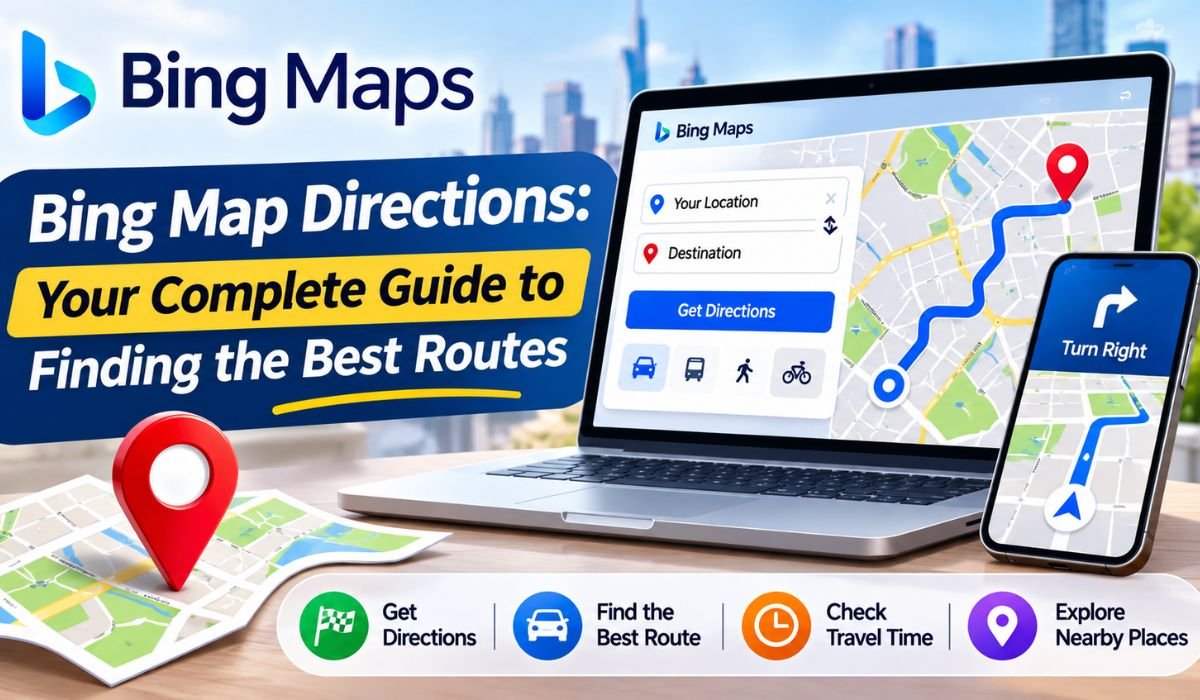
Finding the right route can make everyday travel easier, whether you’re driving to work, visiting a new city, or searching for a nearby restaurant. Bing Map Directions provides a convenient way to explore locations, check travel distances, and plan journeys using Microsoft’s mapping technology.
Bing Maps offers detailed road maps, aerial imagery, location searches, and route-planning tools. Depending on regional availability, users can explore driving directions, walking routes, public transportation options, and traffic conditions.
In 2026, online mapping remains an important part of daily life. However, understanding the features and limitations of each mapping service helps travelers make better decisions. This guide explains how Bing Map Directions works, how to find suitable routes, and how to use its features effectively.
Quick Bio Information About Bing Map Directions
Service Name
Bing Maps
Common Search Term
Bing Map Directions
Developer
Microsoft
Service Category
Online Mapping
Primary Purpose
Directions and Location Search
Main Platform
Web Browser
Road Maps
Available
Aerial Imagery
Available
Streetside Imagery
Selected Locations
Driving Routes
Supported
Walking Routes
Coverage Varies
Public Transit
Selected Regions
Traffic Information
Coverage Varies
Business Search
Available
Travel Estimates
Route-Based
GPS Location
Permission-Based
Consumer Access
Generally Free
Commercial Mapping
Separate Licensing
Enterprise Alternative
Azure Maps
Main Competitor
Google Maps
What Are Bing Map Directions?
Bing Map Directions refers to the route-planning functionality associated with Microsoft Bing Maps. The service helps users identify routes between locations and understand how far they may need to travel.
Microsoft’s mapping technology combines geographical information, road networks, location data, and routing calculations to suggest journeys. Users can search for addresses, landmarks, cities, and businesses without needing specialized mapping knowledge.
Bing Maps is particularly useful when exploring unfamiliar destinations. Instead of relying only on written addresses, travelers can examine surrounding streets, nearby landmarks, and available map imagery.
The service is not identical to a dedicated turn-by-turn navigation application. Its features depend on the interface being used, making it important to distinguish route planning from continuous GPS guidance.
How to Use Bing Map Directions
Using Bing Map Directions begins with opening the available Bing Maps interface in a web browser. Users can search for a destination or select the directions feature when it is available.
Enter a starting location and destination as accurately as possible. Complete street addresses are helpful, although recognized businesses, landmarks, and city names may also work.
After entering the locations, choose an available transportation method. The mapping system can calculate a suggested route and display information such as distance and estimated travel time.
Review the route carefully before traveling. Check whether the destination marker identifies the correct building or entrance, especially when visiting large shopping centers, hospitals, or business complexes.
If alternative routes are displayed, compare their distance, travel time, and road conditions rather than automatically choosing the shortest option.
How to Find Driving Directions With Bing Maps
Driving directions are among the most practical features of Microsoft Bing Maps. They help drivers understand the roads connecting two destinations and estimate how long a journey might take.
A driving route may include highways, local roads, intersections, and major turns. Route calculations consider the available road network and supported routing information.
Travel time estimates are useful for planning, but they should not be treated as guarantees. Congestion, weather, construction, accidents, and unexpected closures can change actual journey times.
When multiple routes are available, drivers should consider more than distance. A slightly longer highway journey may sometimes be more convenient than a shorter route through busy streets.
Before departure, check the current road situation and follow local traffic signs. Mapping information can occasionally be incomplete or outdated.
How to Get Walking Directions on Bing Maps
Walking directions can help people explore neighborhoods, reach nearby businesses, or navigate unfamiliar city centers. They are particularly useful for short journeys where driving is unnecessary.
Unlike driving routes, pedestrian routes may use sidewalks, pathways, crossings, and other accessible connections when these are represented in the mapping data.
Walking time estimates generally reflect an assumed travel pace rather than an individual’s exact speed. Hills, crowded streets, accessibility requirements, and weather conditions can affect the journey.
For tourists, walking directions can provide a useful overview of how attractions connect. However, users should confirm pedestrian access and avoid assuming every suggested pathway is suitable for wheelchairs, strollers, or nighttime travel.
How to Find Public Transportation Directions
Public transportation directions can make journey planning easier in cities with supported transit coverage. Depending on the location and interface, users may be able to explore routes involving buses, trains, or other public transportation services.
Transit information may include stops, transfers, journey estimates, and route details. This can help travelers understand how different transportation services connect.
However, public transportation coverage varies considerably between regions. Some cities have detailed route information, while others offer limited data or no transit planning through Bing Maps.
Travelers should verify departure times, service disruptions, ticket requirements, and operating hours with their local transportation providers. This is especially important when making connections or traveling late at night.
How Bing Maps Traffic Information Helps You Choose Routes
Traffic information can help drivers make more informed decisions before leaving home. In supported areas, Bing Maps may display congestion conditions and traffic-related information.
Traffic visualization makes it easier to identify roads experiencing slower movement. This information can be useful when comparing different routes or deciding whether to delay departure.
For example, a familiar road may become heavily congested during the evening commute. Reviewing available traffic information can help drivers consider another route.
Traffic conditions change continuously, so information displayed earlier may no longer reflect the situation when the journey begins.
It’s also important to understand that traffic coverage differs by location. Not every road or country has the same level of traffic data.
How to Plan Routes With Multiple Destinations
Planning a journey with several stops requires more thought than traveling between two addresses. Whether you’re visiting clients, collecting packages, or exploring attractions, the order of your destinations can affect travel time.
Microsoft’s mapping technology supports routes involving multiple waypoints in certain products. However, the number of stops and available planning features depend on the specific interface.
For practical travel planning, identify your destinations, compare their locations, and arrange stops in a sensible order. Grouping nearby destinations can reduce unnecessary driving.
Automatic route optimization should not be assumed in the standard consumer interface. Businesses requiring advanced delivery planning may need specialized mapping software.
How to Explore Locations Using Bing Maps
Bing Maps provides different ways to examine geographical locations before visiting them. Standard road maps display streets, highways, neighborhoods, and recognizable landmarks.
Aerial imagery offers a broader perspective of buildings, landscapes, and surrounding areas. This can be especially helpful when identifying large properties, parking areas, or unfamiliar destinations.
Bing Maps Streetside provides street-level photographs in selected locations. These images can help users recognize buildings and understand the appearance of nearby streets.
However, aerial and Streetside images are not live camera feeds. They may have been captured months or years earlier, so recently constructed roads or buildings might not appear.
How to Find Nearby Places and Businesses
Finding nearby businesses is another useful part of the Bing Maps experience. Users can search for restaurants, hotels, shopping centers, hospitals, and other places of interest.
Location results may include business names, addresses, contact information, and operating hours, depending on the available data.
For example, someone visiting an unfamiliar neighborhood might search for a pharmacy near their hotel. The map can help identify possible locations and their surrounding streets.
Business details should still be verified before visiting. Opening hours, phone numbers, and even business locations can change.
Microsoft also provides Bing Places, which helps eligible businesses manage information that appears across Bing experiences.
How to Share and Save Bing Map Directions
Sharing directions can be helpful when organizing meetings, family visits, or group travel. Depending on the interface, users may be able to copy a location address or share map information.
A practical approach is to confirm the destination first, then share its complete address and any available map-sharing information.
For frequently visited places, browser bookmarks can provide a convenient way to return to a map. Printing available route instructions may also help travelers who prefer written directions.
Remember that saved routes can become outdated. Road construction, traffic changes, and business relocations may affect journeys, so checking directions again before departure is sensible.
Bing Map Directions on Mobile Devices
Bing Maps can be accessed through supported mobile web browsers, allowing users to explore locations while away from a computer.
When location services are enabled and permission is granted, the browser may use the device’s location to help establish a starting point.
Mobile users should understand the difference between viewing a route and receiving continuous voice-guided navigation. Bing’s browser-based experience should not be assumed to provide every feature of a dedicated GPS application.
An important change for 2026 is that Microsoft discontinued its Windows Maps application in 2025. Microsoft directs users seeking Bing-powered maps to its web mapping experience.
Bing Map Directions vs. Google Maps
Bing Maps and Google Maps both help users explore geographical locations, search for businesses, and plan journeys. However, their features and regional coverage are not identical.
Google Maps offers a broad navigation experience across supported mobile and desktop devices, including dedicated navigation functionality.
Bing Maps focuses on web-based geographical exploration and available routing tools, alongside Microsoft’s broader mapping technology.
Both services provide imagery and location information, although street-level coverage and image freshness can differ.
The better choice depends on your destination and needs. Comparing routes across mapping services can be particularly useful when traveling somewhere unfamiliar.
Common Bing Map Directions Problems and How to Fix Them
Occasionally, Bing Map Directions may not display the expected location or route. An incorrect address, temporary connection problem, or unavailable regional feature could be responsible.
If the map fails to load, refresh the page, check your internet connection, and try an updated browser.
When a destination appears incorrectly, enter a more complete address, including the city and postal code where appropriate.
If your starting location is wrong, review browser location permissions or enter the address manually.
Missing transit routes or traffic information may reflect limited coverage rather than a technical problem. In those situations, checking another mapping service or an official transportation source can help.
Tips for Getting More Accurate Bing Map Directions
Accurate route planning begins with reliable destination information. Entering complete addresses reduces the likelihood of selecting the wrong street or similarly named business.
Before traveling, examine the destination marker and surrounding roads. This is particularly important for large buildings with several entrances.
Compare available routes rather than relying entirely on the shortest distance. Consider traffic conditions, road restrictions, and the type of journey you’re making.
For time-sensitive appointments, allow additional travel time. Even a well-planned route can be affected by unexpected delays.
Most importantly, treat online directions as planning assistance rather than a replacement for road signs, local regulations, or personal judgment.
Benefits and Limitations of Bing Map Directions
One of the main benefits of Bing Map Directions is convenient access to mapping information through a web browser. Users can examine locations, estimate travel distances, and explore available routes without specialized technical knowledge.
Road maps, aerial imagery, and location searches provide useful context for planning journeys.
Nevertheless, Bing Maps has limitations. Streetside coverage, transit information, and traffic data vary geographically. Some advanced routing capabilities belong to commercial mapping products rather than the consumer website.
Understanding these differences helps users choose suitable tools and avoid relying on unavailable features.
Is Bing Map Directions Free to Use in 2026?
The consumer Bing Maps website generally provides map searches and available directions without a separate mapping subscription.
Commercial mapping services are different. Organizations building applications with Microsoft mapping technology may require appropriate licensing or cloud service arrangements.
Microsoft has retired Bing Maps for Enterprise services for free Basic account customers. Existing enterprise customers have until June 30, 2028, to migrate, with Azure Maps serving as Microsoft’s strategic enterprise mapping platform.
This transition does not mean that the consumer Bing Maps website has been discontinued. It mainly concerns enterprise APIs, development tools, and commercial integrations.
Final Thoughts
Bing Map Directions remains a useful option for exploring locations and planning journeys in 2026. Its road maps, aerial imagery, business searches, and available routing features can help travelers understand destinations before setting out.
The most effective approach is to enter accurate locations, review suggested routes, check relevant travel conditions, and confirm important details before departure.
Although Bing Maps cannot guarantee perfect directions or identical coverage everywhere, it provides a practical starting point for everyday travel planning. Understanding its capabilities and limitations allows users to make more confident decisions and choose routes that suit their needs.
FAQs About Bing Map Directions
What Are Bing Map Directions?
Bing Map Directions is a common term for Microsoft’s Bing Maps route-planning functionality. It helps users find routes between destinations, examine distances, and review estimated travel times. Available transportation options depend on the location and mapping interface.
Is Bing Map Directions Free?
Consumer access to Bing Maps is generally free for ordinary map searches and available route planning. Commercial developers and businesses may face separate licensing, subscription, or usage charges for mapping services.
Can Bing Maps Show Driving Directions?
Yes. Bing Maps supports driving route planning, allowing users to examine roads, distances, and estimated travel times. Available route alternatives and traffic information depend on geographical coverage and the interface.
Does Bing Maps Provide Walking Directions?
Walking directions are supported through Microsoft’s mapping technology, although availability varies. Users should verify pedestrian access and local conditions, particularly when routes involve unfamiliar paths or crossings.
Can I Check Traffic on Bing Maps?
Bing Maps offers traffic information in supported locations. Coverage and update availability differ between regions, so users should not assume every road has current traffic data.
Can I Use Bing Map Directions on My Phone?
Yes. Users can access the Bing Maps website through compatible mobile browsers. However, browser-based route planning should not be confused with dedicated voice-guided GPS navigation.
Can Bing Maps Plan Multiple Stops?
Microsoft’s mapping technology supports multiple waypoints in certain products, but the consumer interface may have different limitations. Advanced route optimization is generally associated with specialized mapping services.
Is Bing Maps Better Than Google Maps?
Neither service is automatically better for everyone. Google Maps may be more suitable for users seeking dedicated mobile navigation, while Bing Maps offers useful web mapping, aerial imagery, and location exploration. The best option depends on regional coverage and individual needs.
Learn more and explore exciting content on: Aliza Barber Biography: Age, Husband, Children, Career, and Personal Life
















Leave a Reply